Amid a series of insider information leaks at major corporations, corporate interest in Multi-Factor Authentication (MFA) technology is surging. Industry experts note that, with the government also considering higher fines, MFA has emerged as a central topic in corporate security investments. As a result, discussions around adopting related technologies are expected to gain further momentum.
According to the recent IT security industry trends, companies are increasingly inquiring about implementing or strengthening MFA. The topic has also gained heightened public attention after being directly mentioned during a National Assembly hearing.
Multi-Factor Authentication (MFA) is a technology that allows system access only to users whose identities are verified through multiple authentication methods. Security is significantly enhanced when biometric authentication-such as fingerprint, facial recognition, or vein scanning-is combined with traditional password-based methods. Recently, Coupang pledged to adopt "passKey," which is also considered an MFA method utilizing biometric authentication.
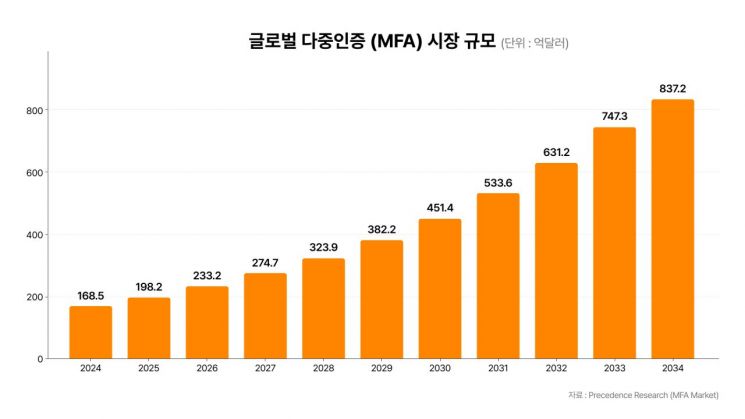
As global corporations such as Tesla and Intel have experienced insider information leaks, MFA is now regarded not as an optional measure for specific industries but as an essential security investment. Against this backdrop, the global MFA market is projected to experience rapid growth in the coming years.
Precedence Research, a global market research firm, forecasts that the market size for MFA and related services will grow from $45.1 billion (approximately 66 trillion won) in 2030 to $83.7 billion (about 124 trillion won) by 2034. The adoption of passwordless, biometric-based authentication methods is also expected to increase at an average annual rate of more than 19%.
In South Korea, there is a clear trend toward stronger authentication requirements, centered around policies and guidelines. The government has identified MFA adoption as a key element in its comprehensive information security strategy. The Korea Internet & Security Agency (KISA) has specified enhanced authentication and access management in its "Zero Trust Guideline 2.0," while the National Intelligence Service has outlined similar requirements in its National Network Security Framework (N2SF) Security Guideline 1.0.
Within this trend, industry observers predict that, starting this year, the adoption of MFA will spread across large corporations, public institutions, financial institutions, as well as startups and the small and medium-sized business (SMB) sector. Some point out that lacking MFA could even hinder partnerships with other companies.
Lee Gihyuk, Professor of Convergence Security at Chung-Ang University, stated, "As insider threats become routine and regulations tighten, MFA has become a condition for survival, not a choice. In particular, as the transition to 'passwordless' systems accelerates, biometric-based MFA will become the core of the market."
Meanwhile, there is growing interest in developments within the technology ecosystem. A notable example is RaonSecure's recent establishment of collaborative frameworks with biometric authentication specialists such as Fujitsu Korea, MesaCore Company, Eternal, and TrustKey. The fact that companies specializing in palm vein, facial, finger vein, and fingerprint authentication are integrating their technologies simultaneously has drawn significant market attention.
The industry interprets these alliances as a sign that there is increasing demand to view MFA not as a single function, but as a foundational infrastructure across all industries. As authentication methods diversify, companies and institutions can combine authentication methods according to their security level and work characteristics, enhancing both the scope of application and design flexibility.
RaonSecure expects this collaboration to further strengthen the competitiveness of its FIDO-based biometric authentication platform, OnePass. The company noted that since OnePass was first introduced to the domestic banking sector in 2016, it has attracted a diverse range of corporate clients in the MFA market and is on the verge of surpassing 10 million monthly active users (MAU) in Japan.
Meanwhile, as the global MFA market expands, the overseas technology exports of domestic security companies are becoming a key point of interest. The main challenge is how to combine authentication methods and operate them reliably to meet the demands of global clients.
An industry official emphasized, "With the global MFA market expanding, now is the right time for Korean security companies to broaden their reach overseas. There is a strong call to leverage the operational expertise accumulated in the demanding domestic market to increase their share in international markets."
© The Asia Business Daily(www.asiae.co.kr). All rights reserved.
![Clutching a Stolen Dior Bag, Saying "I Hate Being Poor but Real"... The Grotesque Con of a "Human Knockoff" [Slate]](https://cwcontent.asiae.co.kr/asiaresize/183/2026021902243444107_1771435474.jpg)












