Ministry of Health and Welfare to Further Reduce Out-of-Pocket Rate Under Special Calculation System
Expansion of Emergency Import and Custom-Manufactured Items
Gradual Abolition of Family Income Criteria
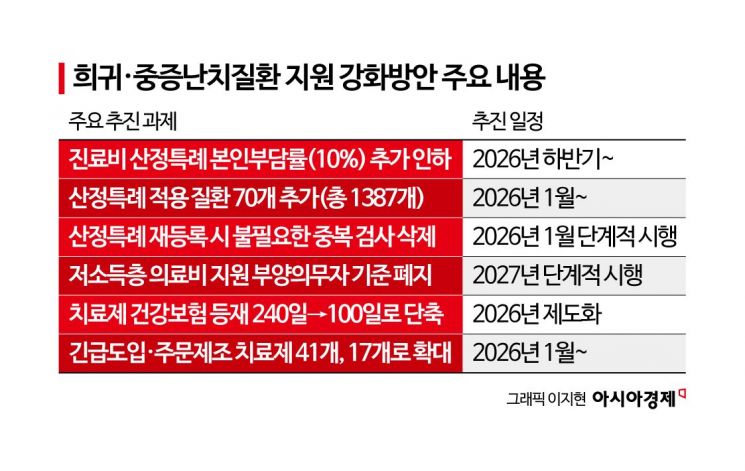
The government has decided to further lower the out-of-pocket expenses for patients with rare and severe intractable diseases that require high medical costs under the special calculation of the National Health Insurance. The time required for rare disease treatments to be listed under the National Health Insurance will be reduced from the current 240 days to 100 days. In addition, to prevent disruptions in the supply of treatments, the government will expand the number of emergency import and custom-manufactured items it directly supplies to 41 and 17, respectively, by 2030.
On January 5, the Ministry of Health and Welfare announced that it has developed a plan to strengthen support for rare and severe intractable diseases in collaboration with the Ministry of Food and Drug Safety, the Korea Disease Control and Prevention Agency, and other relevant organizations.
First, the government will further reduce the current 10% out-of-pocket rate for rare and severe intractable diseases under the special calculation system in the second half of the year. Starting this month, 70 diseases, including congenital functional short bowel syndrome, will be newly included in the list of rare diseases eligible for the special calculation, and this list will continue to expand. As a result, the total number of rare diseases covered under the special calculation will increase to 1,387. Considering the nature of these diseases, which are difficult to cure, the re-registration process required every five years will be revised to be more patient-centered. For nine diseases, including Charcot-Marie-Tooth disease, Wilson's disease, and Behcet's disease, re-registration will no longer require testing.
The income criteria for family members in the "Rare Disease Medical Expense Support Program" for low-income patients will be gradually abolished starting in 2027, lowering the threshold for support. This aims to eliminate blind spots where patients in financial hardship were excluded from support due to their family's income. For rare disease patients who require dietary management, support for special formula, low-protein instant rice, and similar products will be expanded. For patients with glycogen storage disease, support for special corn starch will be added. The government will continue to expand tailored special dietary support according to the specific needs of each disease.
The time required for treatments to be listed under the National Health Insurance will be significantly shortened. Until now, rare disease patients had to wait an average of more than 240 days for new drugs to be covered by insurance. To address this, the government will streamline the process by conducting approval, reimbursement assessment, and negotiation procedures concurrently, reducing the listing period to within 100 days starting this year.
Additionally, to ensure patients do not face difficulties obtaining treatments even if private suppliers discontinue supply due to low demand, the government will expand emergency import and custom-manufacturing of essential medicines by directly purchasing and supplying them. From this year, more than 10 items annually-previously purchased directly by patients from overseas for self-treatment-will be converted to emergency import items, increasing the total to over 41 by 2030. The number of custom-manufactured items will also increase from 7 to 17, to prevent situations where patients are unable to receive treatment due to lack of access to medications.
Furthermore, support for genetic testing and other diagnostic services for suspected rare disease patients and their families will be expanded. To ensure patients can receive continuous diagnosis, treatment, and management in their local area, the government will designate additional specialized institutions in Gwangju, Ulsan, North Gyeongsang Province, and South Chungcheong Province-regions among the 17 cities and provinces nationwide that currently lack such institutions-thereby establishing a regionally integrated care support system. Beyond simple medical support, the government also plans to identify patients' welfare needs throughout their life cycle, including caregiving, rehabilitation, and daily care, and provide tailored referral services.
Minister of Health and Welfare Chung Eun-kyung stated, "More support measures are needed to alleviate the suffering of patients with rare and severe intractable diseases," adding, "We will promptly implement measures that can be enacted this year and continue to identify additional necessary tasks so that patients can maintain hope and not give up on treatment."
© The Asia Business Daily(www.asiae.co.kr). All rights reserved.
![Clutching a Stolen Dior Bag, Saying "I Hate Being Poor but Real"... The Grotesque Con of a "Human Knockoff" [Slate]](https://cwcontent.asiae.co.kr/asiaresize/183/2026021902243444107_1771435474.jpg)
















