Photographing a Seoul Dike Road for a Decade Since 2008
Wounded and Transformed Trees, Captured in Black and White on Hanji Paper
Photographer Kim Joongman (1954-2022) presents a series of tree photographs taken over approximately ten years, starting in 2008, along a dike road in downtown Seoul.
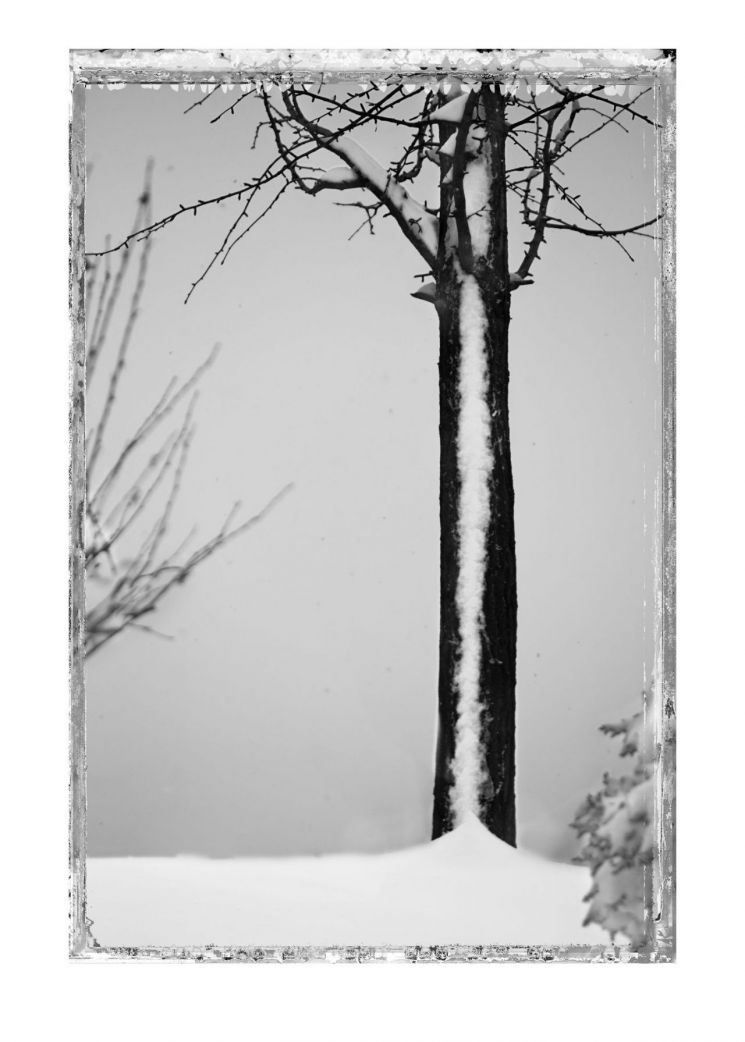
Kim Joongman’s solo exhibition, 'STREET OF BROKEN HEART,' is being held at Topo House in Jongno-gu, Seoul, until February 1. The exhibition centers around large black-and-white prints on Hanji paper, depicting trees that have been wounded and transformed by typhoons and human intervention. The works evoke the aesthetics of ink wash paintings, blurring the boundaries between documentation and contemplation.
Kim Joongman, who has established a unique position in the Korean photography scene by moving between commercial and fine art photography, once again explores the tension between high art and popular art, as well as between documentary and pictorial photography, in his own way. The project began when the artist discovered a nearly broken tree on a deserted road on his way to his studio. Witnessing the annual damage to the trees along that road due to typhoons and urban development, Kim repeatedly walked the same path for a long time, asking, "May I take your picture?" but did not take a single photograph for four years. It was only one day, when the wounds of the trees began to mirror his own inner state, that he finally started photographing them. From that moment, he spent nine years capturing thousands of black-and-white images.
He named this road the 'Street of Broken Heart.' The trees in his works stand at the center of the frame, neither exaggerating nor exposing their wounds, but simply existing as they are. Outwardly, the scenes appear calm and harmonious, yet within them lies a tension between pain, destruction, and the will to survive. Most of the works are characterized by a vertical composition reminiscent of portraiture, reflecting the artist’s intention to confront each tree as an individual being rather than to objectively survey the landscape.
The occasional appearance of a black bird in the frame draws the viewer’s gaze across the images, leaving questions rather than clear answers. Through this project, Kim Joongman seeks an alternative approach to contemporary photography-one that is more shamanistic and human, rather than predominantly sociological. The pain and poignancy of wounds revealed in the city’s abandoned landscapes, and the powerful pull they exert, transform the series from a simple record of scenery into a meditation on existence. 'Street of Broken Heart' refers not only to a specific place, but also expands as a metaphor for society and the inner worlds of individuals living within it. This exhibition prompts viewers to reconsider the meanings of wounds and healing, time and existence, through the medium of photography.
Born in Cheorwon, Gangwon Province, Kim Joongman studied Western painting at the ?cole Nationale Sup?rieure d’Arts Appliqu?s in Nice, France. He made his debut with a solo exhibition at Atelier Jean Pierre Soardi in Nice in 1975, and in 1977, he was recognized as the youngest artist selected for 'France: Photography of Today.' As a pioneer among the first generation of overseas-educated artists, he played a key role in popularizing photography in Korea. Above all, he became known as a fashion photographer who rejected conventional customs and angles, capturing his subjects in their most natural poses.
© The Asia Business Daily(www.asiae.co.kr). All rights reserved.
![Clutching a Stolen Dior Bag, Saying "I Hate Being Poor but Real"... The Grotesque Con of a "Human Knockoff" [Slate]](https://cwcontent.asiae.co.kr/asiaresize/183/2026021902243444107_1771435474.jpg)
















