President Lee Begins 3-Night, 4-Day State Visit to China
Attends Meeting with Korean Residents in China as First Official Event
"Hoping for a New Starting Point for Deeper and Broader Korea-China Relations"
"Industrial Cooperation in Renewa
President Lee Jaemyung, currently on a state visit to China, stated on January 4, "My return visit will serve as an important milestone, building on the 30-year history of diplomatic relations to design a new era for both countries." The meeting between President Lee and Chinese President Xi Jinping comes two months after their summit during the Asia-Pacific Economic Cooperation (APEC) meeting in Gyeongju in November last year. This marks the first visit to China by a South Korean president in over six years since former President Moon Jae-in's visit in December 2019, and the first state visit in over eight years since December 2017.
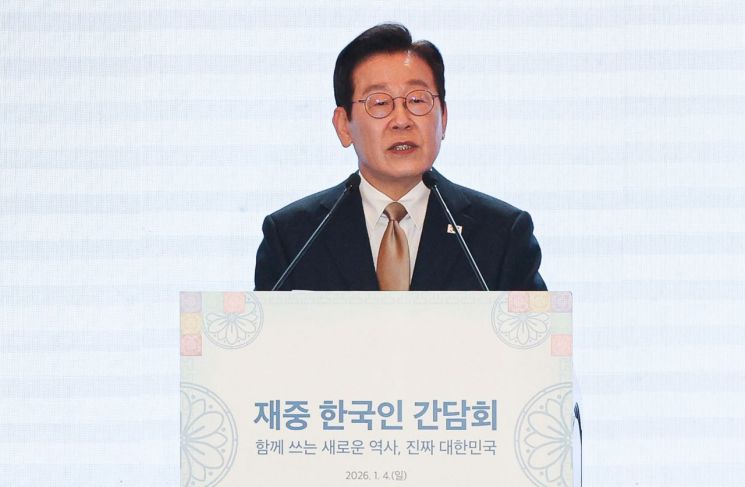
At a meeting with Korean residents in China held at a hotel in Beijing that day, President Lee said, "At last year's APEC summit in Gyeongju, I met with President Xi and promised to substantially restore the strategic cooperative partnership between our two countries and develop a more mature relationship." He continued, "I hope today will be a new starting point for Korea-China relations, filling in the gaps of the past and restoring them to normal, so that we can move forward toward deeper and broader development of our bilateral ties."
President Lee stated, "China has become my first destination for practical diplomacy this year as a state visit. It is said that it is unprecedented for the leaders of Korea and China to pay mutual state visits within just two months." He emphasized, "This reflects the grave shared recognition and strong will of both governments that relations must be normalized as quickly as possible and move toward a future-oriented partnership."
President Lee evaluated the full restoration of Korea-China relations as the greatest achievement since the launch of his administration. He said, "Although there was a diplomatic vacuum for a time due to the illegal imposition of martial law, the government of popular sovereignty declared Korea's return to the international community as a democratic nation immediately after its inauguration in June last year and has worked to normalize diplomatic relations." He added, "There have been various diplomatic achievements, but the full restoration of Korea-China relations, which had regressed for a long time, is the greatest accomplishment and source of pride."
He also mentioned the difficulties faced by the Korean community in China during the COVID-19 pandemic. President Lee said, "During the COVID-19 pandemic, many companies and expatriates left, causing great difficulties for the Korean community in China." He expressed regret that the number of Koreans in China, which once exceeded 500,000, has now dropped to just over 200,000, and when he asked, "It will soon recover, right?" the attendees responded with applause.
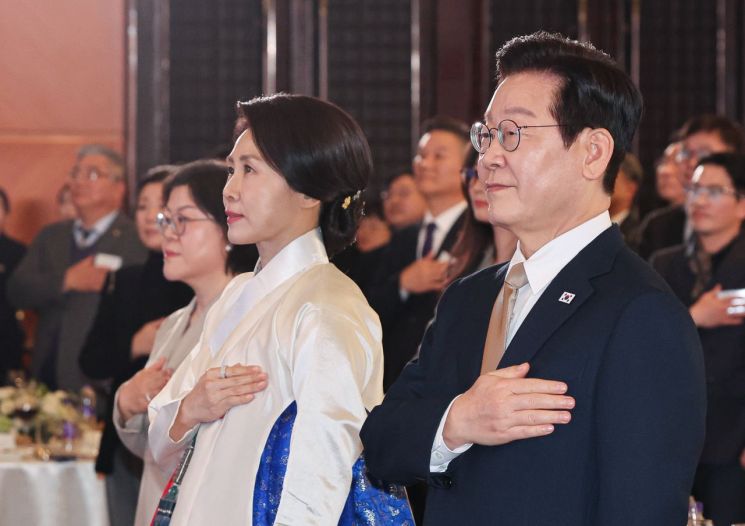
President Lee cited renewable energy, biotechnology, and the silver industry as areas for cooperation with China, saying, "While China now competes with us in the global market, there are still countless areas for future cooperation based on our respective comparative advantages, such as renewable energy, biotechnology, and the silver industry." He also remarked, "Every January, fine dust from China was the biggest issue," and praised China for "mainstreaming fintech, such as Alipay, and achieving many changes and reforms, including a massive expansion of electric vehicle adoption through eco-friendly policies."
President Lee added, "Diaoyutai in Beijing is also the site where the Six-Party Talks on the North Korean nuclear issue were held," and emphasized, "China is an indispensable partner in the pursuit of peace and reunification on the Korean Peninsula."
He also expressed his commitment to supporting Korean residents in China and improving the overseas election system. President Lee said, "Through practical, interest-based diplomacy, we will create models for our businesses to advance in the global market and ensure that, wherever you are, you always feel closely connected to your homeland, Korea, with unwavering national support." He continued, "Despite China's vast geography, only 10 polling stations were set up for recent overseas elections, causing significant inconvenience. We will intensify efforts to improve the overseas election system so that there are no obstacles to the exercise of your rights as citizens."
President of the Korean Association in China: "Korea-China relations have rapidly improved since the launch of the government of popular sovereignty"
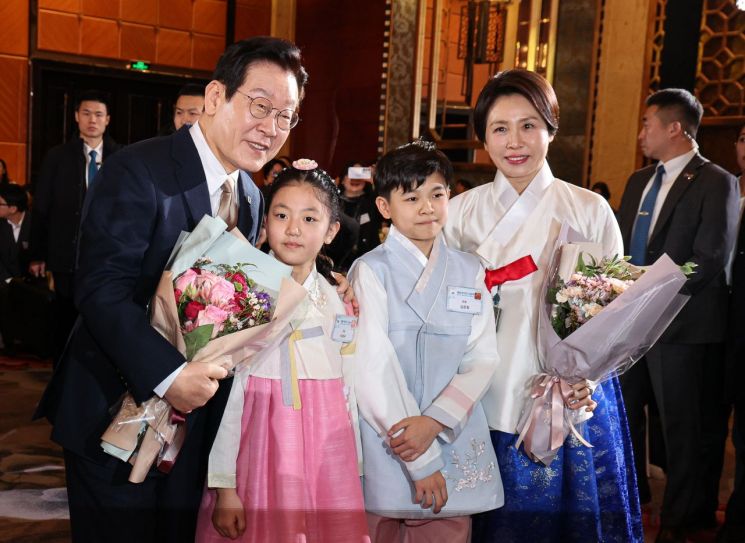
Earlier, Ko Takhee, President of the Federation of Korean Associations in China, delivered a welcome address, saying, "On behalf of the Korean community and 67 regional Korean associations across China, I sincerely welcome President Lee's state visit to China." "Diplomacy may be like waves, but trust between the peoples of Korea and China must be built layer by layer on the ground, which is why we never lost hope for the future even during the difficult times of the pandemic," he said. He continued, "As we hoped, Korea-China relations have rapidly improved since the launch of the government of popular sovereignty, as seen in the meeting at APEC and President Lee's state visit to China today."
Ko went on to say, "The results of 30 years of diplomatic relations between Korea and China have significantly contributed to Korea becoming an advanced nation and China becoming one of the G2 countries. Memories of the golden era of Korea-China trade raise great expectations for cooperation in high value-added sectors such as the digital economy, biotechnology, and renewable energy." He emphasized, "At times like this, more intergovernmental exchanges and the revitalization of private diplomacy between Korea and China are needed. President Lee's words that we should respect what is good and adjust what is unnecessary is one way to address bilateral issues."
President Ko also mentioned issues facing the Korean community, including "free education for children of overseas Koreans, support for Korean international schools, identity and Korean language education for multicultural children, restrictions on employment after graduation for Korean students, visa restrictions for those over 60, and the preservation of historical sites related to the independence movement such as those of General Kim Jwajin." He said, "I hope the voices of the Korean community will be reflected in national policy."
Impromptu Town Hall Meeting with Korean Residents in China
As the dinner began in earnest, President Lee invited Korean residents in China attending the meeting to share their candid thoughts, holding an impromptu town hall meeting that had not been scheduled, according to Kang Yoojeong, spokesperson for the Office of the President. Lee Nayoun, a reporter for Overseas Koreans News, said, "I hope the President's visit to China after eight years will be a turning point in restoring Korea-China relations, and I will join in Korea's new leap forward." Bae Seungdong, Chair of the Korea-China Multicultural Council in China, proposed support for Korean language and cultural education for multicultural children abroad and assistance for retired multicultural families returning to Korea. Lee Seungjun, President of the Federation of Korean Student Associations in Beijing, pointed out that it has become increasingly difficult for Korean students in China to obtain work visas, and suggested establishing a joint Korea-China talent development system linking training, practical experience, and employment.
In his closing remarks, President Lee said, "As I hold meetings with overseas Koreans in various countries, I hear similar suggestions frequently. We will soon accept and review all civil petitions through all overseas missions in an integrated manner," expressing his intention to actively support the activities of citizens as sovereigns. He added, "It is the duty of public officials, who are paid with taxpayers' money, to truly identify what the sovereign people want. The President's obligation is to ensure that the people of Korea can develop and live happier lives."
He went on to say, "The leaders of both countries are working together to create a better environment than before, and anti-Korean and anti-Chinese sentiment has greatly diminished. We will continue to build a mutually beneficial relationship with China, our inseparable neighbor, by complementing each other's shortcomings," once again encouraging the Korean community in China.
Meanwhile, when one attendee asked, "My 10-year-old daughter wonders if the President is getting enough sleep," President Lee replied with a smile, "Please tell her I get plenty of sleep." During the cultural performance at the meeting, students from the Beijing Korean Children's Choir performed "Let's Make Peace" and "I Am a Butterfly" on stage.
© The Asia Business Daily(www.asiae.co.kr). All rights reserved.
![Clutching a Stolen Dior Bag, Saying "I Hate Being Poor but Real"... The Grotesque Con of a "Human Knockoff" [Slate]](https://cwcontent.asiae.co.kr/asiaresize/183/2026021902243444107_1771435474.jpg)


















