Nikkei: "Share Doubled in Just Over a Decade"
As the Japanese stock market continues its upward trend, the wealth gap within Japan is widening.
According to data presented by economist Chiaki Moriguchi, a professor at Hitotsubashi University, at a research meeting of the Policy Research Institute under the Ministry of Finance on January 4, the top 0.01% income earners in Japan accounted for 2.28% of total income in 2023.
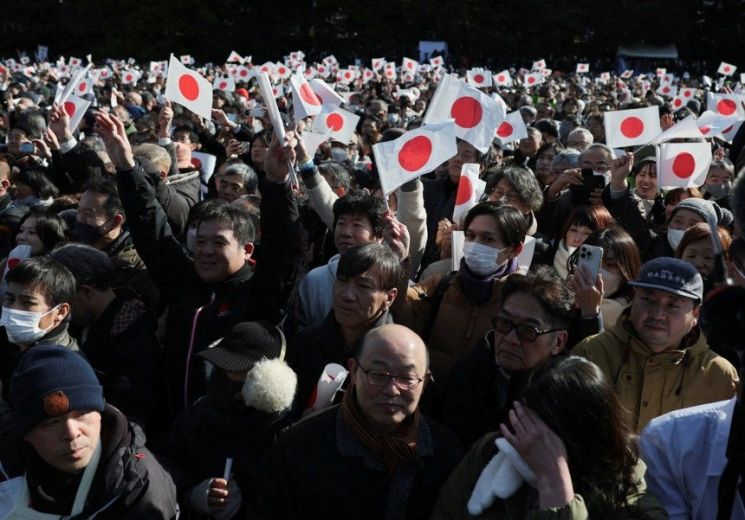 As the Japanese stock market continues to rise, the wealth gap within Japan is reportedly widening. The photo shows citizens gathered in front of the Imperial Palace in Tokyo on the 2nd, waving the Rising Sun Flag and celebrating the New Year. Photo by Reuters Yonhap News
In 2012, when former Prime Minister Shinzo Abe’s economic policy known as “Abenomics” began, the top 0.01% accounted for 1.19% of total income. In just over a decade, this share has roughly doubled. Nikkei reported that “this is the first time the income share of the top 0.01% has exceeded 2%,” and pointed to “capital gains” from stock and real estate transactions as the main factor behind the income growth of the ultra-wealthy.
In fact, when excluding capital gains, the income share of the top 0.01% was 0.82%, showing little change compared to a decade ago.
The increase in income share was not limited to the top 0.01%. The top 0.1% saw their share rise from 3.33% in 2012 to 4.83% in 2023, while the top 1% increased from 10.5% in 2012 to 12.04% in 2023.
However, the income share of the top 5%, 10%, and 20% either remained unchanged or actually decreased compared to previous years.
The Nikkei 225, Japan's leading stock market index, hovered around the 20,000 mark in 2020, but steadily climbed to close at 50,339 at the end of last year.
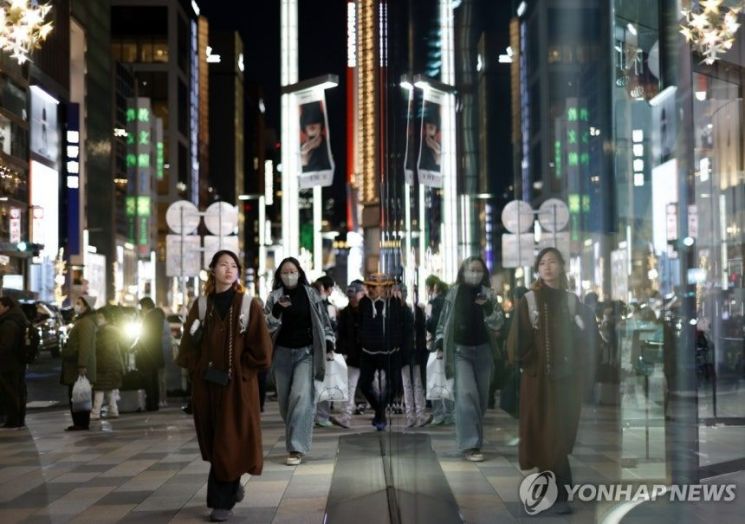
It has also been analyzed that Japan is experiencing a decline in the middle and lower-income classes. Tomoaki Yamada, a professor at Meiji University specializing in macroeconomics, found that the median household labor income dropped from 5.375 million yen (about 49.54 million won) in 1994 to 3.05 million yen (about 28.11 million won) in 2019.
He emphasized, “The decline in income among households below the middle class, which has been a driving force behind the widening gap since the 2000s, is a significant social issue.”
Previously, Japan’s Ministry of Health, Labour and Welfare announced last month that the nation’s Gini coefficient reached 0.5855, the highest level since the survey began in 1962. This figure increased by 0.0012 points compared to the previous survey conducted in 2021.
The Gini coefficient measures the degree of income inequality and wealth disparity, with a value closer to 0 indicating complete equality and a value closer to 1 indicating complete inequality. The Ministry of Health, Labour and Welfare explained that this result was due to an increase in elderly households who have retired or have low earned income.
Currently, the Japanese government is pursuing measures to strengthen taxation on the wealthy, considering that under the current tax system, the income tax burden increases up to an annual income of 100 million yen (about 920 million won), but actually decreases for income above that threshold.
© The Asia Business Daily(www.asiae.co.kr). All rights reserved.


















