K-beauty Goes Viral on SNS, Surpasses France to Become World’s No. 2 Cosmetics Exporter
"Now, the Focus Should Be on Ingredients and Efficacy," Critics Say
The BBC in the United Kingdom has turned its attention to Korea's 'K-beauty' industry.
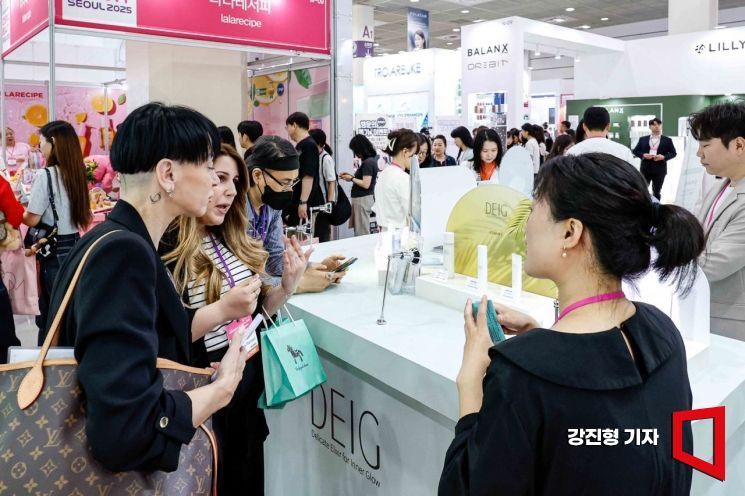 A foreign buyer visiting the 2025 Seoul International Cosmetics & Beauty Industry Expo and International Health Industry Expo in Gangnam-gu, Seoul, is looking at cosmetics.
On January 3, the BBC referenced a viral challenge video promoting a serum containing snail mucin, an ingredient that gained popularity on social media platforms. The BBC remarked, "Who would have thought that a serum containing the sticky substance secreted by snails would become part of skincare routines around the world?" The report continued, "Thanks to this challenge, COSRX, a small Korean brand, has grown into a global company," adding, "It is now a subsidiary of Amorepacific, Korea's largest cosmetics company." The BBC diagnosed that K-beauty, which has grown through word-of-mouth, has established itself as one of the largest industries in Korea, a country known for its intense competition and strong appearance-focused culture.
Recently, searching for 'Korean skincare' on social media platforms such as TikTok and Instagram yields a flood of content from influencers with hundreds of millions of followers. These influencers analyze product ingredient lists, showcase unboxing processes, and demonstrate their preparations for going out by creating the signature Korean glass-like, clear, and luminous skin appearance.
K-beauty products are now easily found anywhere in the world, as they occupy a significant share in major global retailers such as Sephora, Boots, and Walmart. Foreign media outlets reported, "In the first half of 2025, Korea surpassed France, the birthplace of modern cosmetics, to become the world's second-largest cosmetics exporter after the United States," explaining, "At the heart of K-beauty's growth are relentless innovation and social media." The continuous release of new products every few months to spark the next online trend has been a key factor.
The BBC highlighted, "In December of last year, the Korean government designated K-beauty as a national strategic asset and pledged support for manufacturing and exports," emphasizing, "This demonstrates strong confidence in an industry that began as a viral trend and has now become an economic driving force."
However, there are criticisms that excessive social media promotion negatively affects younger generations and encourages overconsumption. Foreign media also pointed out, "As competition in the K-beauty industry is fierce, profit pressures are also high," adding, "Intense competition has led to lower profit margins and increased business failure rates." It was noted that over 8,800 brands have closed down in recent years.
The BBC stressed that it is now more important to focus on product ingredients and efficacy rather than relying on influencer-driven promotion. Additionally, the 15% tariff imposed on Korean products by the Donald Trump administration in the United States, K-beauty's largest export market, is expected to pose a significant burden.
© The Asia Business Daily(www.asiae.co.kr). All rights reserved.

















