Citizen Nomination Group Recruitment Open Until January 23, Target Set at 20,000
Unified Candidate to Be Selected Through Voting on February 9-10
With the June 3 local elections approaching, competition among candidates from the democratic and progressive blocs for the Gwangju Superintendent of Education race is intensifying, fueled by the growing participation of the Citizen Nomination Group. As the number of participants in the Citizen Nomination Group surpasses 10,000, the primary race is rapidly heating up.
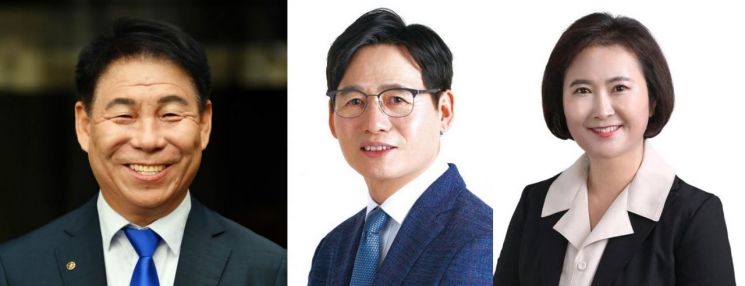 From the left, Yongtae Kim, Sunghong Jung, and Kyungmi Oh, candidates for Gwangju Superintendent of Education.
According to the local education community on January 4, the Gwangju Citizen Nomination Committee, which is responsible for selecting the Democratic Progressive Civic Education Superintendent candidate, announced that applications to join the Citizen Nomination Group have exceeded 10,000. This figure surpasses the 7,989 signatures required from eligible petitioners to enact a Gwangju ordinance through resident initiative.
Any Gwangju citizen aged 14 or older can participate in the Citizen Nomination Group by paying a participation fee of 5,000 won. Despite the higher threshold compared to signing a resident-initiated ordinance petition, the number of applicants is rising quickly. The Nomination Committee believes that the target of 20,000 participants, which was set as a recruitment goal, can be achieved before the deadline. The Citizen Nomination Group plays a role equivalent to that of party members with voting rights in the nomination process.
The Nomination Committee explained that the expansion in participation is the result of citizens' desire for direct democracy combined with growing awareness of issues in the current education sector. The committee stated, "This is the result of Gwangju citizens' willingness to participate in direct democracy," and added, "It also reflects the critical public opinion regarding current educational issues."
Amid this enthusiasm, candidates from the democratic and progressive blocs are competing to expand their support base, focusing on recruiting members for the Citizen Nomination Group.
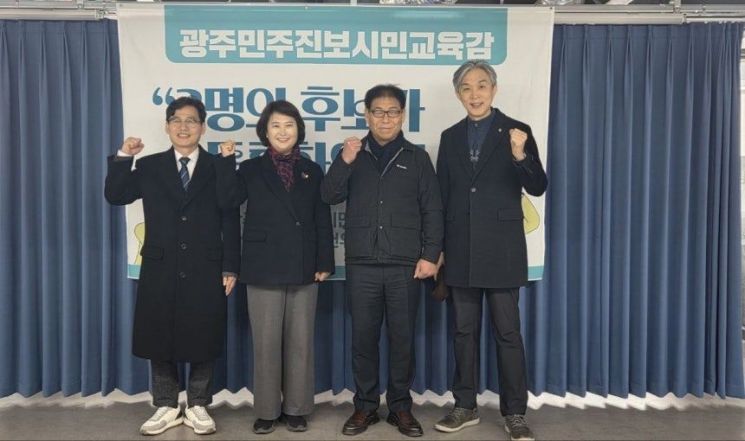 On the 27th of last month, the candidates who completed their registration for the Gwangju Democratic Progressive Civic Education Superintendent Candidate Citizens Nomination Committee (from left: Jeong Sunghong, Oh Kyungmi, Kim Yongtae) and Ahn Seok, the standing committee chairman, are taking a commemorative photo.
Kim Yongtae, former head of the Citizen School at the Gwangju branch of the Roh Moo Hyun Foundation, is accelerating his policy initiatives and solidifying his support base. He is assessed to be securing broad support based on his existing personal networks, such as high school alumni associations and university democratic alumni groups. Kim plans to begin announcing his policies at the Gwangju Metropolitan Office of Education starting January 5, and is also reviewing response strategies from the education sector regarding the ongoing discussion of administrative integration between Gwangju and Jeonnam, which has recently emerged as a local issue.
Oh Kyungmi, former Director of the Education Bureau at the Gwangju Metropolitan Office of Education, is leveraging her experience in the education field to appeal to grassroots sentiment. She explained that participation is growing among alumni, parents, and former students, particularly within the teaching community. Oh plans to hold a publication event for her book "The Whole Neighborhood Was a School" at Dongsin High School on January 10, where she will promote her campaign and introduce practical, teacher- and student-centered pledges.
Jeong Sunghong, former unified candidate of the Democratic Progressive bloc for Gwangju Superintendent of Education, is distancing himself from the numbers game and focusing on a policy-driven campaign. He emphasizes that the increase in Citizen Nomination Group members should not be viewed as a mere numbers competition, but rather as a meaningful expansion of citizen participation. Jeong is scheduled to hold a publication event titled "A New Look at Gwangju Education with Jeong Sunghong" at the Kim Daejung Convention Center on January 17.
The Gwangju Citizen Nomination Committee has defined this nomination process as "a venue for direct democracy." The committee stated, "This is a process that carries the honor of Gwangju citizens," and added, "We will earn the citizens' choice through a dignified nomination procedure."
The Citizen Nomination Committee will finalize the nomination regulations, including the primary method and the weighting of Citizen Nomination Group votes and public opinion polls, on January 7. The final primary, which will combine votes from the Citizen Nomination Group and a public opinion poll, will be held on February 9-10, and the unified candidate will be announced on February 11.
© The Asia Business Daily(www.asiae.co.kr). All rights reserved.


















