On January 2, the Daegu city government announced that it will conduct 120 odor status surveys throughout 2026 at the Daegu Dyeing Industrial Complex, continuing the efforts from last year, to manage odor issues in the Seo-gu district. These surveys, overseen by the Daegu Institute of Health and Environment, focus on assessing the level of odor generated by the complex and its impact on surrounding areas.
The Daegu Dyeing Industrial Complex was designated as an odor management area in 2024, and, in accordance with the Odor Prevention Act, annual status surveys have been conducted since 2025. The results of this year's survey will serve as foundational data for developing strategies to reduce and manage odors in the Seo-gu district.
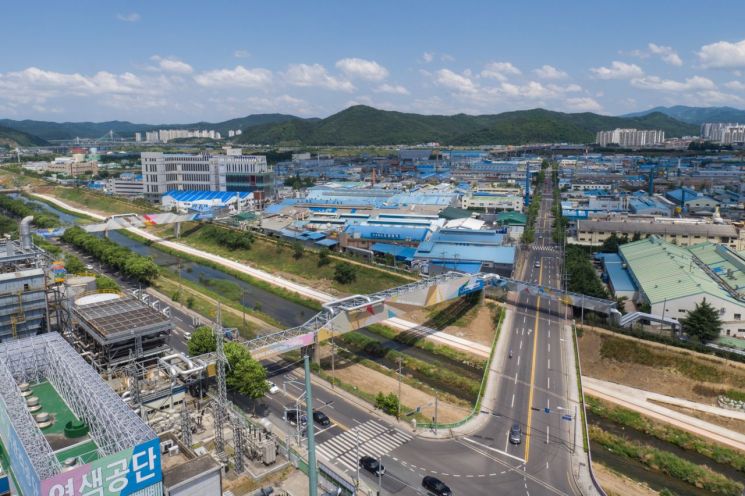
The survey is divided into 'air quality monitoring' and 'business site inspections,' both carried out year-round. Air quality monitoring will measure odor concentration at 10 locations-categorized as emission areas, boundary areas, and impact areas-at dawn, during the day, and at night, with detailed measurements taken for each time period. For business site inspections, 25 odor-emitting facilities within the dyeing industrial complex will be selected to assess their emission levels.
Seo-gu is an area with a high concentration of the dyeing industrial complex and various environmental infrastructure facilities, resulting in significant inconvenience for residents due to odor. Consequently, there is a particularly strong demand among residents for effective odor management.
According to the 2025 odor status survey, the level of complex odors remained similar to that of 2024, at approximately four times (with a standard of 20 times) the baseline, while the concentration of designated odor substances (fatty acids) decreased by 82 percent, indicating overall improvement. However, residents' perception of improvement remains low.
Odor is challenging to manage because it can occur and dissipate suddenly and locally, depending on weather conditions. To address this, starting in 2026, the Daegu city government plans to initiate procedures to implement 'stricter emission standards,' which will double the current odor emission limits for facilities such as industrial complexes.
Meanwhile, in 2026, in addition to the dyeing industrial complex, the Hyunpoong and Singi industrial complexes in Dalseong-gun, where paper mills are concentrated, will also be included in the Ministry of Climate, Energy and Environment's odor status survey. This is expected to advance the identification and management of odor-prone areas within the region.
Kim Jeongseop, Director of the Environmental Water Resources Bureau of Daegu City, stated, "Through this status survey, we will check whether the dyeing industrial complex is being managed in line with its designation as an odor management area, and use the results as basic data for odor management and improving residents' living environments. We will do our utmost to create a pleasant urban environment."
© The Asia Business Daily(www.asiae.co.kr). All rights reserved.
![Clutching a Stolen Dior Bag, Saying "I Hate Being Poor but Real"... The Grotesque Con of a "Human Knockoff" [Slate]](https://cwcontent.asiae.co.kr/asiaresize/183/2026021902243444107_1771435474.jpg)
















