2026 Tuition Cap Set at 3.19%
Lowered by 2.3 Percentage Points, but No Freeze Request Issued
Freeze Pressure Lifted... Private Universities Likely to Raise Fees
The movement to increase university tuition fees in South Korea is expected to spread. Although the legal cap for university tuition fee increases for the 2026 academic year has been set at 3.19%, lower than the 5.49% cap for 2025, the government did not request universities to freeze tuition this year. As a result, tuition fees are expected to rise consecutively, especially at private universities that have faced pressure to freeze fees for several years.
According to the education sector on January 2, the Ministry of Education, which announced the legal cap for university tuition fee increases for the 2026 academic year on December 31, has begun providing detailed guidance on how to calculate the tuition increase rate starting today.
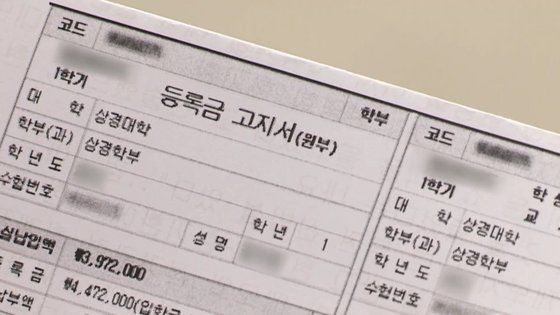 The Ministry of Education has finalized the legal cap for university tuition fee increases for the 2026 academic year at 3.19%. Although this is lower than the 5.49% cap for the 2025 academic year, tuition fees are expected to rise consecutively, especially at private universities that have faced pressure to freeze fees for several years. The photo shows a tuition fee bill from a university. Photo by The Asia Business Daily
The legal cap for tuition fee increases for the 2026 academic year has been lowered by 2.3 percentage points compared to 2025. This was calculated by applying 1.2 times the average consumer price inflation rate for the previous three years (2023-2025), in accordance with the Higher Education Act.
Although the legal cap has been lowered, there is a prevailing sentiment on university campuses that tuition should be raised up to the maximum limit. In a survey conducted by the Korean Council for University Education, a consultative body of four-year private universities, only 7 out of 87 universities responded that they plan to freeze tuition.
The Ministry of Education’s announcement to abolish “National Scholarship Type II” has also become a variable. Although the government has disclosed the legal cap for university tuition fees each year, it has effectively forced a tuition freeze in practice by providing budget support only to universities that froze or lowered tuition. However, the Ministry of Education has decided to eliminate this penalty clause starting from the 2027 academic year.
Most notably, the Ministry of Education omitted the phrase “please freeze tuition” from the official notice regarding tuition increase rates that it sends annually to universities nationwide. While the ministry has requested universities to freeze tuition for several years, in addition to setting the legal cap, this time it only provided the method for calculating the increase rate.

Some interpret this as the government being mindful of the position of private universities. While the government’s “Creating 10 Seoul National Universities” policy is expected to focus support on national universities, the financial situation of private universities continues to deteriorate.
However, universities cannot raise tuition at their own discretion. The increase must be approved by the Tuition Review Committee, which includes student representatives. Student organizations such as the National University Student Council have stated that they will thoroughly oppose any attempts by universities to increase tuition fees.
© The Asia Business Daily(www.asiae.co.kr). All rights reserved.


















