From Large-Scale Conflicts to Theories of Contact with Extraterrestrial Life
Interpretations Intertwined with Climate Crisis, War, and Economic Uncertainty
As the new year of 2026 begins, the predictions of Bulgarian prophet Baba Vanga, who is said to have foretold the 9/11 terrorist attacks and the COVID-19 pandemic, and 16th-century French astrologer Nostradamus are being revisited. On December 31 (local time), international media outlets such as the Sunday Guardian reported that, amid growing instability in international affairs, the climate crisis, and economic uncertainty, the past statements of Baba Vanga and Nostradamus are once again attracting attention.
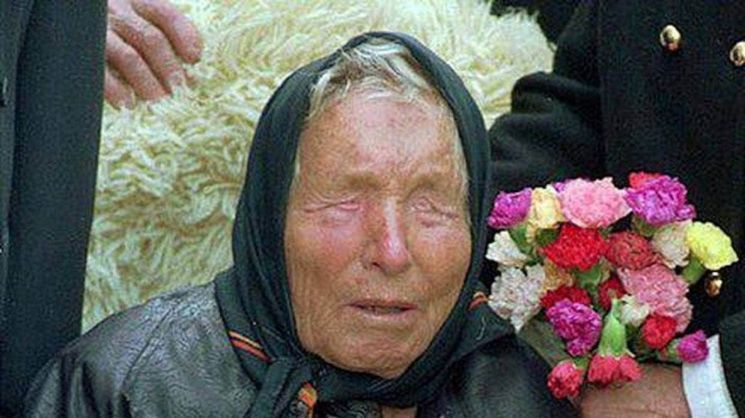 Baba Vanga claimed to have gained the ability to see the future after losing her eyesight in a sandstorm accident at the age of 12, and she is known for predicting the future of humanity up to the year 5079. Wikipedia
First, Baba Vanga, the blind prophet born in Bulgaria in 1911, is known to have predicted that in 2026 there would be a large-scale global conflict, worldwide natural disasters, a severe economic recession, and the possibility of contact with extraterrestrial life. In particular, she warned that this year, geopolitical tensions among major powers such as the United States, China, and Russia would escalate to extremes. Experts believe that ongoing conflicts such as the Taiwan Strait issue, the Russia-Ukraine war, and the Israel-Hamas war could become potential flashpoints for further escalation. Regarding natural disasters, she reportedly mentioned that large-scale earthquakes, volcanic eruptions, and extreme weather events could destroy about 7 to 8 percent of the Earth's land area. The scientific community, independent of these predictions, explains that it is a scientifically confirmed fact that abnormal weather events such as heatwaves, floods, and wildfires are becoming more frequent due to climate change. The economic outlook is also bleak.
Furthermore, Baba Vanga foresaw that the world economy would suffer a major blow due to currency crises, increased market volatility, and deepening inflation. She is also said to have predicted that the center of global power and the economy would shift from the West to Asia, with China at its core. Predictions about the possibility of contact with extraterrestrial life are also drawing renewed attention. Interest in this topic grew last July when it was revealed that the ATLAS telescope, part of the Asteroid Terrestrial-impact Last Alert System in the Rio Hurtado region of Chile, had observed the interstellar object '3I/ATLAS.' However, NASA clarified that this object is an interstellar asteroid with a hyperbolic orbit, not a closed orbit around the Sun, and drew a clear line, stating that there is no direct connection to extraterrestrial life.
Meanwhile, Baba Vanga’s real name was Vangeliya Pandeva Gushterova. She claimed to have gained the ability to see the future after losing her eyesight in a sandstorm accident at the age of 12, and she is known for predicting the future of humanity up to the year 5079. Her supporters believe that she foresaw the 9/11 terrorist attacks, the election of former U.S. President Barack Obama, the COVID-19 pandemic and the emergence of variant viruses, and major floods in Australia and Asia. On the other hand, there is also a considerable amount of skepticism, with many arguing that her predictions have been interpreted retrospectively.
Analysis: A Cultural Phenomenon Reflecting Anxiety about the Future
Alongside Baba Vanga, the prophecies of 16th-century French astrologer Nostradamus are also being revisited. Nostradamus’s real name was Michel de Nostredame, and he was born in France in 1503. He worked as a physician and astrologer, and gained fame for his book of prophecies, Les Propheties, published in 1555. The book contains 942 quatrains filled with metaphors and symbols.
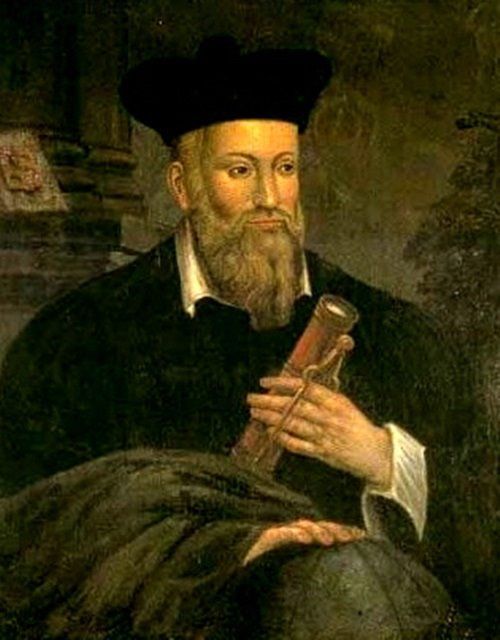 Nostradamus's real name was Michel de Nostredame, and he was born in France in 1503. He worked as a physician and astrologer. Wikipedia.
The most famous of Nostradamus’s predictions is the “end of the world in July 1999.” In addition, he is credited around the world with having predicted the Great Fire of London, the French Revolution, the rise of Hitler, and the world wars. However, because his writings mix medieval French and Latin expressions, there is considerable room for interpretation, and the lack of clear references to specific times or places has fueled ongoing debates about their credibility.
Some claim that phrases in his prophecies such as “a great war for seven months,” “unprecedented disasters in two cities,” and “three fires will arise in the East” suggest international conflict and a realignment of power in 2026. Others interpret the line “a great swarm of bees will arise in the surprise of night,” which is the 26th quatrain, as being related to the year 2026. However, foreign media have analyzed that the reason why the prophecies of Baba Vanga and Nostradamus attract attention every year is that cultural phenomena reflecting anxiety about the future are projected through prophetic discourse. The more unstable the international situation and the greater the social uncertainty, the more frequently these prophecies are invoked.
© The Asia Business Daily(www.asiae.co.kr). All rights reserved.
![Clutching a Stolen Dior Bag, Saying "I Hate Being Poor but Real"... The Grotesque Con of a "Human Knockoff" [Slate]](https://cwcontent.asiae.co.kr/asiaresize/183/2026021902243444107_1771435474.jpg)

















