In Iran, protests against the economic crisis-including inflation exceeding 40% and a sharp decline in the exchange rate-have spread nationwide, resulting in at least six deaths.
According to Iran's semi-official Fars News Agency on January 1 (local time), two people died and several others were injured when local police attempted to arrest a protest leader in Lordegan, located in southwestern Iran.
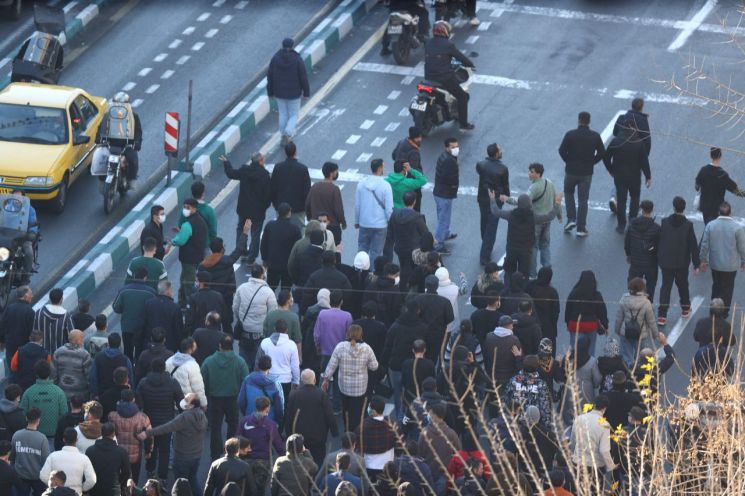 On the 29th of last month, merchants in Tehran, the capital of Iran, held street protests to oppose the economic crisis. Photo by AFP Yonhap News
Fars reported that some protesters set fires and opened fire, injuring several police officers.
The agency also stated that in Azna, in western Iran, rioters attacked a police headquarters and set police cars on fire, leaving three dead and 17 injured. However, it did not specify the identities of the casualties.
The semi-official Tasnim News Agency reported that the previous day in Khorramabad, Lorestan Province in western Iran, one member of the Basij militia was killed and 13 Islamic Revolutionary Guard Corps (IRGC) soldiers were injured while responding to protests. The Basij militia is a paramilitary organization affiliated with the IRGC, which protects Iran's theocratic regime. According to local prosecutors, 20 people were arrested following the protests.
Based on reports from Iranian media that day alone, six people have been confirmed dead. The Associated Press noted that these deaths may signal that the Iranian government has begun to take a more hardline approach.
In addition, Reuters, citing human rights groups Hengaw and the Human Rights Activists News Agency (HRANA), reported that one protester was shot and killed in Isfahan Province in central Iran. However, Fars and other media outlets have not confirmed reports related to this incident.
Authorities are trying to curb the spread of protests while moving cautiously out of concern for public sentiment. On that day, Iranian government spokesperson Fatemeh Mohajerani stated on the social networking service X (formerly Twitter) through a signed message that "the president will meet with representatives of the merchants, and direct dialogue will also take place in each region." However, she did not mention the specific content of these discussions.
The current wave of protests began on December 28 in the capital, Tehran, led by merchants furious over the currency's collapse, and has since spread nationwide as university students and other young people have joined in. Iran is suffering from a severe economic crisis due to longstanding Western sanctions related to its nuclear program, missile development, and support for regional terrorism.
© The Asia Business Daily(www.asiae.co.kr). All rights reserved.
![Clutching a Stolen Dior Bag, Saying "I Hate Being Poor but Real"... The Grotesque Con of a "Human Knockoff" [Slate]](https://cwcontent.asiae.co.kr/asiaresize/183/2026021902243444107_1771435474.jpg)
















