Criticism: "The impact of VAT on the birth rate will be very limited"
As China’s low birth rate problem intensifies, the authorities have decided to impose a 13% tax on contraceptives such as condoms and birth control pills.
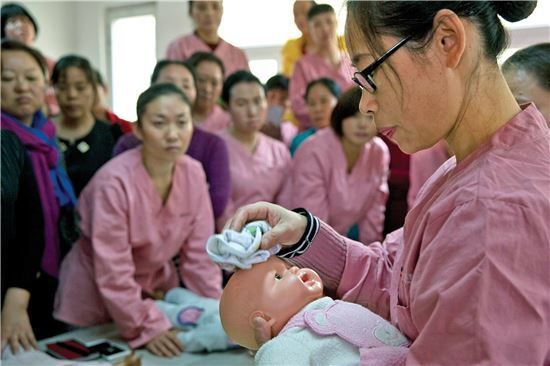 Helper women are learning baby care skills using life-sized baby dolls at Liming, a maternity helper staffing agency in Beijing, China. The photo is not directly related to the article content. Photo by AP Yonhap News.
On December 31 (local time), the BBC reported that the Chinese government will begin imposing a value-added tax (VAT) of 13% on contraceptives starting in the new year. Until now, contraceptives had been exempt from VAT. However, with the population declining over the past three years and no signs of a rebound in the birth rate, the government aims to raise the price of contraceptives by imposing a tax, making them harder for consumers to purchase and increasing barriers to contraception.
However, public reaction online has been cold. On social media, users commented, “I’ll buy a lifetime supply of condoms before the VAT is imposed,” and “Does the government not realize that raising a child costs far more than condoms?” Many pointed out that the fundamental cause of the declining birth rate is the high cost of raising children, and that simply raising the price of contraceptives without addressing this issue will not help. Chia-Chi Tieh, a researcher at the University of Virginia’s Demographic Research Group, also criticized the move in an interview with AP, saying, “The impact of VAT on increasing the birth rate will be very limited.”
There is also a concern that if condom usage declines, not only will the birth rate not increase, but the spread of sexually transmitted diseases could become more prevalent. Foreign media reported that “the number of people infected with sexually transmitted diseases in China decreased during the COVID-19 pandemic but is now rising again,” and that in 2024, there were 100,000 cases of gonorrhea and 670,000 cases of syphilis. The number of people living with HIV/AIDS in China is also estimated to be as high as 1.4 million.
There are also concerns that this policy could lead to an increase in unwanted pregnancies among socially vulnerable groups. For students or low-income individuals, even a slight increase in the price of contraceptives could make them unaffordable. A resident of Xi’an told foreign media, “If VAT is imposed, students and low-income groups will be forced to take risks during sexual activity.”
Furthermore, there are warnings that excessive government intervention in the personal choice of childbirth could have the opposite effect. Previously, there was public outrage after reports that some local governments in China contacted women to ask about their menstrual cycles or childbirth plans.
Meanwhile, China, which once enforced the world’s strictest birth control policy, has seen its population decline since 2022. The one-child policy was abolished in 2015, and the government allowed two children in 2016 and three children in 2021. However, these measures failed to stop the low birth rate, and China lost its position as the world’s most populous country to India in 2023. In 2024, the number of newborns was 9.54 million, a 56% drop compared to 16.87 million in 2014.
According to a 2024 report by the Yuwa Population Research Institute in Beijing, the fierce competition in education and the resulting burden of tuition, along with the difficulty women face in balancing work and family, have driven up the cost of raising children. In addition, the real estate downturn has shaken asset values, and growing anxiety about the future among younger generations has further worsened the situation.
© The Asia Business Daily(www.asiae.co.kr). All rights reserved.
![Clutching a Stolen Dior Bag, Saying "I Hate Being Poor but Real"... The Grotesque Con of a "Human Knockoff" [Slate]](https://cwcontent.asiae.co.kr/asiaresize/183/2026021902243444107_1771435474.jpg)
















