Average Competition Rate at Top 10 Universities: 5.29 to 1
Changes in Recruitment Groups and Score Reflection Methods Shape Application Trends
In the 2026 regular college admission cycle, the competition rates among major universities showed mixed results. While the overall number of applicants to top-tier universities slightly increased, changes such as adjustments in recruitment groups and modifications to the way scores are reflected led to a competitive landscape that differed from last year.
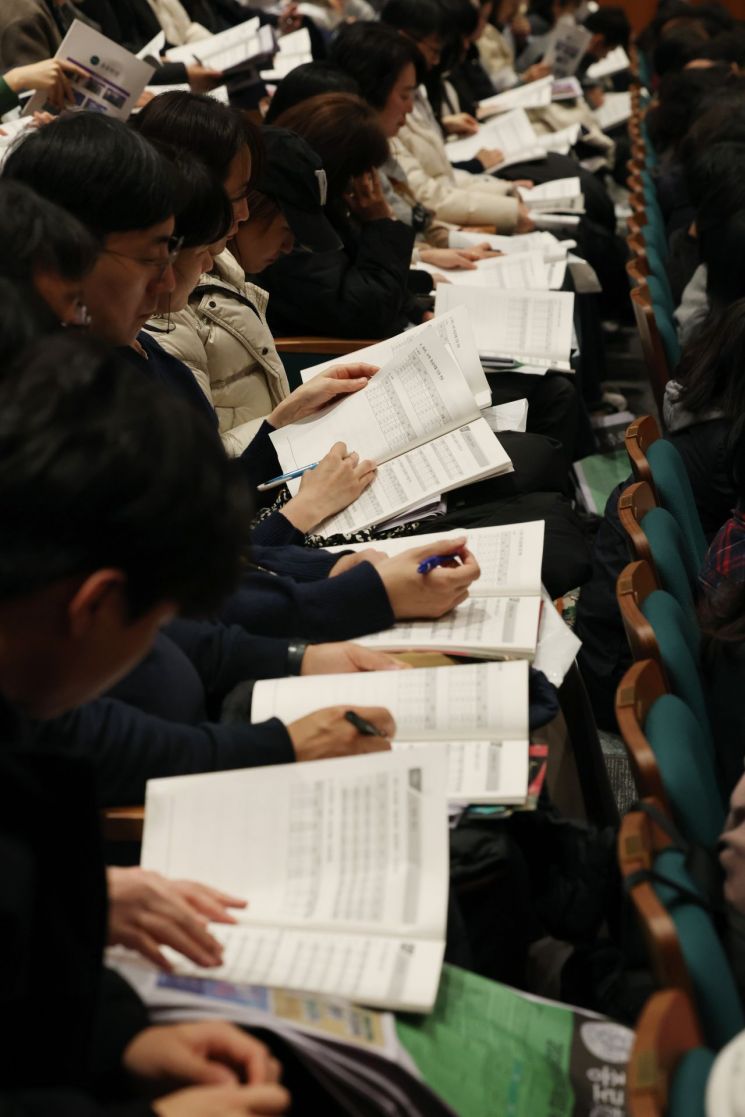 Parents and examinees are listening to the instructor's explanation at the "2026 Regular Admission Probability Prediction and Application Strategy Seminar." Photo by Yonhap News
According to the admissions industry on January 1, the total number of applicants for the 2026 regular admissions at the top 10 universities was 82,889, resulting in an average competition rate of 5.29 to 1. The number of applicants increased by 645 compared to the previous year, but the competition rate was marginally lower than last year's 5.30 to 1.
By university, Sogang University recorded the highest competition rate at 8.39 to 1, followed by Chung-Ang University (7.06 to 1), Hanyang University (6.64 to 1), and Hankuk University of Foreign Studies (6.17 to 1). Among these, six universities-Yonsei University, Sungkyunkwan University, Sogang University, Hanyang University, Ewha Womans University, and Hankuk University of Foreign Studies-saw increases in both the number of applicants and competition rates. In particular, Sogang University experienced the largest increase, with more than 1,000 additional applicants, while Hanyang University and Yonsei University also posted double-digit growth rates.
In contrast, Seoul National University, Korea University, Chung-Ang University, and Kyung Hee University saw both the number of applicants and competition rates decline. Chung-Ang University had the largest decrease, and Korea University also saw a drop of more than 900 applicants. Seoul National University experienced only a slight decline.
Admissions experts analyzed that this year’s regular admissions were far more difficult to predict than in previous years. Several factors contributed to this, including increased English exam difficulty, shifts in the number of students taking social studies, a reduction in medical school quotas, changes in recruitment groups at each university, adjustments to subject weighting, and modifications in the way scores are reflected.
In fact, changes in university-specific policies directly affected application patterns. Korea University moved its undergraduate recruitment group from Group C to Group A, resulting in a sharp decrease in applicants for that admission track. In contrast, Sogang University shifted its science-based liberal arts program to Group C, leading to a significant increase in applicants, and Ewha Womans University’s nursing program more than doubled its number of applicants after changing its recruitment group.
Some departments at Sungkyunkwan University not only switched their recruitment group from Group A to Group B but also became the first among major universities to use percentile scores instead of standardized scores. Sogang University also revised its CSAT reflection structure, changing from a system that gave uniformly high weighting to certain subjects to one that now gives the highest weighting to the best-performing subject between Korean and Mathematics.
Lim Seongho, CEO of Jongro Academy, stated, "These changes are not limited to specific universities but have a ripple effect on application strategies at other universities as well. There is a significant possibility that the regular admission cutoff scores may differ considerably from previous expectations."
© The Asia Business Daily(www.asiae.co.kr). All rights reserved.

















