Proportion of Young People in Regional Areas Continues to Decline
Limitations of Policy Effectiveness Highlighted
Although the government is working to expand youth employment opportunities in regional areas, the concentration of young people in the Seoul metropolitan area has actually intensified. As a result, there are calls for a shift in employment policies to effectively encourage young people to settle in local regions.
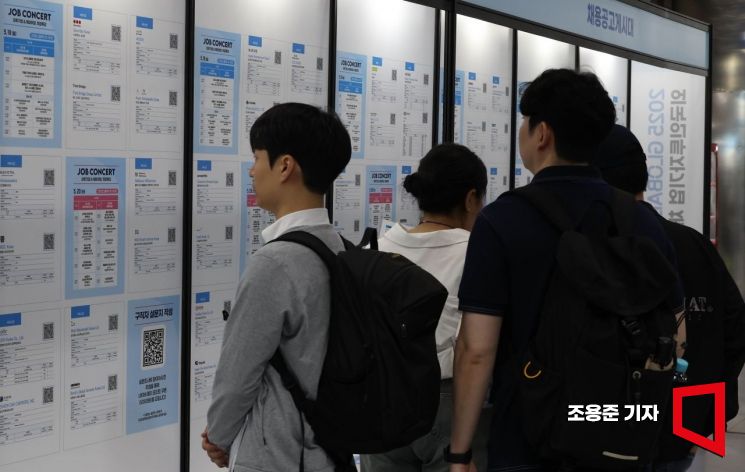 Job seekers visiting the '2025 Global Talent Fair' held at COEX in Samseong-dong, Gangnam-gu, Seoul, are looking over the job posting board.
The proportion of young people residing in the Seoul metropolitan area rose from 49.1% in 2000 to 54.5% this year. This indicates that, despite policy support, the trend of declining youth populations in regional areas continues.
Kim Kiheon, Senior Research Fellow at the National Youth Policy Institute, stated in the winter issue of the academic journal "Regional Industry and Employment," jointly published by the Korea Employment Information Service and the Korean Regional Employment Society, "Despite a variety of policies being implemented at the central government level, the outflow of young people from regional areas persists. A paradigm shift in policies is urgently needed to encourage young people to remain in local communities." He also evaluated the new administration's youth policy direction, saying, "It remains at the level of expanding existing programs, and lacks a clear core strategy that runs through the overall youth policy."
As directions for improving regional youth policies, Kim proposed a comprehensive approach that links employment policies with housing, education, culture, and welfare, as well as strengthening inter-ministerial cooperation. He also emphasized the need to establish a step-by-step support system that reinforces connections between local companies and universities from the time students are enrolled, leading to employment and settlement in the region.
There were also arguments for a more detailed approach that takes into account the specific characteristics of youth migration. Min Bokyung, Research Fellow at the National Assembly Futures Institute, highlighted the need for customized policies that consider gender and life cycle. According to the analysis, the proportion of women moving to the Seoul metropolitan area was highest between ages 19 and 24, while for men it was highest between ages 25 and 29. This was interpreted as reflecting differences in the timing of social entry and career formation processes by gender.
Examining the factors driving migration by age group, employment issues were identified as the key factor for young people aged 25 to 29. Min explained, "The lack of high-quality jobs available in regional areas for young people to choose from during their early career-building years is fueling the concentration in the metropolitan area."
For those aged 30 to 34, housing issues, in addition to employment, were found to have a relatively greater impact on migration decisions. Regarding this, Min stated, "Rather than applying the same policies nationwide, strategies tailored to local conditions and the life stages of young people are needed."
Specifically, for young people aged 20 to 24, she proposed fostering talent and supporting settlement by linking local universities and companies. For those aged 25 to 29, she suggested expanding high-quality employment opportunities by nurturing strong local small and medium-sized enterprises. For those aged 30 to 34, policies focused on housing stability, such as supplying long-term public rental housing and strengthening childcare support programs, were presented as effective alternatives.
© The Asia Business Daily(www.asiae.co.kr). All rights reserved.
![Clutching a Stolen Dior Bag, Saying "I Hate Being Poor but Real"... The Grotesque Con of a "Human Knockoff" [Slate]](https://cwcontent.asiae.co.kr/asiaresize/183/2026021902243444107_1771435474.jpg)
















