First Precise Determination of Distance and Mass Through Simultaneous Observations by Ground-Based and Space Telescopes
A Saturn-mass planet, which had been drifting alone through space after escaping the gravitational pull of its star, has been captured by a Korean observation network. Ground-based and space telescopes from Korea and Europe simultaneously detected the same moment, marking the first successful and precise measurement of both the distance and mass of such a solitary planet. The decisive clue that revealed the identity of this previously unseen celestial body came from Korea's continuous observation network.
On January 2, the Korea Aerospace Administration announced that an international research team, including the Korea Astronomy and Space Science Institute, had discovered a solitary planet with Saturn-like mass using Korea's exoplanet search system KMTNet and the Gaia space telescope of the European Space Agency (ESA).
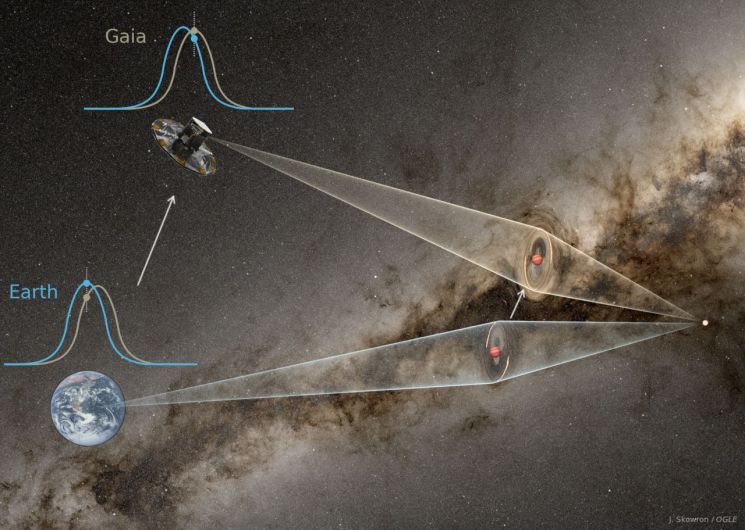 Virtual image of observing a solitary planet with Saturn-like mass using the ground-based telescope KMTNet and the Gaia space telescope. Provided by the Space Agency
The solitary planet identified in this study is named 'KMT-2024-BLG-0792' and has a mass approximately 0.7 times that of Saturn. It is located about 10,000 light-years from Earth and is classified as a rogue planet, freely moving through the galaxy without being bound by the gravity of a central star.
'Simultaneous Detection' by 24-Hour Observation Network and Space Telescope
A rogue planet is a planet that wanders through space alone, having escaped the gravity of its central star. Since it does not emit its own light and lacks a host star, it is difficult to observe directly. It can only be discovered through the microlensing phenomenon, where the gravity of an unseen celestial object bends the light from a background star. The Einstein radius serves as the standard for the degree to which the light is bent.
Currently, rogue planets can only be discovered through the microlensing phenomenon. Microlensing occurs when the gravity of an unseen object bends the light of a background star, causing a temporary increase in brightness. Because this event is brief, continuous observation capability is crucial. KMTNet, with its three telescopes located in Chile, Australia, and South Africa, enables 24-hour monitoring, offering a significant advantage in capturing such short-lived signals.
The research team detected the microlensing signal using KMTNet and then combined this with data from the Gaia space telescope, which observed the same region six times over a 16-hour period. This allowed for precise calculation of the planet's distance and mass. This is the first time that the physical properties of a rogue planet have been accurately determined by combining simultaneous data from both ground-based and space telescopes.
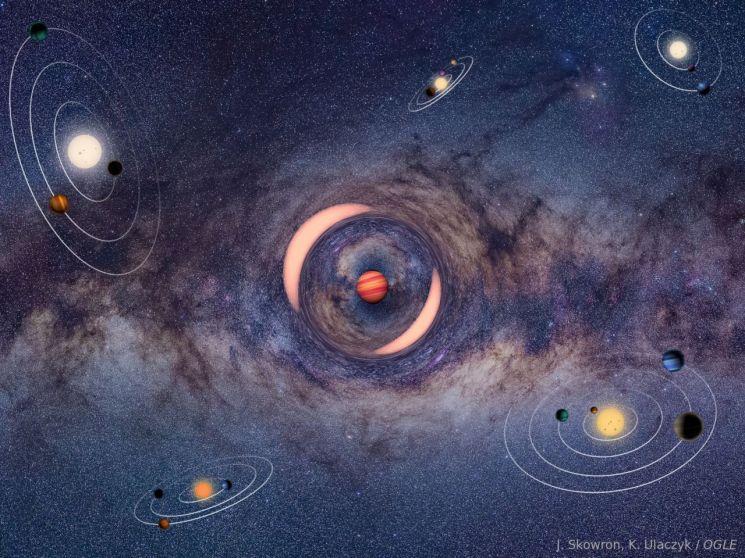 Conceptual diagram of microlensing phenomenon of a rogue planet. Provided by the Space Administration
This study also has significant academic implications. Previously, all nine rogue planets discovered using the microlensing method were found outside a specific Einstein radius range (about 9 to 25 microarcseconds), known as the 'Einstein Desert.' However, this planet is the first to be found within this range, offering new clues that could expand existing theories about the formation and distribution of rogue planets.
This research was jointly conducted by Peking University in China and the Korea Astronomy and Space Science Institute. The first and corresponding author of the paper is Professor Dong Subo of Peking University, and the second author is researcher Wu Zexuan, also from Peking University. From the Korean side, Dr. Ryu Yunhyeon of the Korea Astronomy and Space Science Institute participated as the third author, and Dr. Lee Chungwook served as a corresponding author. Many researchers from the institute's microlensing research team were also listed as co-authors.
Kang Kyeongin, Director of Space Science Exploration at the Korea Aerospace Administration, stated, "Based on the excellent performance of KMTNet established by the Korea Astronomy and Space Science Institute, Korea is playing a leading role in the discovery of exoplanets using microlensing, especially rogue planets. We will continue to produce new achievements in space science through simultaneous observations with ground-based and international space telescopes."
The results of this research were published in the international journal Science on January 1, 2026 (Eastern Standard Time) under the title "A free-floating-planet microlensing event caused by a Saturn-mass object."
© The Asia Business Daily(www.asiae.co.kr). All rights reserved.


















