Deputy Assistant Secretary for Public Diplomacy Comments on X
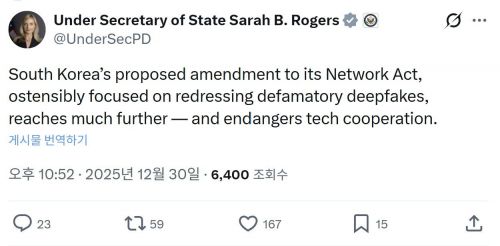
The U.S. Department of State has publicly expressed concerns regarding the amendment to the Information and Communications Network Act, which was passed by the National Assembly in South Korea under the leadership of the Democratic Party of Korea.
On December 30 (local time), Sarah Rogers, U.S. Department of State Deputy Assistant Secretary for Public Diplomacy, wrote on X (formerly Twitter), "South Korea’s Network Act amendment appears on the surface to focus on addressing the issue of defamatory deepfakes, but in reality, it has much broader implications and jeopardizes technological cooperation."
The "Network Act" referenced by Deputy Assistant Secretary Rogers refers to the so-called "Fake Information Eradication Act" (the amendment to the Information and Communications Network Act) led by the Democratic Party in South Korea, which passed the Cabinet meeting on December 30 and is scheduled to take effect in July next year.
According to this amendment, the concepts of illegal and fake information are specifically defined, and the distribution of such information through information and communications networks is prohibited.
In a subsequent post, Deputy Assistant Secretary Rogers stated, "While it is fully understandable that deepfakes are a concerning issue, it would be more desirable to provide victims with civil remedies rather than granting regulators 'invasive' powers that could lead to viewpoint-based censorship."
This comment is interpreted as emphasizing that regulatory authorities should not excessively intervene in the realm of freedom of expression.
Previously, on December 23, the U.S. Department of State also imposed entry bans on five individuals in response to the European Union’s enactment of the Digital Services Act (DSA), which regulates major U.S. tech companies, stating that the EU had led this legislative effort.
At that time, Deputy Assistant Secretary Rogers described those subject to the entry restrictions as "individuals who incited the censorship of Americans’ speech."
The latest amendment, named the "Fake Information Eradication Act" by the Democratic Party, includes provisions that allow for punitive damages to be imposed on media outlets and YouTubers who intentionally distribute fake or manipulated information.
© The Asia Business Daily(www.asiae.co.kr). All rights reserved.

















