'Monkey Christ' Restorer Dies at 94
From Internet Meme to Opera, Controversy Continues
Failed Restoration Turns Village into Tourist Hotspot
Cecilia Jimenez, who sparked worldwide controversy by transforming the face of Jesus into an ape-like image, has passed away at the age of 94. On December 30 (local time), international media outlets such as the BBC and The Guardian reported that Cecilia Jimenez, the Spanish amateur painter who became globally known for altering the image of Jesus to resemble a monkey during the restoration of a mural in a Spanish cathedral, has died.
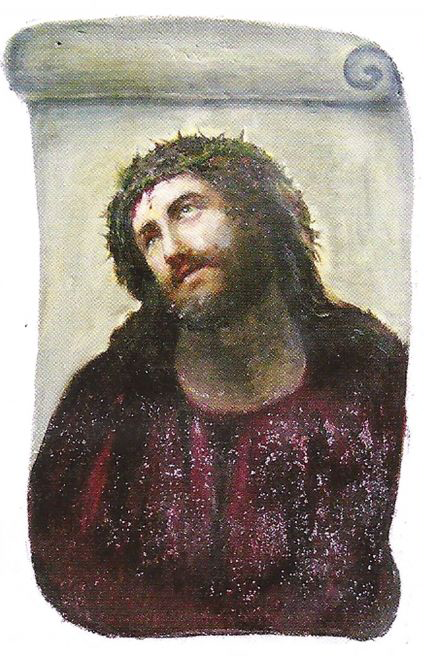
Back in 2012, Jimenez was tasked with restoring the 19th-century mural "Ecce Homo" at the Santuario de Misericordia in the village of Borja, Aragon, Spain. The mural had suffered severe damage over more than a century, but the church entrusted the restoration not to a professional conservator, but to Jimenez, a devout parishioner and amateur painter.
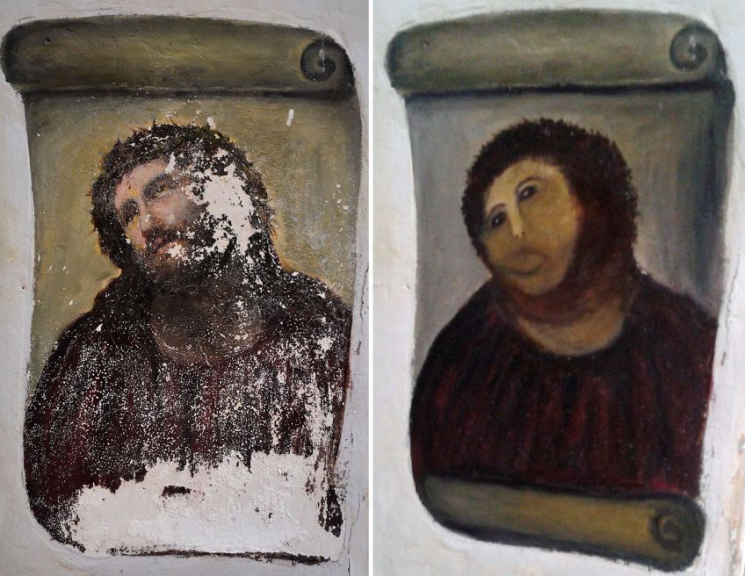 Comparison of the damaged version (left) of the 19th-century painter Elias Garcia Martinez's 'Ecce Homo' and the restored version (right) by Cecilia Jimenez. Photo by APF Yonhap News
However, the result was drastically different from the original. The face of Jesus lost its contours, with the eyes and mouth appearing blurred and distorted. International media and social networking services (SNS) harshly criticized the work, calling it "Monkey Christ" and "the worst art restoration in history." The British daily The Guardian reported that Jimenez suffered extreme stress due to the criticism and lost about 17 kilograms in weight.
This incident escalated beyond a simple mishap, sparking a debate over the desecration of religious art. Some Catholic believers expressed outrage, claiming that the sacred face of Jesus had been defiled. The art community also criticized the event as an example of poor cultural heritage management. On the other hand, some argued that the mural was already severely damaged and that it was unfair to place all the blame on her.
Interestingly, the "failed restoration" changed the fate of the village. As the awkward painting spread as an internet meme, the cathedral became a world-famous tourist destination. According to the BBC, while Borja previously attracted about 5,000 visitors annually, over 40,000 tourists visited in 2013 alone, generating approximately 600,000 euros in revenue. This income was used for local charities and cultural preservation funds. Interest was so high that low-cost airline Ryanair even arranged special flights to Zaragoza Airport, near the cathedral. Even now, visitors continue to flock to see the "Ecce Homo" mural.
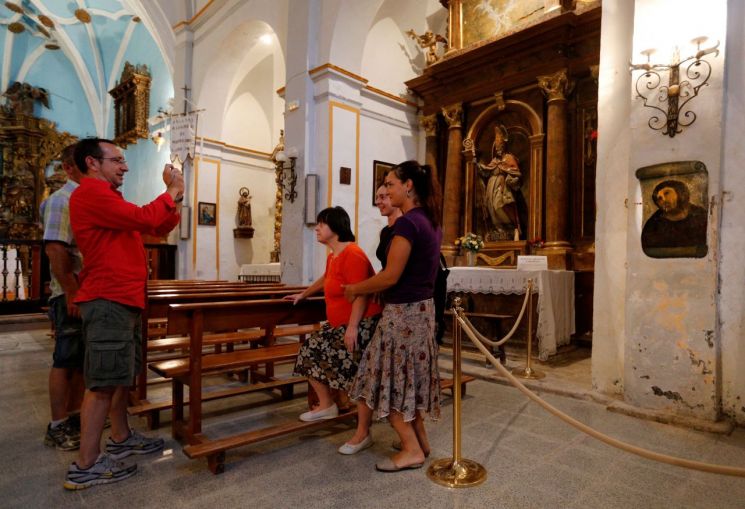 The failed restoration spread as an internet meme, turning the cathedral into a world-famous tourist attraction. Even now, visitors continue to come to see the "Ecce Homo" mural. Photo by AFP Yonhap News
Over time, Jimenez came to accept her newfound notoriety. She signed a contract to share copyright revenue from souvenirs and related images sold at the cathedral, and later served in an honorary role promoting tourism for the village. Experts have stated that it is technically possible to restore the mural closer to its original form, but since the painting itself has become a modern cultural icon, it remains preserved as is.
This incident remains a symbol of the value of art, failure, and the power of popular culture. In 2023, an opera based on this true story, "Ecce Homo," premiered in Las Vegas, once again drawing attention to the event. The life of Cecilia Jimenez, who transformed from an object of ridicule into a symbol that revitalized her community, is expected to be remembered as a prime example of how, in the internet age, a single individual's mistake can become a global cultural phenomenon.
© The Asia Business Daily(www.asiae.co.kr). All rights reserved.
![Clutching a Stolen Dior Bag, Saying "I Hate Being Poor but Real"... The Grotesque Con of a "Human Knockoff" [Slate]](https://cwcontent.asiae.co.kr/asiaresize/183/2026021902243444107_1771435474.jpg)


















