Petroleum and Imported Agricultural, Livestock, and Fisheries Products Drive Price Increases
Petroleum Prices Surge 6.1%... Largest Rise in 10 Months
 Deputy Prime Minister and Minister of Economy and Finance Koo Yoon-chul attended the Economic Ministers' Meeting and Growth Strategy Task Force held at the Government Seoul Office in Jongno-gu, Seoul on the 31st, speaking about the annual consumer price trends and support for vulnerable groups during the winter season. 2025.12.31 Photo by Jo Yongjun
The consumer price inflation rate in December 2025 recorded 2.3%, marking a fourth consecutive month of increases in the 2% range. The rise in petroleum products and imported agricultural, livestock, and fisheries products due to a strong exchange rate drove overall prices higher.
According to the "Consumer Price Trends for December and the Year 2025" released by the National Data Agency on December 31, consumer prices this month rose 2.3% compared to the same period last year. Compared to November (2.4%), the rate of increase slowed by 0.1 percentage point. The inflation rate had been in the 2% range in June and July of this year, fell to 1.7% in August, but then remained in the 2% range with 2.1% in September and 2.4% in both October and November.
Due to the impact of the high exchange rate, petroleum product prices surged by 6.1%, increasing overall inflationary pressure. This is the highest increase in petroleum products in ten months since February this year (6.3%). In particular, diesel prices rose by 10.8% and gasoline by 5.7%. Diesel prices saw their largest increase in about three years since January 2023 (15.5%), and gasoline prices experienced their biggest jump since February this year (7.2%). Lee Dowon, Director of Economic Trend Statistics Review, analyzed, "The rise in the exchange rate and the reduction in the fuel tax cut rate appear to have contributed to the upward pressure on prices."
Processed food prices rose by 2.5%, but the rate of increase slowed compared to the previous month (3.3%). This was due to a base effect, as items that saw concentrated shipment price hikes in December last year were excluded from the year-on-year comparison. Some items, such as bread (3.3%) and coffee (7.8%), continued to see price increases.
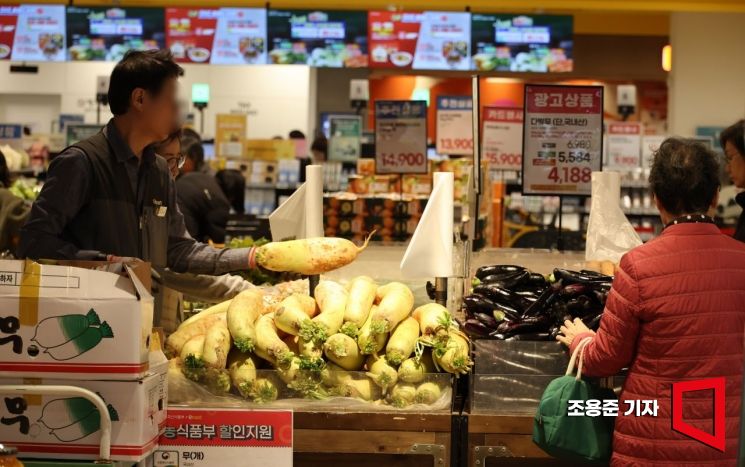 As the kimchi-making season begins in earnest, customers visiting a large supermarket in Seoul on the 19th are purchasing agricultural products such as radish, green onions, napa cabbage, and salted seafood to prepare for kimchi-making. Photo by Jo Yongjun
Prices of agricultural, livestock, and fisheries products rose by 4.1%, contributing 0.32 percentage points to overall inflation. Among these, agricultural products increased by 2.9%, livestock products by 5.1%, and fisheries products by 6.2%. As shipments, which had been delayed due to frequent autumn rains, increased, the rate of increase for fruits slowed (from 11.5% to 5.3%), while the rate of decrease for vegetables widened (from -4.7% to -5.1%). By item, rice (18.2%), apples (19.6%), tangerines (15.1%), mackerel (11.1%), imported beef (8.0%), and pork (4.4%) all showed upward trends.
The living price index, which is composed mainly of frequently purchased items and closely reflects perceived inflation, rose by 2.8%. The "index excluding food and energy," which is the core inflation indicator used by the Organisation for Economic Co-operation and Development (OECD), rose by 2.0%, while the core inflation index excluding agricultural products and petroleum products increased by 2.3%.
On an annual basis, the rate of price increases slowed to the lowest level in five years. This year’s inflation rate was 2.1%, down 0.2 percentage points from last year (2.3%). The annual consumer price inflation rate remained in the 0% range from 2019 to 2020, then rose to 2.5% in 2021, 5.1% in 2022, and 3.6% in 2023, before gradually stabilizing to 2.3% in 2024 and 2.1% this year.
The annual living price index also rose by 2.4%, the lowest level since 2020. Petroleum products shifted from a -1.1% decrease last year to a 2.4% increase this year. This is the first rise in petroleum product prices in three years since 2022 (22.2%). Although international oil prices themselves fell, the high exchange rate led to higher domestic prices. In fact, the average annual price of Dubai crude oil dropped from $79.6 last year to $69.9 this year, but the average annual exchange rate rose significantly from 1,364 won to 1,422 won. Director Lee explained, "It appears that the rise in the exchange rate and the reduction in the fuel tax cut rate led to higher gasoline and diesel prices."
Deputy Prime Minister and Minister of Economy and Finance Koo Yoonchul commented on price stabilization on this day, stating, "Ahead of the Lunar New Year holiday, we will promote discount support for agricultural, livestock, and fisheries products," and added, "To prevent the spread of avian influenza (AI), we will strengthen quarantine measures and, if necessary, prepare measures to stabilize the supply of eggs."
© The Asia Business Daily(www.asiae.co.kr). All rights reserved.


















