5% One-Time Wealth Tax on Net Worth Over $1 Billion
Tech Titans Like Page and Thiel Consider Relocating
Industry Warns: "Wealth Tax Will Kill California Startups"
As discussions about introducing a wealth tax targeting billionaires are underway in California, billionaire leaders of major tech companies are fiercely opposing the proposal, threatening to relocate to other states if the bill passes.
According to CNBC and Business Insider on December 30 (local time), progressive Democratic lawmakers in California and the Service Employees International Union-United Healthcare Workers West (SEIU-UHW) are pushing for a one-time 5% tax on individuals with a net worth of $1 billion (approximately 1.4415 trillion won) or more.
They are collecting about 875,000 signatures to put the bill to a statewide referendum in November next year. If the bill passes, the tax will be levied based on net worth as of January 1, 2026. The plan aims to address the severe wealth gap within the state and make up for healthcare budget shortfalls caused by federal budget cuts. SEIU-UHW estimates that the bill could raise up to $100 billion.
Local media outlet San Francisco Chronicle reported that, if the bill passes, 214 billionaires in California would be subject to the tax, most of whom are tech industry moguls and venture capitalists.
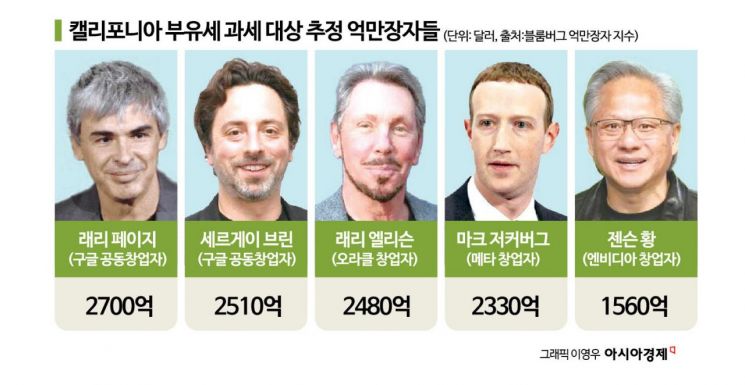
According to the Bloomberg Billionaires Index as of this day, major targets for the tax are estimated to include Google co-founder Larry Page ($270 billion), Google co-founder Sergey Brin ($251 billion), Oracle founder Larry Ellison ($248 billion), Meta founder Mark Zuckerberg ($233 billion), and Nvidia founder Jensen Huang ($156 billion). In the case of Larry Page, he would have to pay approximately $13.5 billion in taxes if the bill passes.
Key figures in the tech industry facing massive taxes are strongly opposing the bill, with some threatening to leave California and others vowing to unseat politicians who support the proposal.
According to The New York Times, Larry Page recently expressed to those around him his desire to leave California. State records show that three limited liability companies associated with him have filed incorporation documents in Florida. The media, citing sources, also reported that billionaire investor Peter Thiel, founder of PayPal and Palantir with a net worth of $26.8 billion, is considering relocating, having established residence and registered as a voter in Miami, Florida.
The tech industry points out that the net worth used as the basis for taxation under the bill is largely based on stock holdings, meaning the tax would be imposed on unrealized gains.
Garry Tan, CEO of startup accelerator Y Combinator, warned that taxing unrealized gains would "kill small tech companies in California" through the wealth tax.
Palmer Luckey, founder of Anduril, noted that this tax could force founders to sell a significant portion of their company shares, stating that "companies are being effectively forced to prioritize profit over mission or long-term sustainability."
There is also disappointment over Representative Ro Khanna, who had previously been close to the tech industry, supporting the bill. Martin Casado, partner at Andreessen Horowitz, and CEO Tan, who had made significant campaign contributions to Khanna in the last election, warned that they would work to unseat him. However, Representative Khanna, responding sarcastically to the backlash from tech moguls, said, "I will miss them very much."
In addition to opposition from the tech industry, California Governor Gavin Newsom also opposes imposing a state-level wealth tax, citing concerns about declining competitiveness. Earlier this month, he stated, "We cannot isolate ourselves from the other 49 states." However, Business Insider noted that if the wealth tax bill passes by referendum, Governor Newsom would not have the authority to veto it.
© The Asia Business Daily(www.asiae.co.kr). All rights reserved.

















