Regular In-Person Meetings with All Relevant Ministries to Begin Next Year
Discussions Expand to Business Challenges, Robotics, and Digital Cooperation
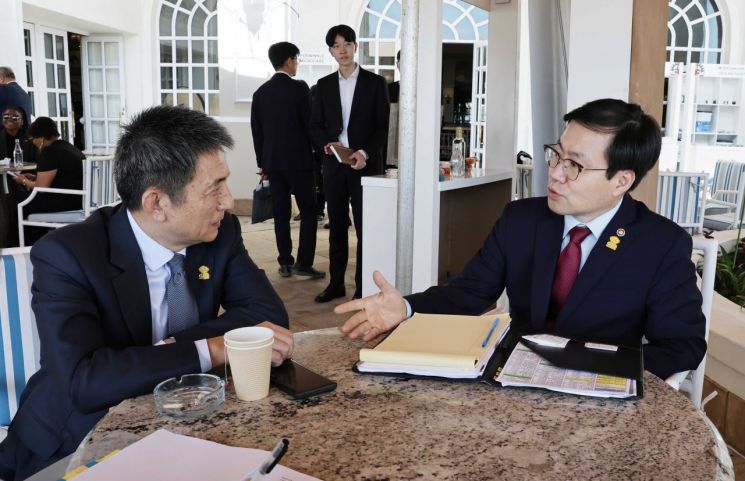
South Korea and China have agreed to accelerate follow-up negotiations on the Free Trade Agreement (FTA) regarding services and investment. Starting next year, the two countries will institutionalize regular in-person consultations involving all relevant ministries and hold additional trade ministerial meetings to focus on resolving outstanding issues. This move is seen as an effort to enhance predictability for businesses in both countries by reactivating institutional cooperation amidst growing uncertainties in the global trade environment.
The Ministry of Trade, Industry and Energy announced that on December 30, Trade Minister Yeo Han-koo held a Korea-China trade ministerial meeting in Beijing with Li Chenggang, China’s Vice Minister of Commerce and Chief Negotiator for International Trade (ministerial level), to discuss ways to accelerate follow-up negotiations on the Korea-China FTA services and investment chapter and to review the overall status of FTA implementation.
During the meeting, both sides agreed to overhaul the consultation structure to break the long-standing deadlock in the follow-up negotiations on services and investment. Specifically, from 2026, regular in-person meetings involving all relevant ministries will be held to intensively discuss remaining issues. In addition, an extra trade ministerial meeting will be convened in the first half of next year, allowing the trade ministers of both countries to directly review the progress of negotiations. This signifies an intention to elevate discussions from the working level to the ministerial level to secure momentum for the negotiations.
The two sides also discussed key issues that have arisen during the implementation of the Korea-China FTA. They exchanged views on matters directly related to FTA implementation, such as cooperation in the petrochemical sector, access to government procurement markets, and protection of intellectual property rights. Both countries agreed to continuously strengthen substantive cooperation based on the FTA. This is interpreted as an attempt to enhance institutional stability across industries in both countries, including the petrochemical sector, which is currently facing oversupply and restructuring pressures.
Prior to the meeting, the government also organized a session to directly hear from Korean companies operating in China. On December 29, Minister Yeo held a roundtable with Korean businesses in China to review major business trends and listen to difficulties they are experiencing on the ground. The participating companies reportedly conveyed specific challenges related to regulations, customs clearance, market access, and the investment environment.
The government classified the issues raised at the roundtable by sector, distinguishing between those that can be addressed in the short term and those requiring mid- to long-term consultations, and exchanged views with the companies on future support directions and response principles. The industry demands raised during this process were also discussed at the trade ministerial meeting on the same day. The government plans to continue seeking solutions through follow-up negotiations, the Korea-China FTA Joint Committee, and working-level consultation channels. In addition, the government will maintain a regular communication system with the industry to reflect on-site feedback in policy consultations and strengthen support to stabilize the business environment for Korean companies and improve their access to the Chinese market.
Separately from the trade ministerial meeting, Minister Yeo also held a series of meetings with major Chinese policy and trade institutions. He met with senior officials from the China Council for the Promotion of International Trade (CCPIT) and the Development Research Center (DRC) of the State Council to exchange views on changes in the global trade environment, supply chain restructuring, the impact of technological innovation on industries, and the future direction of Korea-China trade cooperation. In particular, both sides agreed on the need to operate a continuous policy dialogue channel to address common challenges faced by companies in both countries, such as environmental and digital transformation, changes in global norms, and enhancing the predictability of trade and investment cooperation.
Based on this, the two countries decided to expand policy research cooperation and strengthen practical communication by industry, thereby gradually building a foundation for substantive cooperation. The plan is to go beyond mere declarations and broaden points of contact at the research and working levels to establish a mid- to long-term cooperation structure.
In addition, Minister Yeo visited the Korea Innovation Center (KIC China) in Zhongguancun, Beijing’s leading innovation cluster, to discuss ways for Korean startups to enter the Chinese market. He also visited GALBOT, a Beijing-based humanoid robot development startup, to examine major cases and on-site demand for how industrial robots are being utilized in quality control, process automation, and digital transformation in actual production settings.
During on-site meetings, opinions were also exchanged on potential areas for technological cooperation with Korean companies, testbed collaboration, and mutual information sharing regarding standards and certification. Through this, both sides confirmed the potential for mutual complementarity in the AI and robotics convergence sector and agreed to seek points of contact for future policy and industrial cooperation discussions.
© The Asia Business Daily(www.asiae.co.kr). All rights reserved.

















