Reuters Compares Early-Year Forecasts with Actual Market Trends
Tariff Shock Feared by Wall Street Turns Out Limited
S&P Surpasses Expectations, Dollar Index Declines
Many of Wall Street's forecasts for the U.S. stock market, the dollar, and monetary policy in 2025 have turned out to be significantly different from the actual market trends. While President Donald Trump's aggressive tariff policies were somewhat anticipated, the financial market's response deviated from Wall Street's initial scenarios. Contrary to expectations, the stock market rose, the dollar weakened, and monetary policy turned out to be much more accommodative than projected.
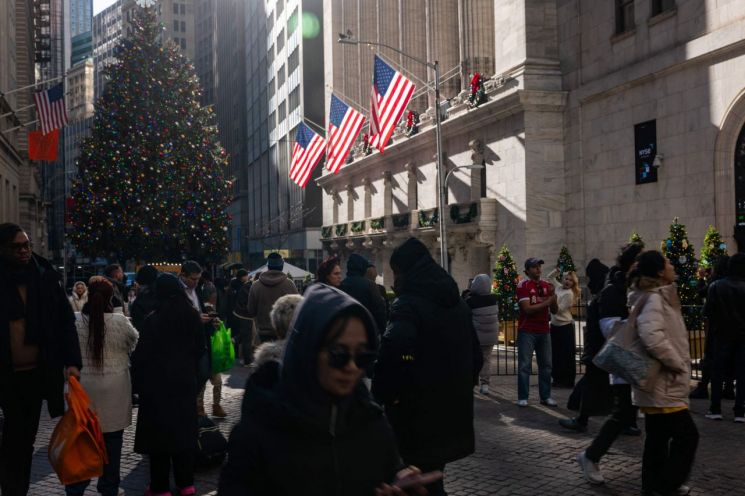 On the 24th, ahead of the Christmas holiday, people are passing by in front of the New York Stock Exchange (NYSE) in the United States. Photo by AFP
On the 29th (local time), Reuters compared early 2025 expert forecasts with actual market movements and summarized some of Wall Street's most notable misjudgments of the year.
The most significant miss was that the shock of the Trump administration's second-term tariff policies on the financial markets was much more limited than expected. President Trump, aiming to address trade imbalances, announced reciprocal tariffs on April 2. This initially caused significant turmoil in global financial markets, including the United States. U.S. Treasury yields surged, and the benchmark S&P 500 index plunged about 15% within three days. However, after President Trump postponed the tariff measures and the Treasury market stabilized, the stock market quickly rebounded and recovered its losses. While some in the market mocked this with the term "TACO" (Trump Always Chickens Out), the consensus is that policy flexibility ultimately minimized market shocks.
In a survey conducted by Reuters among experts at the end of last year, the S&P 500 index was expected to reach 6,500 points by the end of 2025, representing an annual increase of 9%. In reality, however, the S&P 500 has approached the 7,000 mark, making it likely to post nearly double the initially projected rate of increase.
The dollar's movement also ran counter to market expectations. The dollar index, which measures the value of the dollar against the currencies of six major countries, has fallen by nearly 10% so far this year. In the first half alone, it plunged 12%, marking the steepest drop in about 50 years since former President Richard Nixon abandoned the gold standard.
Wall Street had predicted that high tariffs would fuel inflationary pressure, which would keep U.S. monetary policy tight and strengthen the dollar. However, global investors, concerned about policy uncertainty, reduced their holdings of dollar assets and strengthened hedging strategies against currency volatility. In addition, the actual inflationary pressure caused by tariffs was limited, and the Federal Reserve cut its benchmark interest rate by 0.25 percentage points in three consecutive moves starting in September. This stands in stark contrast to the interest rate futures market's forecast just a year ago, which anticipated only one rate cut in 2025.
The Chinese yuan also defied Wall Street's expectations. At the beginning of the year, experts predicted that China would devalue the yuan to offset the burden of tariffs and boost exports. However, the actual exchange rate trend was the opposite. The yuan rose to the 7 yuan per dollar level, reaching its highest point in 14 months. While China's exports to the United States fell by 20%, exports to other regions increased, and China's annual trade surplus is expected to surpass 1 trillion dollars.
Reuters analyzed, "For now, it appears that investors are gradually adapting to Trump's new economic policies," adding, "The trade issues that dominated 2025, the artificial intelligence (AI) bubble, the increase in federal government debt, and concerns over central bank independence remain critical issues, suggesting that next year could also be highly volatile."
© The Asia Business Daily(www.asiae.co.kr). All rights reserved.

















