Ministry of Health and Welfare to Overhaul Bojeongsim Operating System
Jung Eun-kyung: "I Feel a Heavy Responsibility for the Lack of Procedural Consistency in Enrollment Expansion"
The government has announced that, in order to address the controversies that arose during previous expansions of medical school enrollment and to enhance policy predictability, it will present the medical school enrollment quota for the next five years or more in advance. In addition, the overall operating system of the "Health and Medical Policy Deliberation Committee" (Bojeongsim), the highest decision-making body for health and medical policy, will be extensively reorganized to restore its status and credibility.
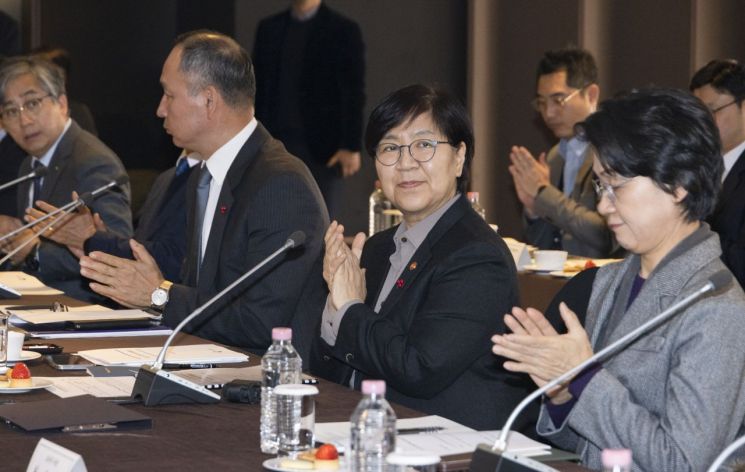 Jung Eun-kyung, Minister of Health and Welfare, is presiding over the "1st Health and Medical Policy Deliberation Committee Meeting of 2025" held on the 29th at the Plaza Hotel in Jung-gu, Seoul. Ministry of Health and Welfare
The Ministry of Health and Welfare held the first Bojeongsim meeting of the year on the 29th at The Plaza Hotel in Jung-gu, Seoul, together with newly appointed committee members, and discussed the revised plan for committee composition and operation, as well as the draft review criteria for the scale of physician training after the 2027 academic year.
To enhance transparency in the operation of Bojeongsim, the minutes and verbatim records of all future meetings will be made public on the Ministry of Health and Welfare's website. These records will be released within one month of the report at the next meeting.
To further activate the committee’s operation, regular meetings will be held quarterly, with additional meetings convened as needed. Agenda items requiring specialized review will be thoroughly discussed in subcommittees before being submitted to the main committee. Based on the agendas and policy issues, plans to reorganize subcommittees will also be developed in the future.
Furthermore, the proportion of government committee members with low policy relevance will be reduced, while the ratio of private sector members will be increased to better reflect the voices of the public and the medical field. To this end, the Ministry plans to promptly pursue amendments to the Enforcement Decree of the Framework Act on Health and Medical Services.
Regarding the scale of physician training after the 2027 academic year, five review criteria have been established to restore public trust and enhance predictability. When determining future workforce size, Bojeongsim will comprehensively consider the following: resolving regional, essential, and public healthcare disparities; changes in the future medical environment due to demographic structure and technological advancement; changes in health and medical policy such as improvements to the healthcare delivery system; ensuring the quality of medical education; and securing stability through five-year cycle supply and demand projections.
In particular, to prevent confusion among students and parents, the government will present the medical school enrollment quota for a period of five years or more. In accordance with the law, a medium- to long-term supply and demand projection will be conducted every five years, and adjustments to the quota will be considered in response to changing circumstances. Bojeongsim will respect the results of the medium- to long-term physician workforce supply and demand projections conducted by a committee of experts, and will discuss the scale of physician training after 2027 based on these criteria.
Jung Eun-kyung, Minister of Health and Welfare, who presided over the meeting, stated, "I feel a heavy sense of responsibility regarding the painful criticism that there was a lack of procedural consistency and substantive discussion in the previous efforts to increase medical school enrollment," and emphasized, "Going forward, we will do our utmost to listen to voices from the field and operate the committee with the utmost transparency."
© The Asia Business Daily(www.asiae.co.kr). All rights reserved.
![Clutching a Stolen Dior Bag, Saying "I Hate Being Poor but Real"... The Grotesque Con of a "Human Knockoff" [Slate]](https://cwcontent.asiae.co.kr/asiaresize/183/2026021902243444107_1771435474.jpg)
















