University Graduate Employment Rate at 69.5%
“Medical and Pharmaceutical” Field Tops the List with 79.4% Employment Rate
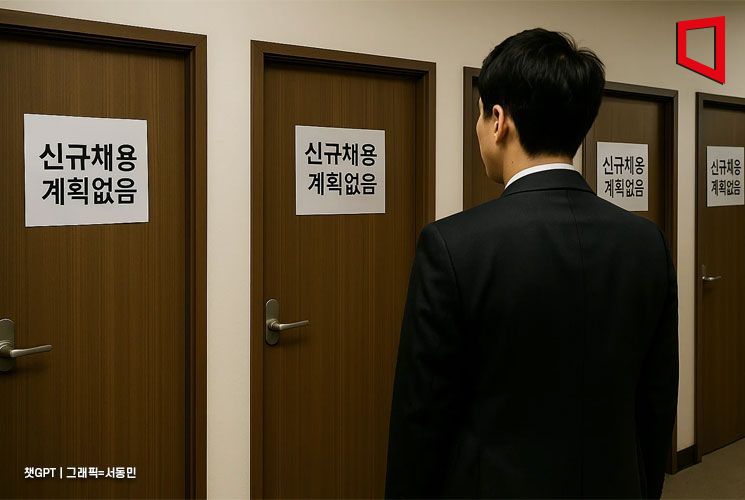
Due to the chill in the youth employment market, the employment rate for graduates of higher education institutions, such as universities and graduate schools, turned downward for the first time since 2020. Analysts attribute this to a decrease in new hires by companies amid the economic downturn, as well as an increase in young people not actively seeking jobs. Despite these challenges, the medical and pharmaceutical fields achieved an employment rate close to 80%, significantly surpassing the average.
According to the results of the "2024 Higher Education Institution Graduate Employment Statistics Survey" released on December 30 by the Ministry of Education, the National Data Office, and the Korea Educational Development Institute, among 634,904 graduates from universities, junior colleges, and graduate schools nationwide in August 2023 and February 2024, the employment rate for eligible job seekers (excluding those continuing studies, serving in the military, or foreign students) was 69.5% (377,120 people). This is a decrease of 0.8 percentage points from the previous year's 70.3%.
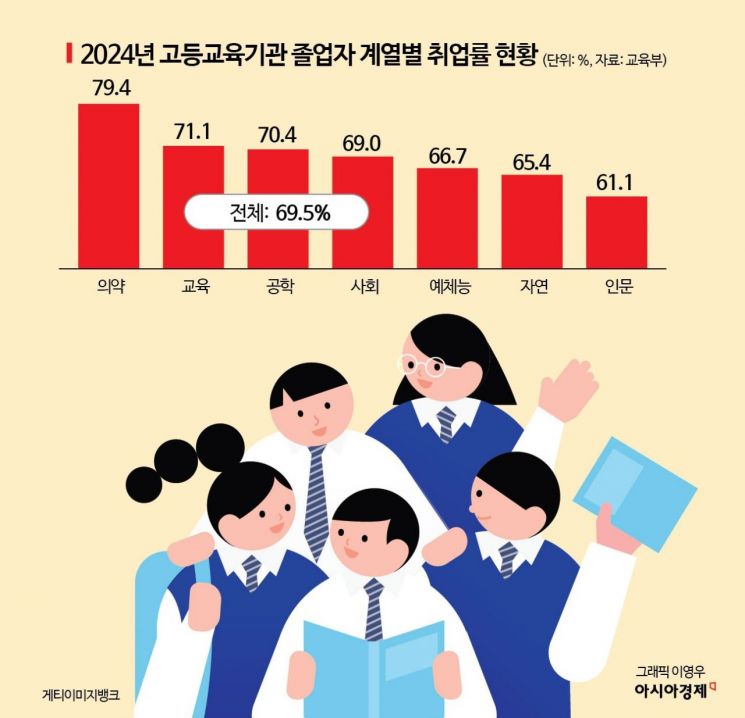
Except for the education field, which saw a 1.6 percentage point increase, all other academic fields experienced a drop in employment rates compared to the previous year. The medical and pharmaceutical field ranked first with an employment rate of 79.4%, followed by the education field (71.1%) and engineering (70.4%). Social sciences (69.0%), arts and sports (66.7%), natural sciences (65.4%), and humanities (61.1%) all fell below the average (69.5%).
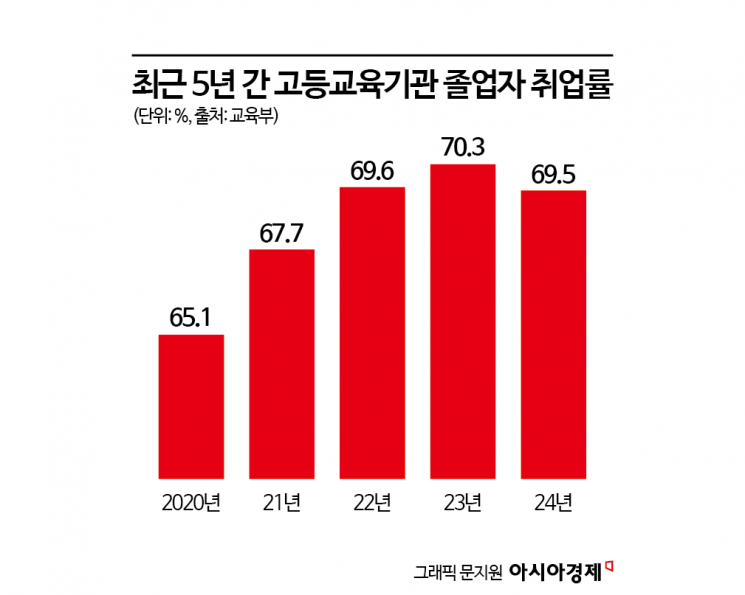
Although direct comparison is difficult due to the expanded survey scope since 2023, this is the first time since 2020 that the previously rising employment rate has declined. A Ministry of Education official explained, "As of December last year, the Composite Economic Index, Economic Sentiment Index (ESI), and Business Survey Index all declined, along with employment-related indicators, which appears to have influenced the results."
The cold employment climate is also evident in the job preparation period. The proportion of graduates who found employment before graduation (43.9%) or within three months after graduation (20.7%) decreased by 0.4 and 0.8 percentage points, respectively, compared to the previous year (44.3% and 21.5%).
The percentage of employed graduates enrolled in the National Health Insurance as workplace subscribers also dropped by 1.5 percentage points from the previous year, reaching only 87.0%. The field with the highest proportion of workplace health insurance subscribers was medical and pharmaceutical (94.5%), followed by engineering (92.9%) and social sciences (88.6%).
The proportion of freelancers among employed graduates was 7.4%, with the highest rates in arts and sports (21.1%), humanities (10.1%), and education (7.5%). Additionally, 4.2% were solo entrepreneurs, 0.7% were engaged in individual creative activities, 0.5% found employment overseas, and 0.2% were engaged in agriculture, forestry, or fisheries.
By type of institution, graduate schools had the highest employment rate (82.1%), followed by junior colleges (72.1%), universities (62.8%), and colleges of education (60.5%). Compared to the previous year, employment rates declined in all institution types except for colleges of education (up 0.1 percentage points): graduate schools (down 0.3 percentage points), junior colleges (down 0.3 percentage points), and universities (down 1.8 percentage points).
Monthly income was highest for graduate school graduates, followed by university and junior college graduates. Doctoral graduates from graduate schools earned an average monthly income of 6,532,000 won, followed by master's graduates (4,962,000 won), university graduates (3,146,000 won), and junior college graduates (2,693,000 won). The overall average was 3,426,000 won.
Regional and gender differences in employment rates persisted. The employment rate gap between the Seoul metropolitan area (71.3%) and non-metropolitan areas (67.7%) was 3.6 percentage points. Among the 17 regions, Seoul (72.2%), Incheon (70.4%), Ulsan (70.7%), Gyeonggi (69.6%), and Jeonnam (71.1%) exceeded the overall average. Busan had the lowest employment rate (64.8%), while Jeju saw the largest year-on-year decrease (down 2.8 percentage points). The employment rate gap between men (71.2%) and women (67.9%) was 3.3 percentage points, maintaining a difference in the 3% range for a second consecutive year (previous year: 3.9 percentage points).
The Ministry of Education explained that, starting with this survey, the post-graduation employment and further study status of "international students" was also included. Last year, there were 36,271 international student graduates from universities and graduate schools, an increase of 3,386 from the previous year (32,885). Among them, the number of employed international graduates (4,993) increased by 1,386 over the same period. The employment rate (33.4%) increased by 11.7 percentage points, and the further study rate (15.6%) rose by 1.9 percentage points compared to the previous year.
This statistical data can be accessed on the websites of the Ministry of Education, the Korea Educational Development Institute, and the National Statistical Portal.
© The Asia Business Daily(www.asiae.co.kr). All rights reserved.



















