All Sectors Including Education, Care, Environment, Safety, and Digital Government
Throughout 2025, Gwangju City received a total of 68 institutional awards in evaluations conducted by central ministries and government agencies, including seven Presidential Awards, two Prime Minister’s Awards, and 21 ministerial-level or higher commendations.
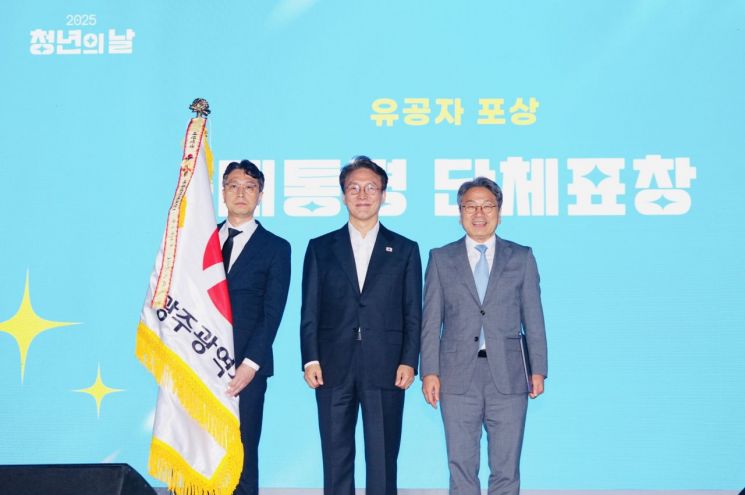 Prime Minister Kim Minseok and Gwangju Mayor Kang Kijeong are taking a commemorative photo at the 2025 Youth Day ceremony. Photo by Gwangju City
According to Gwangju City on the 29th, the Presidential Awards were given across a wide range of municipal fields, including education, care, environment, economy, emergency response, and digital government. This marks the highest number of awards received in a single year to date. The city explained that, along with the Prime Minister’s Awards and numerous ministerial-level commendations, these results confirm the effectiveness of its administrative policies as recognized by government evaluations.
In the youth and education sectors, Gwangju was selected as an outstanding institution in the comprehensive evaluation of youth policies such as the Work Experience Dream Project, housing cost support for workers, and the Youth Dream Bank, earning a Presidential Commendation. The city secured national funding by achieving the highest rating in the evaluation of the Regional Innovation-centered University Support System (RISE) plan and its implementation. Additional achievements included being selected as an excellent region in the pilot area evaluation for the Special Education Development Zone, receiving an A grade in the annual evaluation of Glocal Universities, and attaining the highest grade (A) in the first-year operation of the Special Education Development Zone.
In the welfare and care sectors, the “Gwangju-style Integrated Care” model was presented as the standard model for the Integrated Care Support Act, which is set to be implemented nationwide. Other accomplishments included winning the Grand Prize at the Korea Policy Awards, being recognized as the top institution in the regional welfare project evaluation, and being selected as an excellent local government in the implementation of the Community Social Security Plan. The city also received UNICEF Child-Friendly City top-tier certification, the Prime Minister’s Award for contributions to population policy, and the Presidential Commendation for contributions to the advancement of childcare services.
In the safety and disaster sectors, Gwangju received three Presidential Commendations for the Safe Korea Training, emergency preparedness drills, and comprehensive emergency response training. The city also achieved top results in various evaluations, including being recognized as an excellent institution in disaster management evaluation, the best institution in national safety education, and earning high marks in the firefighting technology competition and fire policy academic conference.
In the environment and climate sectors, the Carbon Neutral Points System, introduced for the first time nationwide, received the country’s first-ever policy certification from the Ministry of the Interior and Safety in September 2025. The participation rate for the Carbon Neutral Points System reached 58%, ranking first in the country, and the city was selected as a best practice case for local government carbon neutrality. Gwangju also received top ratings in the operation of water supply, sewage, and waste treatment facilities, and was recognized as an excellent local government in groundwater conservation and management.
In the administration and innovation sectors, artificial intelligence (AI) and data-driven administration were key areas of evaluation. Policies such as AI Dangjigi, the 10 a.m. start time for elementary school parents, and breakfast support for industrial complex workers were either adopted as government policies or presented as benchmarking cases for other local governments. The city also achieved an excellent grade in the local government innovation evaluation, ranked among the top in the joint government evaluation for metropolitan cities, and received the highest (SA) grade in the evaluation of provincial governors’ pledge implementation.
Lee Byungcheol, Director General of Planning and Coordination for Gwangju City, stated, “The achievements in 2025 were not limited to specific sectors, but rather demonstrated administrative success across all areas of municipal governance.”
© The Asia Business Daily(www.asiae.co.kr). All rights reserved.
![Clutching a Stolen Dior Bag, Saying "I Hate Being Poor but Real"... The Grotesque Con of a "Human Knockoff" [Slate]](https://cwcontent.asiae.co.kr/asiaresize/183/2026021902243444107_1771435474.jpg)
















