Anomaly Detected 30 Seconds After Liftoff
Initial Flight Data Secured: "Cause Analysis and Enhanced Launch Reliability"
The private space launch vehicle company Innospace announced that the first commercial launch of its small launch vehicle, Hanbit-Nano, conducted in Brazil, was terminated early in flight according to safety procedures. The company has begun analyzing the cause of the launch failure based on the flight and measurement data collected so far, while the official investigation will be led by an agency under the Brazilian Air Force.
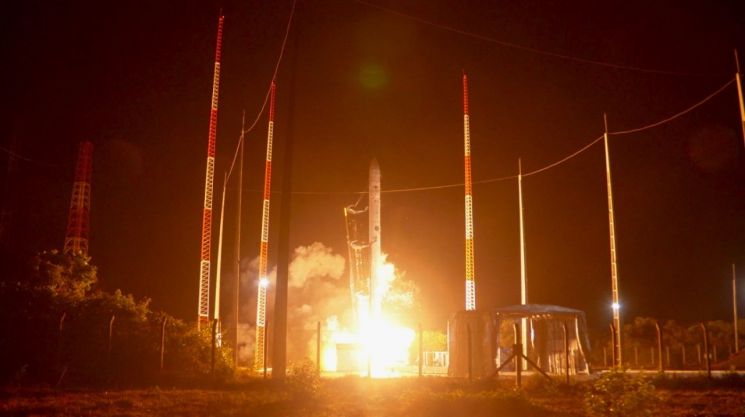 The 'Hanbit-Nano' launch vehicle that took off on the 23rd (Korean time) from the Alcantara Space Center in Brazil. Provided by Innospace
Innospace stated on the 29th that the launch mission carried out on the 23rd from the Alcantara Space Center in Brazil was terminated due to signs of an anomaly in the vehicle during flight. The launch vehicle began its ascent normally immediately after liftoff, but about 30 seconds into the flight, a situation suggesting possible damage to the vehicle was detected.
The two-stage small launch vehicle Hanbit-Nano successfully lifted off at 10:13 a.m. KST on the 23rd, powered by a 25-ton-class hybrid rocket engine that stably passed through the initial phase. This marks the world's first flight of a medium-to-large hybrid rocket engine.
However, as the vehicle passed through a cloud layer during ascent, communication between the vehicle and the ground was lost, and subsequent evidence indicated that the vehicle suffered damage from an unknown cause. The launch vehicle separated into several parts, showed signs of first-stage engine thrust termination, and entered free fall after losing thrust and attitude control.
After confirming that the instantaneous impact point (IIP) was within the safety zone of the launch site, Innospace activated the flight termination system (FTS) according to pre-agreed procedures, thereby ending the mission. No casualties or additional ground facility damage occurred during this process.
Secured Flight Data: The Technological Foundation for a Retry
The video, flight measurement, and tracking data collected so far cover the vehicle's liftoff and initial flight phase. The company regards this data as a core technological asset for identifying the cause and enhancing launch reliability.
The final cause of the launch failure will be determined through the official investigation process led by the Center for Investigation and Prevention of Aeronautical Accidents (CENIPA) under the Brazilian Air Force. Innospace and the Brazilian Air Force are currently conducting a joint preliminary technical analysis.
The customer satellite and payload carried on this mission will be compensated for losses through the customer's own insurance. The company believes there will be no significant impact on the structure of its commercial launch service contracts or its mid- to long-term business plans. Some launch vehicle debris has been recovered and will be used for future cause analysis and technical improvements.
Innospace is reviewing a plan to attempt another Hanbit-Nano launch at the Alcantara Space Center next year, based on the secured launch slot. The specific schedule will be finalized according to the results of CENIPA's official investigation and the completion of subsequent measures.
Kim Sujong, CEO of Innospace, said, "The first commercial launch is the highest hurdle, as it must prove not only technological completeness but also a reproducible system of reliability and safety. We will do our utmost to enhance technological completeness and the probability of launch success based on the flight data we have secured."
© The Asia Business Daily(www.asiae.co.kr). All rights reserved.

















