Signed 103.3 Billion Won Contract with KARI
Development of Attitude Control Thrusters and Landing Engine
Hanwha Aerospace, in collaboration with the Korea Aerospace Research Institute (KARI), will develop the propulsion system for the lunar lander scheduled to launch in 2032 using domestic technology. Leveraging over 30 years of experience in the development of spacecraft propulsion systems, the company aims to contribute to South Korea's independent lunar exploration capabilities.
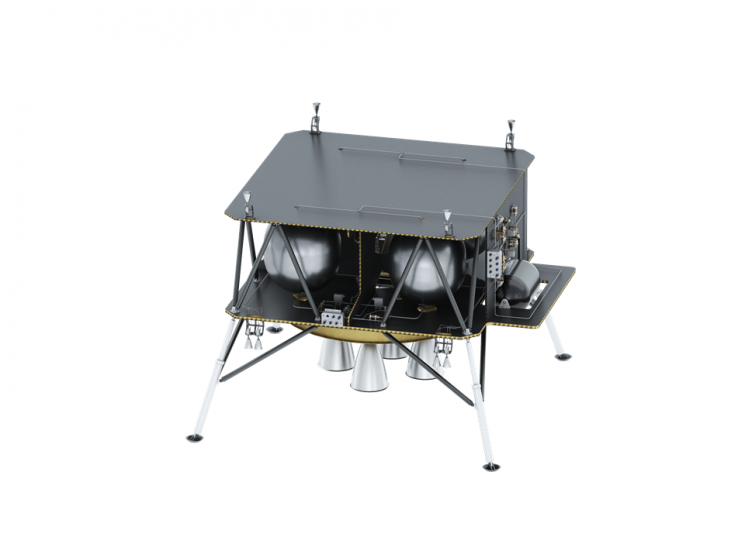 'Graphic of the Lunar Lander Propulsion System' developed jointly by Hanwha Aerospace and the Korea Aerospace Research Institute. Hanwha Aerospace
On the 29th, Hanwha Aerospace announced that it had signed a contract worth 103.3 billion won with KARI for the "Development, Assembly, and Testing of Lunar Lander Propulsion System Components."
This project is part of the government's lunar exploration program. KARI will handle the design of the lunar lander propulsion system, while Hanwha Aerospace will be responsible for the manufacturing and testing of the landing engine and attitude control thrusters to be mounted on the lunar lander by 2032, as well as the overall assembly and testing of the propulsion system.
For a soft landing on the Moon, advanced thrust control technology and the ability to safely handle and manage propellants are essential. Hanwha Aerospace is the only domestic company equipped with both the technology and infrastructure to develop a bipropellant propulsion system based on monomethylhydrazine and nitrogen tetroxide (MMH·NTO), which meets these requirements.
Since developing the propulsion system for the multipurpose practical satellite (Arirang-1) in 1994, Hanwha Aerospace has spent 32 years developing spacecraft propulsion systems for next-generation medium-sized satellites, the geostationary public communication satellite (Cheollian-3), and the lunar orbiter "Danuri," among others.
If the development of the lunar lander propulsion system succeeds, the technology and infrastructure can be applied to future national space exploration projects, including medium- and large-scale lunar probes, Mars orbiters, and Mars landers.
A Hanwha Aerospace representative stated, "Based on industry-academia collaboration, we will actively participate in government space programs to help secure South Korea's independent space development capabilities and further vitalize the space industry ecosystem."
© The Asia Business Daily(www.asiae.co.kr). All rights reserved.
![Clutching a Stolen Dior Bag, Saying "I Hate Being Poor but Real"... The Grotesque Con of a "Human Knockoff" [Slate]](https://cwcontent.asiae.co.kr/asiaresize/183/2026021902243444107_1771435474.jpg)
















