Interview with Guro District Mayor Jang Inhong
Full-scale Implementation of the Guro-type Basic Society... Strengthening the Welfare Network
"No More Saying 'There's No Other Choice'"
Conflict-Resolving Administration
Jang Inhong, Mayor of Guro District in Seoul, will complete nine months in office this weekend. He became a first-term district mayor after winning the by-election for local government heads held on April 2 of this year, securing 56.03% of the vote.
He was born in Guro and graduated from elementary, middle, and high school in this area. Except for the period when he served in the military as a KATUSA (Korean Augmentation to the United States Army), he has lived in Guro for 60 years.
He has run in six elections in Guro. He lost three consecutive times starting in 2002, and has won three times since 2014. Naturally, he is well-versed in local affairs. Having served as a member of the Seoul Metropolitan Council for eight years, he is also familiar with long-standing local issues.
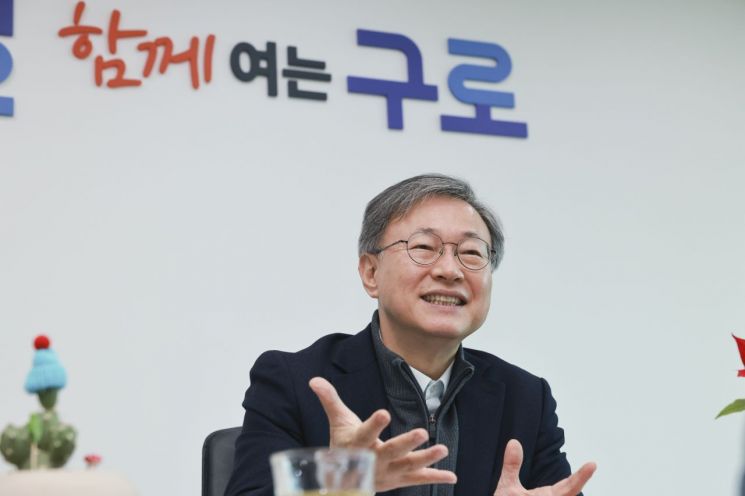 Jang Inhong, Mayor of Guro District, explained the 'Guro-type Basic Society' in an interview with The Asia Business Daily on the 22nd. Provided by Guro District Office.
His dedication to creating the "Guro-type Basic Society" and his focus on supporting small and medium-sized business owners stem from his deep understanding of the district's unique characteristics.
Mayor Jang stated, "A basic society is one where our community takes responsibility for ensuring a humane life," adding, "This year, we established a system to build a basic society tailored to Guro's characteristics, and next year will be the time for full-scale implementation."
Mayor Jang explained, "Ahead of the full implementation of the Integrated Care Act next year, we established a dedicated department," and "We amended ordinances to reorganize the organization and formed a Basic Society Task Force led by the Deputy Mayor, so that the public and private sectors can work together." The following is a Q&A.
-The local elections are just around the corner. Among the 25 district mayors in Seoul, you have the shortest term.
▲I have spent the past nine months since taking office without a moment to spare. (The previous mayor, Moon Heonil, a member of the People Power Party, resigned voluntarily last October after refusing to place about 17 billion won worth of stocks in a blind trust - Editor's note.) After taking office, I found that there was a six-month vacancy without a mayor, and unresolved issues had piled up like a mountain even before that.
-Was there really that much to do?
▲Guro District achieved results in "communicative administration" by resolving four out of five major issues that had persisted for years within eight months. When I took office, collective civil complaints were at their peak. When Egis Asset Management, the owner of D-Cube City, pushed for a full conversion to office space after Hyundai Department Store withdrew, residents protested for nearly a year.
Instead of handling the matter unilaterally, Guro District took on the role of mediator between residents and business owners. The district provided administrative support to ensure the negotiation process proceeded step by step, and an agreement was reached through negotiations between the residents' representatives and Egis.
For the hydrogen fuel cell power plant in Cheonwang-dong, the project was scrapped with a strong commitment to prioritizing residents' concerns. The conflict over the Gocheok Neighborhood Park's artificial turf multi-purpose field was resolved through a compromise. The underground parking lot at Guro Street Park was put on hold out of respect for residents' concerns. Although the proposal was submitted to the Seoul Metropolitan Council, it was not approved, and given the high level of concern about damage to the park, a cautious approach is being maintained.
-Why couldn't these issues be resolved before?
▲The will of the mayor is crucial. The actions and decisions of the mayor set the standard for public officials. If you only focus on administrative limitations and say there is "no other choice," nothing will get done.
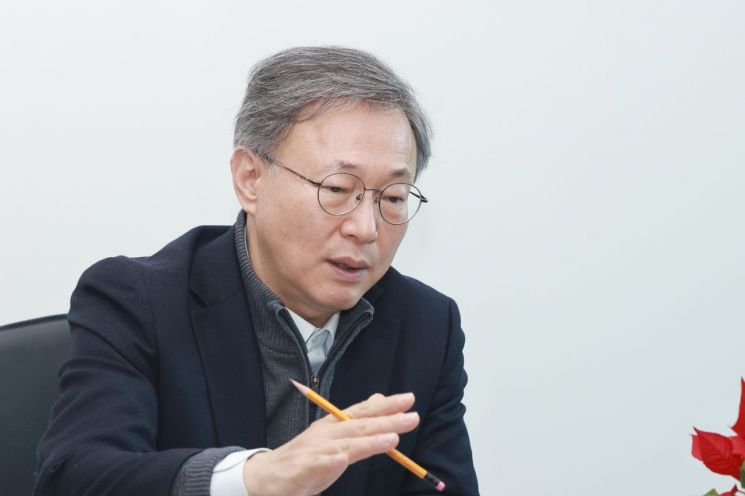 Jang Inhong, Mayor of Guro District, announced that he has resolved a long-standing and contentious issue over the past nine months. Provided by Guro District Office.
-You emphasize the Guro-type Basic Society. How is it different from the existing system?
▲The core of a basic society is a community that takes responsibility for ensuring a humane life. To achieve this, it's not just about expanding welfare programs, but about restructuring the entire administrative approach.
Previously, housing, income, care, health, and education were handled separately by different departments. However, the Guro-type Basic Society looks at these aspects from the perspective of each resident and connects them. For example, when visiting a senior citizen living alone, we don't just check their health status; we also look at their emotional well-being, living environment, and income issues together. That's why, starting next year, we have created a system where social workers, counselors, and doctors visit as a team.
-Isn't this a bit idealistic?
▲The vision for Guro is to become a city with a support system that prevents lives from falling apart all at once when people get sick, lose their income, need care, or face housing instability. The welfare network must be tightly woven so there are no gaps. That is also the purpose of the Integrated Care Act. Building a system that utilizes artificial intelligence (AI) is also necessary for this reason. Of course, it can't all be done overnight. Guro can't do it alone, either.
If the results of next year's local elections strengthen the connection between metropolitan and basic local governments, it will gain further momentum. For now, we are steadily implementing what can be done within Guro District itself.
-Your situation is different from other district mayors who are in their fourth or eighth year of office. What policies will you focus on in the new year?
▲Next year, we will issue the Guro Love Gift Certificate at a scale of 20 billion won. Since the local economy is still struggling, we must actively support small and medium-sized business owners.
There are many areas in Hang-dong and Cheonwang-dong that lack route buses or village buses. We are preparing to introduce public buses to connect these areas to the district office and other public institutions.
We will also strengthen neutral support to reduce conflicts and facilitate redevelopment and reconstruction, and next year, we plan to expand the highly requested maintenance project academy into a regular curriculum. Instead of blaming the lack of time, I will do my utmost to fulfill the role entrusted to me by the residents.
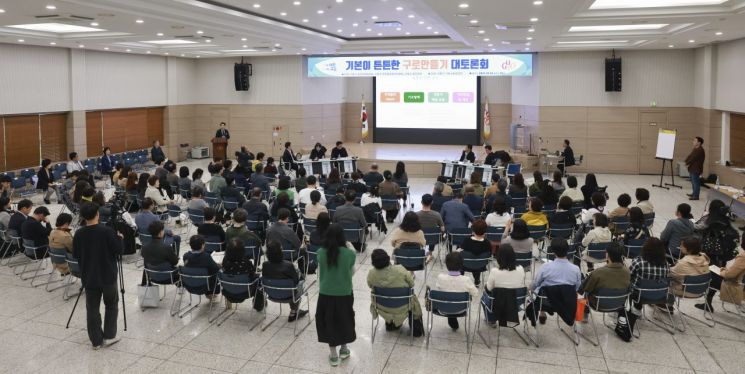 Guro District held a large forum last October to explore the direction of the "Guro-type Basic Society." Six expert panelists and 100 citizen panelists attended the forum. Provided by Guro District.
© The Asia Business Daily(www.asiae.co.kr). All rights reserved.



















