SKT Elite Team to Unveil Proprietary AI Model at First Presentation on December 30
519 Billion Parameters, 33 Billion Activated During Inference
Trained at Ultra-Large Scale, Operates Efficiently When Needed
Collaboration with Major Affiliates Including SK Hynix, Joined by AI Academia and Industry
The SK Telecom consortium, selected as Korea's national elite artificial intelligence (AI) team, will unveil the country's first ultra-large AI model with 500 billion parameters.
SK Telecom announced that it will unveil Korea's first ultra-large AI model with 500 billion parameters, "A.X K1 (A.Dot X K1)", at the "Independent AI Foundation Model Project 1st Presentation" hosted by the Ministry of Science and ICT on December 30.
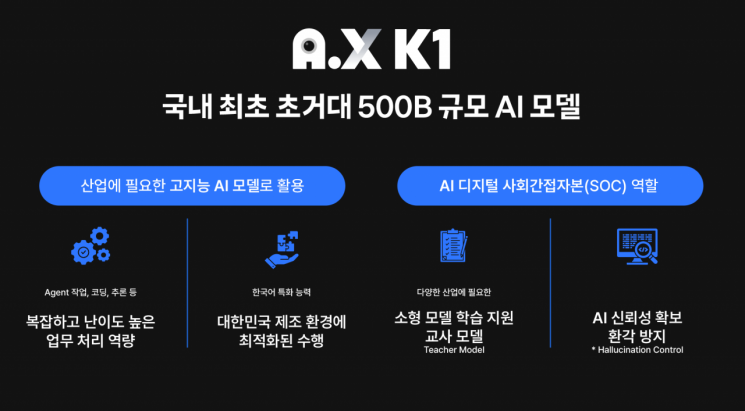 SK Telecom announced that it will unveil Korea's first ultra-large AI model with 500 billion parameters, 'A.X K1 (A.Dot X K1)', at the 'Independent AI Foundation Model Project 1st Presentation' hosted by the Ministry of Science and ICT on the 30th. Provided by SK Telecom
The A.X K1 to be introduced on this day consists of a total of 519 billion parameters, and about 33 billion parameters are activated during inference tasks upon user request. The model is designed to be trained at an ultra-large scale but can operate with lighter specifications when needed. According to SK Telecom, global cases have shown that ultra-large models of 500 billion parameters or more are stable in capabilities such as complex mathematical reasoning and multilingual understanding.
Based on this, the model’s scalability is greatly enhanced, enabling advanced functions such as high-level coding and agent tasks. Agent tasks refer to the AI model’s ability to autonomously determine and execute tasks. This means the AI can take actions such as sending emails or creating documents on its own, even without explicit user instructions.
Furthermore, from the ultra-large model stage, A.X K1 can serve as a "teacher model" that supplies knowledge to models with 70 billion parameters or less, playing the role of digital social overhead capital (SOC) in the AI ecosystem. The SK Telecom elite team plans to expand research so that A.X K1 can transfer its knowledge to various small and specialized models.
Another feature is the model’s enhanced Korean language comprehension. A.X K1 was designed from the outset to be trained in Korean, enabling it to naturally understand Korean input. Thanks to this Korean language specialization, it is well-suited for developing services tailored to Korea.
SK Telecom will also enhance public accessibility to AI, making it available to everyone. By providing A.X K1 through the AI service "A.Dot," which has more than 10 million subscribers, users will be able to access AI via phone, text, web, app, and other channels. Liner, another member of the elite team, operates specialized knowledge search services for over 11 million global subscribers, enabling highly accurate and reliable information retrieval services.
In terms of strengthening industrial competitiveness through the AI transformation, SK Telecom plans to expand the application fields to include: A.Biz, an enterprise solution for improving work productivity; manufacturing AI solutions for optimizing production processes; real-time character conversations and autonomous behaviors in games developed by Krafton; and humanoid robot technology.
A.X K1 is also expected to serve as a testbed for Korea's semiconductor industry. Given that performance verification in AI semiconductor development requires enormous data volumes and high data transmission speeds, ultra-large language models (LLMs) like A.X K1 can be efficiently utilized for state-of-the-art AI semiconductor performance testing.
The SK Telecom elite team consists of eight organizations, including SK Telecom, Krafton, 42dot, Rebellion, Liner, SelectStar, Seoul National University, and the Korea Advanced Institute of Science and Technology (KAIST). Through this collaboration, they have built the entire value chain-from semiconductors and data centers to models and services-with independent technology, forming a "full-stack sovereign AI."
Within the elite team, Liner is responsible for accuracy through specialized knowledge information retrieval technology, SelectStar ensures reliability with large-scale data construction and validation technology, Krafton contributes scalability with global multimodal research and development experience, 42dot provides versatility with on-device AI technology, and Rebellion is in charge of efficiency with domestically developed neural processing unit (NPU) technology.
SK Group affiliates are also participating in the model’s utilization and verification. Major affiliates such as SK Hynix, SK Innovation, SK AX, SK Broadband, as well as the Chey Institute for Advanced Studies and the Korea Foundation for Advanced Studies, are among more than 20 organizations that have submitted letters of intent to participate.
The SK Telecom elite team plans to open source A.X K1 to a wide range of companies in Korea’s AI ecosystem. The team will release the open source and application programming interface (API) through major development communities and SK Telecom services, providing an environment for Korean companies to develop AI agents.
Additionally, the team aims to strengthen the competitiveness of Korea’s AI ecosystem by building an integrated support system for AI model development and releasing some of the training data to public and private platforms.
Kim Taeyoon, Head of Foundation Models at SK Telecom, stated, "With the development of Korea's first 500 billion-parameter model, we have established a new turning point for Korea to become one of the global top three in AI amid fierce international competition." He added, "As the national AI leader, we will continue our efforts to achieve AI for everyone."
© The Asia Business Daily(www.asiae.co.kr). All rights reserved.
![Clutching a Stolen Dior Bag, Saying "I Hate Being Poor but Real"... The Grotesque Con of a "Human Knockoff" [Slate]](https://cwcontent.asiae.co.kr/asiaresize/183/2026021902243444107_1771435474.jpg)
















