Surge in Personal Rehabilitation Applications Amid Prolonged Economic Downturn
Delinquency Rate Among Vulnerable Self-Employed Surpasses 11%
As the economic downturn continues for an extended period, there has been a sharp increase in the number of people turning to the courts because they can no longer manage their debts. This year, the number of personal rehabilitation applications has reached the highest level since statistics began to be collected.
According to the courts on December 27, the number of personal rehabilitation applications filed with courts nationwide from January to November this year totaled 136,681. This has already surpassed last year's annual total of 129,499 applications, marking the highest level since 2015. From 2020 to 2022, the annual number of personal rehabilitation applications hovered around 80,000, but in 2023, it surged to over 120,000.
The number of approved personal rehabilitation cases is also rising rapidly. From January to November this year, courts approved 105,399 personal rehabilitation cases, which is also the highest figure since statistics have been compiled. The scale of debt has also increased. In the first half of this year, the average debt amount for personal rehabilitation applicants was 158.88 million won, up about 9% from last year’s average.
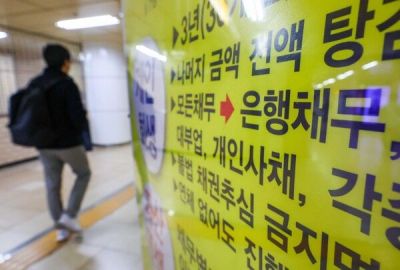 This year, the number of personal rehabilitation applications has reached the highest level since statistics began to be collected. Yonhap News
Programs such as fast-track debt adjustment and personal workout only apply to loans from affiliated financial institutions. However, personal rehabilitation covers debts from non-financial sectors, including private loans. Therefore, the increase in personal rehabilitation applications suggests not only a rise in overall debt, but also an increase in borrowers facing situations that cannot be resolved through existing debt adjustment programs.
In fact, since the COVID-19 pandemic, self-employed individuals who relied on loans due to a sharp drop in sales, as well as vulnerable groups who experienced job loss or reduced income, have been falling into bad credit status in succession. Once credit deteriorates, normal economic activity becomes difficult due to measures such as account seizures, making it hard to find new employment or recover income, which leads to a vicious cycle.
This is also evident in counseling cases handled by the Korea Inclusive Finance Agency. For example, Ms. A, a woman in her 50s living in Seongnam, Gyeonggi Province, saw her debts balloon to 80 million won after closing the five mobile phone stores she operated due to the impact of the COVID-19 pandemic. Although she eventually found a job, her bank account was seized, preventing her from receiving her salary properly.
The situation for self-employed individuals remains unstable. According to the Bank of Korea, as of the end of September this year, the outstanding loans to self-employed people amounted to 1,072.2 trillion won. The overall delinquency rate stands at 1.76%, which is slightly lower than at the beginning of the year but still above the long-term average.
In particular, the risk of default is severe among vulnerable self-employed individuals, who have borrowed from multiple financial institutions and are classified as having low income or poor credit. The delinquency rate among these vulnerable self-employed people, who account for about 10% of all self-employed individuals, is 11.09%, which is more than 20 times higher than the 0.5% delinquency rate among self-employed individuals with relatively strong repayment capacity.
Experts predict that “if the economic recovery is delayed and high interest rates persist, the demand for personal rehabilitation is unlikely to decrease any time soon.”
© The Asia Business Daily(www.asiae.co.kr). All rights reserved.

















