Even Self-Driving Cars Stop If Doors Aren't Closed
Human Assistance Needed via Ride-Hailing Apps
Robotaxis, which operate using autonomous driving technology, have created a new type of job: closing car doors.
On December 25 (local time), The Washington Post (WP) reported in an article titled "When the Robotaxi Stops, a Secret Human Army Comes to the Rescue" that demand is increasing for people who resolve issues when robotaxis encounter problems. The article introduced the case of Don Adkins, who assisted a Google Waymo robotaxi that was stopped on a street in Los Angeles (LA).
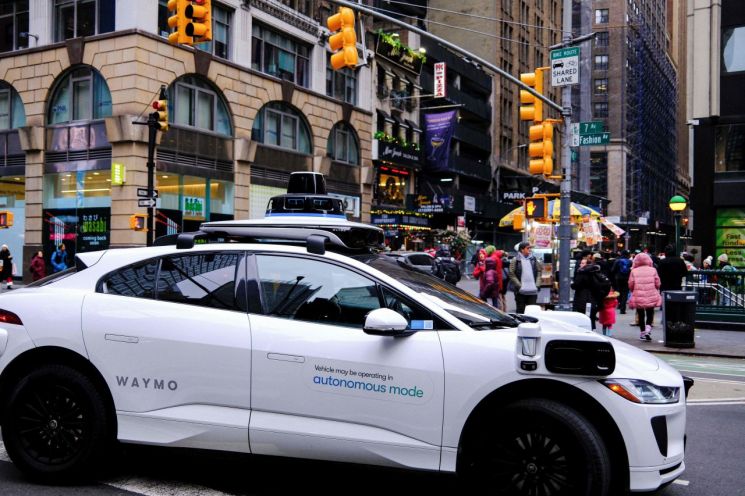 A Waymo autonomous Jaguar electric vehicle operating in Manhattan, New York City, USA. Photo by AFP Yonhap News
One night this month, Adkins was walking along Sunset Strip in LA when he heard a voice calling for help. Following the sound, he discovered a Waymo Jaguar vehicle, operating as an unmanned taxi, with its turn signal on and repeatedly saying, "Please close the right rear door." He initially ignored it and walked past, but after hearing a car honking behind the Waymo vehicle, he stepped onto the road and pushed the rear door shut.
WP explained that Adkins had witnessed the "Achilles' heel" of Waymo's robotaxis, which transport thousands of passengers every week in cities such as LA and San Francisco. These vehicles can drive on city streets and compete with human taxi drivers without a driver, but if someone does not close the rear door after a ride, the vehicle becomes stranded. There are frequent cases where robotaxi passengers do not properly close the door when exiting, or seat belts get caught in the door, preventing it from closing completely. In such situations, the robotaxi stops and cannot continue operating without human assistance.
According to WP, Waymo pays more than $20 in LA through an app called "Honk" to people who close improperly shut doors or assist robotaxis in trouble. Honk is a ride-hailing app similar to Uber, but for the towing industry.
Cesar Marenco, who runs a towing company in Inglewood, LA, regularly takes on the job of closing Waymo's doors. In a recent TikTok video, he showed himself approaching a Waymo vehicle with a rear door that could not close properly due to a seat belt being stuck, and shutting the door. The video went viral, surpassing 400,000 views. Marenco told WP that he handles up to three cases per week related to Waymo robotaxis, such as closing open doors or towing vehicles that have lost power because they failed to reach a charging station in time.
Another LA towing company operator, Evangelica Cuevas, said she earns about $22 to $24 (around 30,000 won) for closing a Waymo vehicle's door, and $60 to $80 (about 90,000 to 120,000 won) for towing work. However, Cuevas added that when considering fuel and labor costs required for vehicle retrieval, these fees are not always profitable.
WP interpreted the work of closing and towing Waymo robotaxis as an example of how new human jobs can emerge to compensate for the shortcomings of automation as it advances. On the other hand, for companies operating robotaxi businesses, these cost issues remain a challenge to be addressed. Philip Koopman, a professor of engineering at Carnegie Mellon University who has studied autonomous vehicles for nearly 30 years, pointed out that paying people to close doors and retrieve broken-down vehicles is "an expensive task" for Waymo. He emphasized that the company will need to minimize such costs as it scales up and competes with Uber and Lyft.
© The Asia Business Daily(www.asiae.co.kr). All rights reserved.

















