Nomination by Bar Association, Association of Law Professors, and Association of Law Schools
Aiming for Passage During December Extraordinary Session
Democratic Party Prepared for Unilateral Passage if No Agreement with Opposition
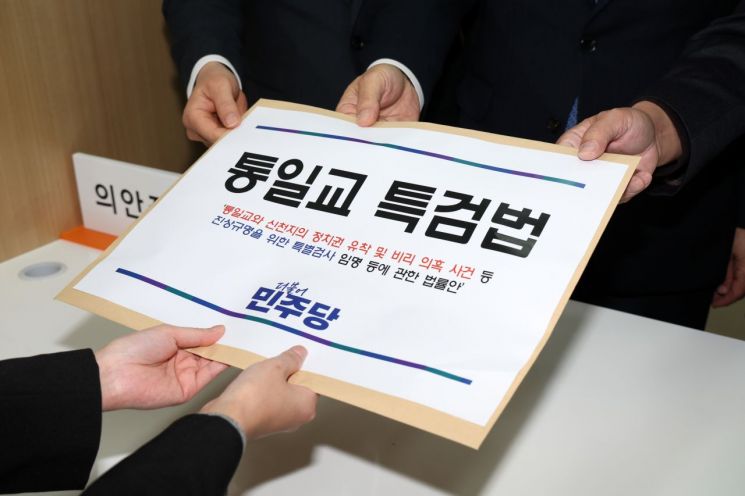
On December 26, the Democratic Party of Korea submitted a bill for a special prosecutor act concerning suspicions of political intervention by the Unification Church and Shincheonji. The party adopted the so-called third-party nomination system, granting the right to recommend special prosecutor candidates to the Korean Bar Association, the Korean Association of Law Professors, and the Association of Law Schools.
Moon Jinseok, Senior Deputy Floor Leader of the Democratic Party, Lee Yongwoo, Chair of the Democratic Party's Legal Committee, and Kim Hyunjung, Senior Spokesperson for the party's parliamentary group, submitted the special prosecutor bill to the National Assembly, with Kim Byungki, the party's Floor Leader, as the chief sponsor. The scope of the special prosecutor's investigation includes not only suspicions related to the Unification Church but also allegations of political intervention by Shincheonji. Moon explained that Shincheonji was included in the investigation because "excluding Shincheonji from the probe into collusion between religion and politics could result in an incomplete investigation." Regarding the exclusion of the Kim Keonhee special prosecutor and others from the investigation, he added, "We did not consider it a criminal matter, as it falls within the special prosecutor's discretion."
In addition to the special prosecutor and assistant prosecutors, the bill stipulates that up to 30 prosecutors and up to 60 government officials may be seconded to the team. The investigation period is set at 90 days, with a possible 30-day extension at the special prosecutor's discretion, and an additional 30-day extension if approved by the President. An extra 20 days is allotted for preparations for the special prosecutor's office and related matters.
The nomination method for the special prosecutor, as argued by the People Power Party and others, was changed from recommendations by the Cho Kuk Innovation Party and the Reform New Party to a third-party nomination system. Moon explained, "Lee Junseok, leader of the Reform New Party, was the leader of the People Power Party during the 2020 presidential election," adding, "It was deemed inappropriate for someone in that position to recommend a special prosecutor."
Instead, to avoid any misunderstandings regarding potential affiliations with the Democratic Party, one candidate each will be recommended by the Bar Association, the Association of Law Professors, and the Association of Law Schools, and the President will appoint one of the three as special prosecutor.
The party set a firm deadline for passage before January 8 of next year. Moon stated, "We will process the bill during the December extraordinary session, which ends on January 8." Regarding negotiations with opposition parties, he said, "Reaching an agreement with the opposition is the best approach, but if no agreement is reached, the Democratic Party is prepared to push it through alone," leaving open the possibility of unilateral passage. He also mentioned that the timing of the bill's passage would depend on the situation in the Legislation and Judiciary Committee, which will review the special prosecutor bill, and anticipated it would be early next year.
© The Asia Business Daily(www.asiae.co.kr). All rights reserved.

















