Official Communication Body Launched Two Years Ahead of Legal Schedule
Small Business Owners, Civil Society, Corporations, and Experts Gather
Actionable Mutual Growth Strategies Discussed Based on Commercial District Impact Assessment
An official communication body has been launched to discuss ways to achieve mutual growth between the local commercial districts and the planned complex shopping mall in Gwangju. The Gwangju City Government established the win-win council nearly two years ahead of the legal schedule, initiating full-scale discussions involving small business owners, civil society, and large corporations.
On December 26, the city held the inaugural meeting of the "Gwangju Complex Shopping Mall Win-Win Development Council" in the city hall's medium conference room, beginning efforts to assess the impact of the complex shopping mall on local commercial districts and to develop strategies for mutual growth.
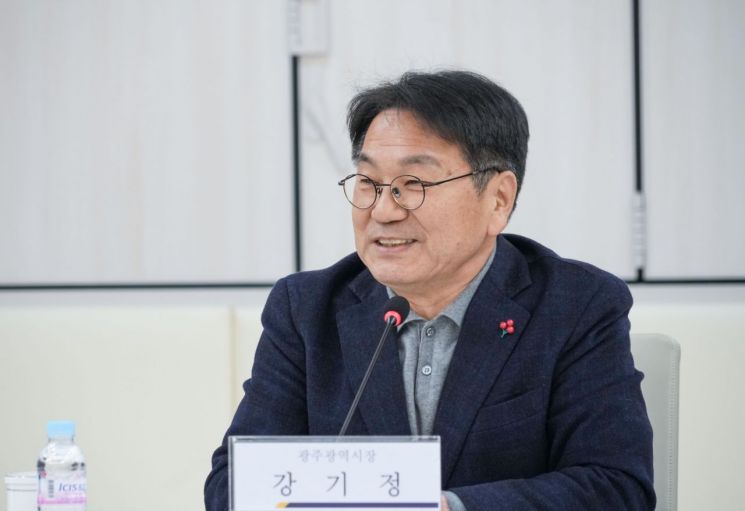 Kang Gijeong, Mayor of Gwangju Metropolitan City, is presiding over the kickoff meeting of the Complex Shopping Mall Win-Win Development Council held in the city hall's medium conference room on the morning of the 26th. Provided by Gwangju City
The Win-Win Development Council is Gwangju City's official communication platform, established to go beyond formal opinion gathering and to develop actionable plans for mutual growth regarding the construction of the complex shopping mall. Notably, the council was formed proactively about two years earlier than the legal requirement under the Distribution Industry Development Act, which only mandates operation 60 days prior to business commencement.
From the early stages of the complex shopping mall project, Gwangju City has made "mutual growth" a core principle, holding multiple meetings with small business owners and related organizations to gather on-the-ground opinions. The council was established to use the final report from the commercial district impact assessment, completed on December 15, as a starting point for more realistic and concrete discussions on mutual growth strategies.
The council includes representatives from Gwangju City and its five districts, as well as associations of small business owners and merchants, large corporations, consumer groups, civil society organizations, youth groups, and experts. It is structured to broadly reflect the perspectives of various social stakeholders, not just direct stakeholders in the complex shopping mall.
At the first meeting, participants received a report on the council's structure and operational direction, listened to the results of the commercial district impact assessment, and discussed strategies for revitalizing local commercial districts and supporting small business owners. Attendees agreed that rather than rushing to a conclusion, it is important to have thorough discussions and reviews to develop mutually beneficial solutions that can be effectively implemented in the field.
Gwangju City plans to operate the Win-Win Development Council on a regular basis and to convene working-level meetings as needed to address emerging issues in detail. The city will gradually discuss tasks such as converting purchase points to local currency, expanding sales channels for small businesses, and creating a mutual growth fund to revitalize local commercial districts. Administrative and institutional support will be provided to ensure that the outcomes of the council's discussions are reflected in policies and projects.
Mayor Kang Gijeong stated, "The construction of the complex shopping mall is a strategic choice to inject vitality into the local commercial districts and the city as a whole, which have been stagnating due to the spread of online consumption and weakened consumer sentiment. It is also intended to expand Gwangju's 'consumption base.' The Win-Win Development Council, launched today, is a key infrastructure for building 'Gwangju, the city where people want to stay,' and a platform for realizing mutual growth."
Mayor Kang further emphasized, "The impact of attracting a complex shopping mall and large department stores on local commercial districts cannot be simply categorized as positive or negative. National cases show that such developments have sometimes contributed to revitalization, while in other cases, certain sectors have faced difficulties. Therefore, I urge everyone to work together to devise solutions that enable local businesses, citizens, and companies to achieve mutual growth."
© The Asia Business Daily(www.asiae.co.kr). All rights reserved.
![Clutching a Stolen Dior Bag, Saying "I Hate Being Poor but Real"... The Grotesque Con of a "Human Knockoff" [Slate]](https://cwcontent.asiae.co.kr/asiaresize/183/2026021902243444107_1771435474.jpg)
















