Spread of Hangover Remedy Culture
Consumed as a "Relationship Item" for Both Self-Care and Consideration at Social Gatherings
Accessibility and Perceived Effectiveness Emerging as Key Competitive Factors in the Market
As concerns about hangovers grow, a drinking culture is spreading in which people either avoid excessive drinking altogether or use hangover remedies depending on the situation. In particular, among younger generations, hangover remedies are being consumed not only as a means of managing one’s condition, but also as “relationship items” that take into account the atmosphere of social gatherings.
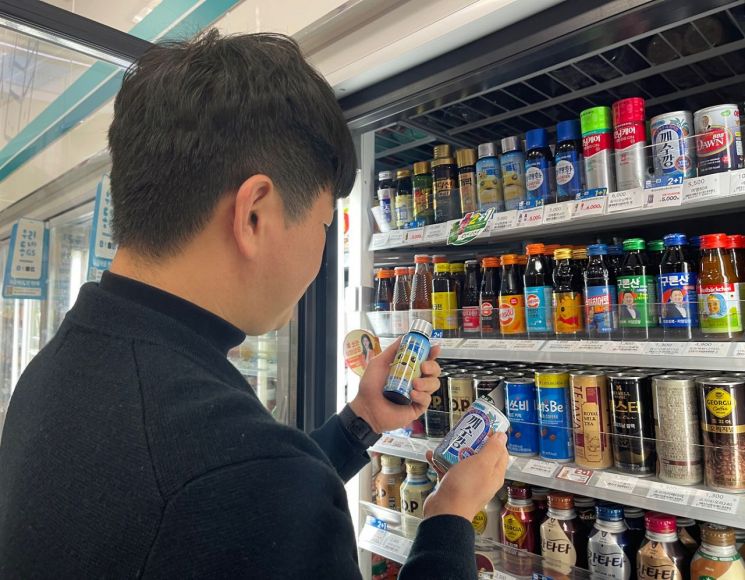
According to the “2025 Hangover Remedy Survey” conducted by market research firm Embrain Trend Monitor on December 27, targeting 1,000 men and women aged 19 to 59 who have experience drinking alcohol, 48.2% of respondents said they often experience hangovers after drinking. The proportion of those who said they do not prefer drinking because of hangovers also increased from 31.9% last year to 35.3% this year.
Among respondents, 69.1% said they do not like alcoholic beverages that cause severe hangovers. A clear majority also said they drink in a way that does not interfere with their daily life (68.4%) and only drink enough to avoid feeling a hangover (58.5%). This indicates a growing trend of adjusting alcohol consumption to enjoy social gatherings while still considering one’s condition the next day.
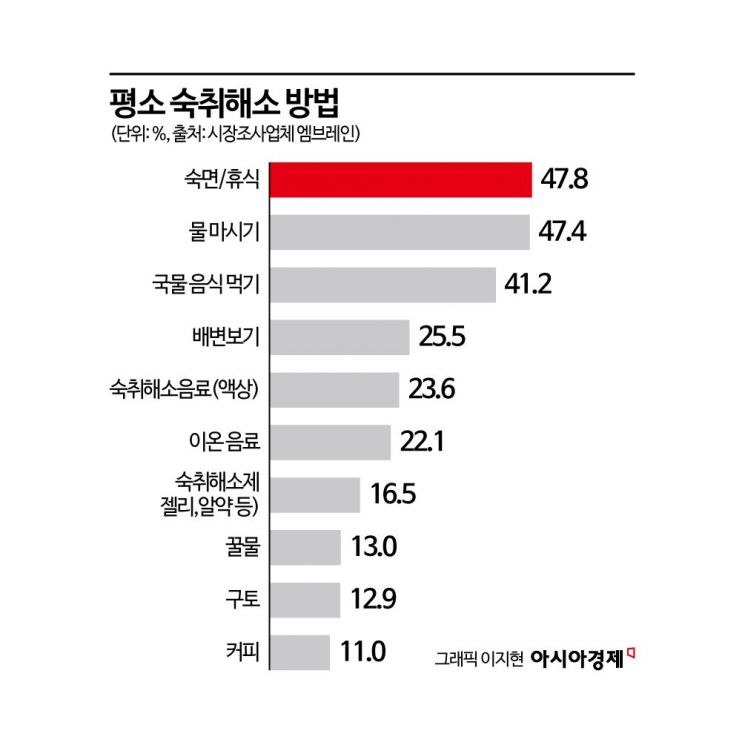
As for hangover remedies, the most common methods were getting enough sleep or rest (47.8%), drinking water (47.4%), and eating soup-based foods (41.2%). The most effective methods were also cited as sleep or rest (50.2%) and drinking water (37.4%). However, among people in their 20s and 30s, the use of products such as hangover relief drinks, jellies, and pills was more common, indicating that hangover remedies are naturally becoming part of the drinking culture for these generations.
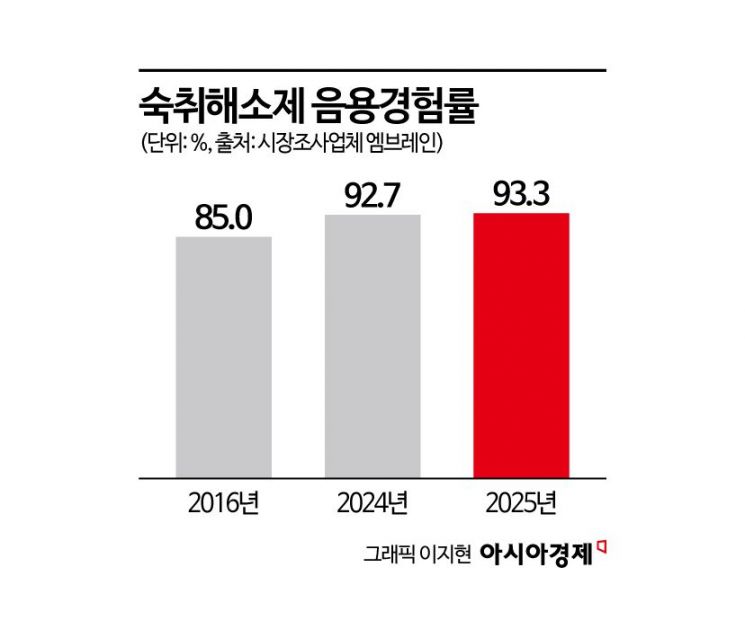
The rate of experience with hangover remedies reached 93.3%, indicating that these products have become mainstream. However, only 37.0% of respondents said they take them in advance before drinking, and just 18.3% keep them on hand. Instead, there was a strong tendency to use them only in “risk-anticipated moments” such as when heavy drinking is unavoidable at company gatherings (54.0%), when experiencing a severe hangover (48.3%), or when there is an important event the next day (48.0%). Notably, among people in their 30s, hangover remedies were distinctly recognized as a tool for managing work-related risks. Compared to those in their 20s and 50s, people in their 30s were more likely to use hangover remedies as items that facilitate consideration and relationships.
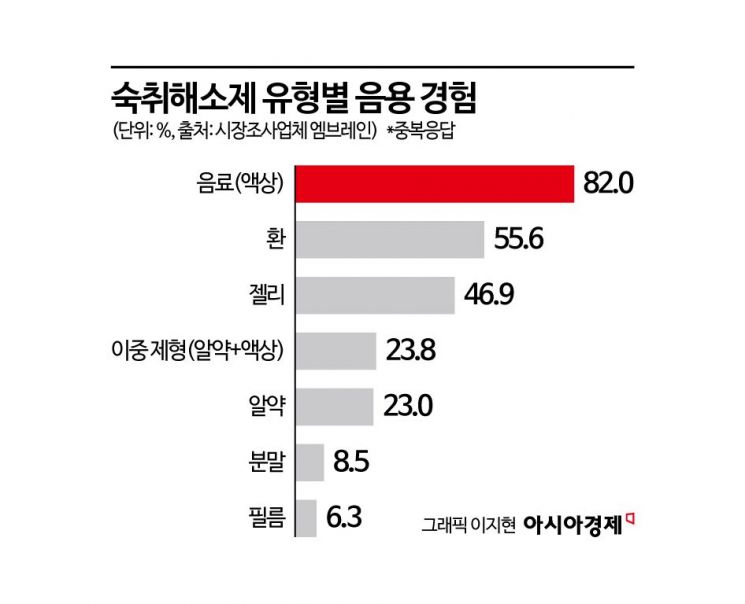
By product type, liquid drinks had the highest experience rate at 82.0%, followed by pill form (55.6%), and jelly or gel form (46.9%). Preference was also highest for liquid drinks (74.3%). Among people in their 20s and 30s, preference for jelly or gel forms was relatively high, suggesting that portability and taste influence their choices.
The most important factor when purchasing was the effectiveness of the hangover remedy (62.9%), followed by discount promotions (40.1%) and price (36.0%). In fact, convenience stores were the dominant purchase channel at 86.7%, indicating that accessibility is likely to become a key competitive factor in the hangover remedy market going forward.
When it comes to perceived effectiveness, both expectations and skepticism coexisted. 48.1% agreed that “taking a hangover remedy makes the next day less difficult,” and 46.7% believed it “helps them recover faster.” On the other hand, 45.4% said “the placebo effect seems stronger,” and 43.1% felt “the price is high relative to the effect.”
Nevertheless, about half of all respondents said they intend to use hangover remedies in the future, and 64.9% said they would purchase them regardless of price if the effects were fast. In particular, respondents in their 20s and 30s were more likely to say they would use hangover remedies every time they drink, suggesting that among younger generations, hangover remedies are increasingly being positioned as a “self-care” consumption item.
© The Asia Business Daily(www.asiae.co.kr). All rights reserved.



















