On December 26, Minister of Climate, Energy and Environment Kim Sung-hwan visited sites in the plastic waste collection and recycling industry to inspect the implementation status of the anti-plastic policy and to accelerate the transition to a circular economy.
The Ministry of Climate, Energy and Environment announced that on this day, Minister Kim visited plastic waste collection, sorting, and recycling companies in Hwaseong, Gyeonggi Province, to assess on-site conditions and listen to industry feedback. This visit was part of a field inspection aimed at enhancing the completeness of the "Comprehensive Anti-Plastic Policy," which is currently in its final drafting stage.
Previously, on December 23, the government released the comprehensive anti-plastic policy at a public forum held at the National Assembly. The policy includes a target to reduce waste plastic generated from households and businesses by more than 30% compared to projections by 2030. Specifically, the government plans to manage the annual waste plastic output at around 7 million tons by reducing 1 million tons at the source and expanding the use of recycled materials by 2 million tons by 2030. The final version of the policy will be confirmed early next year after stakeholder meetings and inter-ministerial consultations.
For his first schedule of the day, Minister Kim visited C&Tech Korea, a company that produces recycled materials by crushing and grinding plastics from waste electronics, to inspect the electronics recycling process. During the visit, he observed how plastics recovered from electronic products are converted into recycled materials such as flakes and pellets.
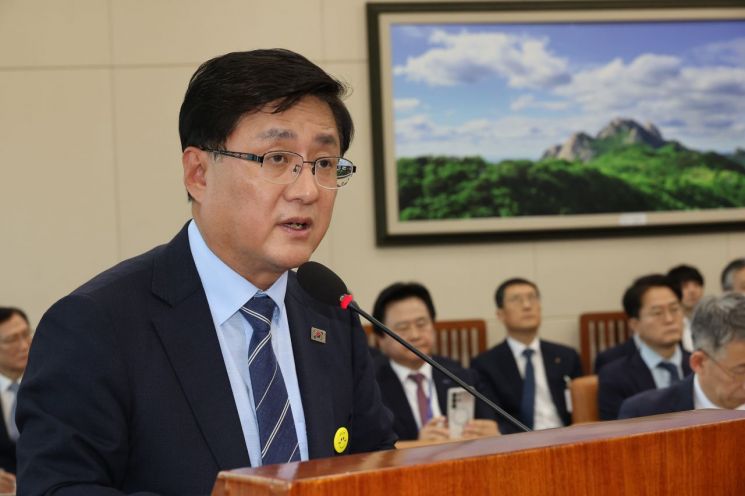 Minister of Climate, Energy and Environment Kim Sung-hwan Reporting on Work
(Seoul=Yonhap News) Photo by Park Dongju = Minister of Climate, Energy and Environment Kim Sung-hwan is reporting on work at the plenary meeting of the Climate, Energy, Environment and Labor Committee held at the National Assembly in Yeouido, Seoul on October 16, 2025. pdj6635@yna.co.kr (End)
Starting in January next year, the Ministry will expand the scope of the Extended Producer Responsibility (EPR) system for electronics from medium and large-sized products to include small electronic devices. Accordingly, the Ministry plans to strengthen policy support to ensure that collected plastics can be reused in electronic products.
Minister Kim then visited Gieun RS, a plastic sorting company, to check the process of classifying plastic waste from households and other sources by item and material. He inspected the sorting process using optical sorting equipment and discussed both plans for modernizing sorting facilities and the challenges faced on-site.
Finally, Minister Kim visited recycling companies such as RM, H2, and Superbin, which produce high-quality recycled materials from collected PET bottles. At these companies, he inspected the so-called "bottle-to-bottle" recycling process, where PET bottles are crushed and washed to create flakes and pellets.
In particular, as a mandatory recycled material usage ratio of 10% will be applied from next year to companies producing more than 5,000 tons of bottled water and beverage PET bottles annually, Minister Kim requested the cooperation of the recycling industry to ensure a stable supply of high-quality recycled materials.
Minister Kim stated, "The plastic issue is a contemporary challenge directly linked to responding to the climate crisis and is a core agenda for a sustainable future. We will work to accelerate the transition to a circular economy society where plastics are continuously recycled, so that the efforts of the industry can bear fruit as soon as possible."
© The Asia Business Daily(www.asiae.co.kr). All rights reserved.

















