NYT Exposes Abuses by U.S. Organizations
Recruiting Trainees Through J-1 Visas for Commission Profits
Violations of Working Hours and Industrial Accidents Rampant
Case of Korean University Student Highlighted...Currently in Litigation
State De
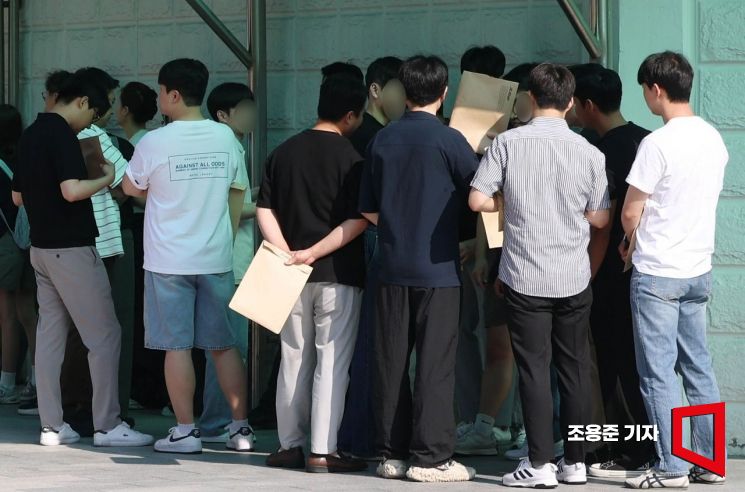 As the U.S. Department of State has resumed the visa issuance process for foreign students and trainees, which had been temporarily suspended, a long line of people waiting to receive visas is forming in front of the U.S. Embassy in Jongno-gu, Seoul on June 23, 2025. Photo by Jo Yongjun
There have been cases where the J-1 (non-immigrant exchange visitor) visa program, which is issued in the United States for the purpose of cultural exchange, has been exploited by unscrupulous organizations, effectively turning it into a form of modern-day slavery. Foundations in the United States recruit trainees using the J-1 visa as bait, collect fees in exchange for connecting them with companies in the U.S., engage in insurance sales, and turn a blind eye to issues of labor exploitation.
According to the New York Times (NYT) on the 25th (local time), more than 300,000 people enter the United States each year on J-1 visas. The J-1 visa is a non-immigrant visa issued for the purpose of cultural exchange and training, and is granted to interns, researchers, and others. The NYT explained that because the U.S. government has failed to properly regulate the J-1 visa program, there have been numerous cases of unfair profits and conflicts of interest.
The NYT covered the case of a Korean university student, identified as Kang, among the victims. Kang entered the United States in 2023 after seeing promotional materials for the J-1 visa that described it as a "once-in-a-lifetime opportunity." To obtain the J-1 visa, Kang paid a fee of about $5,000 (approximately 725,000 KRW) to an organization called "J-1 Visa Exchange."
The factory where Kang was assigned to work was a steel plant in Indiana. There, he received almost no training for his work and was forced to clean septic tanks. Although he expected to have an internship focused on cultural exchange and training, the reality was quite different. When Kang expressed his dissatisfaction to the company, he was fired. Kang is currently pursuing legal action in the United States. Throughout this process, the "sponsor" provided no assistance whatsoever.
Organizations like "J-1 Visa Exchange" typically recruit university students or trainees in Korea through job fairs and similar events. They act as intermediaries, connecting J-1 visa students and trainees with companies in the United States, and are referred to as "sponsors." Many sponsors operate as for-profit or non-profit foundations.
One prominent example is the World International Student Exchange (WISE), established in 1990. WISE recruited 3,300 J-1 visa workers annually up to 2023. The fee income earned through this process amounted to $4.9 million (about 7.1 billion KRW).
Foreign students recruited by the WISE Foundation in 2012 also suffered harm after entering the United States. They were sent to a seafood processing plant in Alaska, where they endured grueling labor for up to 19 hours a day. These students reported the foundation to the Department of State, which oversees the J-1 visa program.
In 2019, other foreign students were sent to a pig farm in Nebraska, where they worked 12-hour shifts each day. One trainee pointed out, "There were issues with working hours, and even if we were injured on the job, we couldn't go to the hospital." Those who reported these issues to the Department of State said they were threatened with deportation if they protested, saying, "It felt like slavery."
In 2024, there was a serious industrial accident. A German student suffered a severe disability after a truck tire exploded while working on a farm in Oklahoma, resulting in a depressed skull fracture.
While such incidents continued to occur, foundation operators enriched themselves with fee income collected from J-1 visa holders and companies. David Dahl, who founded the WISE Foundation, received $520,000 (about 750 million KRW) in a single year and moved into a mansion of more than 200 pyeong (approximately 7,000 square feet). According to the NYT's investigation, the foundation's board consisted of the founder's wife, parents, and other relatives.
The American Institute For Foreign Study not only collected fees but also maximized profits by selling insurance. After establishing a separate company to provide accident and travel insurance, it required J-1 visa holders to purchase insurance for up to $100 (about 150,000 KRW) per month in addition to the recruitment fees. The NYT criticized, "Sponsors can charge students and trainees any amount they want, with no upper limit on costs."
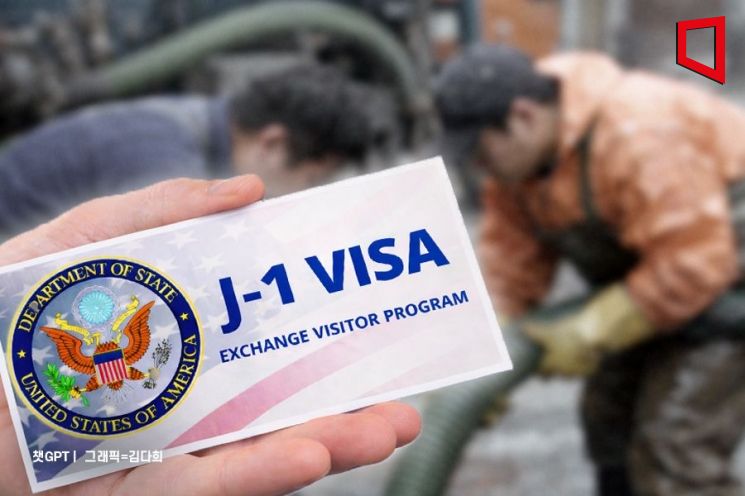
The NYT pointed out that the Department of State is aware of the sponsors' problematic operations but only conducts superficial oversight. In 2013, the U.S. Congress attempted to pass a bill banning fees related to foreign worker recruitment programs, including the J-1 visa, but the bill was defeated due to lobbying by sponsors.
© The Asia Business Daily(www.asiae.co.kr). All rights reserved.
![Clutching a Stolen Dior Bag, Saying "I Hate Being Poor but Real"... The Grotesque Con of a "Human Knockoff" [Slate]](https://cwcontent.asiae.co.kr/asiaresize/183/2026021902243444107_1771435474.jpg)

















