Request to Reduce Out-of-Pocket Treatment Costs
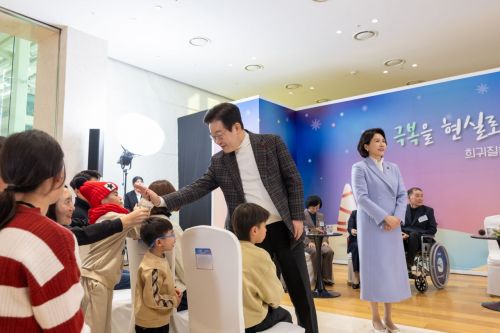 President Lee Jae-myung is giving high-fives to children after a meeting with rare disease patients and their families held on the 24th at the Proton Therapy Center of Yonsei Cancer Hospital in Sinchon, Seodaemun-gu, Seoul. Photo by Yonhap News
On December 24, patients suffering from rare and intractable diseases and their families met with President Lee Jae-myung to share the difficulties they face in their battle against illness.
At the "Communication Event with Rare Disease Patients and Their Families" held at Severance Hospital in Sinchon, Seoul, about 30 patients and guardians attended and requested measures from President Lee and government officials, such as reducing the out-of-pocket burden for treatment costs.
The father of a seven-year-old child with glycogen storage disease said, "Many parents of children with rare diseases have to give up their jobs to care for their child. The financial burden keeps increasing, while our income is cut in half," he said. "For most families, this means living in economic hardship for a lifetime." He added, "I hope the out-of-pocket rate for treatment costs can be lowered, even just a little, so that we can at least maintain a basic standard of living."
He became emotional as he presented President Lee with a "Hope Cookie" for glycogen storage disease, a cookie with a reduced carbohydrate content. He explained, "Our child cannot eat foods like ramen or sweet and sour pork, which most children enjoy. For mothers, figuring out and developing delicious foods with low carbohydrates has become a way of life," he said. "We named the cookie we developed 'Hope Cookie.'"
The mother of a nine-year-old child with Emanuel syndrome said, "My child suffers from a severe disability and cannot walk or speak on their own. It took us seven years just to get an accurate diagnosis." She continued, "There are fewer than 10 patients with this syndrome in Korea, and only about 30 worldwide. Currently, support for nursing costs is limited to about 100 specific disease codes. Rare disease children like mine, who are not included on that list, are excluded from support."
The mother of a seven-year-old child with congenital biliary atresia also said, "My child has undergone eight surgeries, leaving too many holes in their small body. Dressing changes are essential, but since they are not covered by insurance, it is a financial burden."
President Lee commented, "It may not be easy to give an immediate answer to what the parents have said today, but please review the issues thoroughly and prepare policies accordingly. This is truly a difficult matter."
President Lee also gave various gifts, including a presidential wristwatch, to the patients and their families, and took commemorative photos with them. According to Namjoon Kim, spokesperson for the Presidential Office, President Lee called each patient by name, made eye contact, and encouraged them with high-fives.
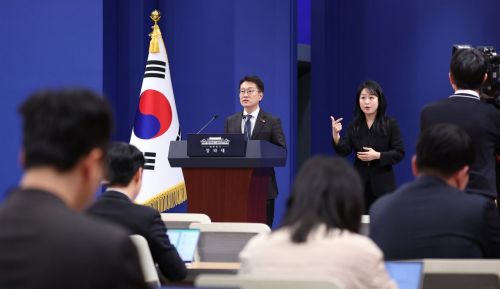
Earlier that day, President Lee attended a "Rare Disease Patients and Families On-site Communication" meeting and said, "A person's life is precious, and no one should be excluded, disadvantaged, or marginalized simply because they are a minority," pledging to improve support for treatment, diagnosis, and welfare for rare disease patients and their families. He added, "The issue of guaranteeing treatment for rare disease patients is something that is difficult to bear as an individual."
President Lee stated, "Because the number of patients is extremely small, there are arguments that it would be excessive for the government to take full responsibility, and there is very little public interest, so the economic necessity for the budget spent is in fact quite limited." He continued, "It is a difficult issue. The government has provided a considerable level of policy support for rare disease patients so far, but from your perspective, it is naturally not enough, and it must be very hard in this situation."
President Lee said, "The new administration is preparing many improvements for support in treatment, diagnosis, and welfare for rare disease patients. There are parts that have not yet been implemented, and many aspects are still lacking." He added, "I will listen to your comments today, and if additional measures are needed, we will take further action." First Lady Kim Hye-kyung also attended the event.
© The Asia Business Daily(www.asiae.co.kr). All rights reserved.
![Clutching a Stolen Dior Bag, Saying "I Hate Being Poor but Real"... The Grotesque Con of a "Human Knockoff" [Slate]](https://cwcontent.asiae.co.kr/asiaresize/183/2026021902243444107_1771435474.jpg)

















