Ministry of Economy and Finance to Collaborate with International Organizations
Designing Operational Plans for Credit Issuance Body
Establishing a Trading System Integrating Technology and Finance
Introducing Futures to Encourage Financial Institution Participation
The government is moving to establish international standards and build a multilateral platform involving multiple countries to take the lead in the Global Voluntary Carbon Market (GVCM).
On December 24, the government announced the "GVCM Roadmap" at the Economic Ministers' Meeting and the Industrial Competitiveness Enhancement Ministers' Meeting, presided over by Deputy Prime Minister and Minister of Economy and Finance Koo Yoonchul at the Government Complex Seoul.
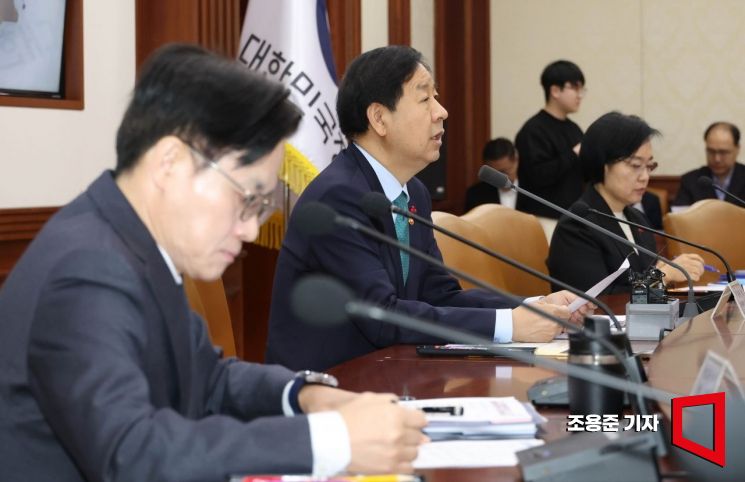 Deputy Prime Minister and Minister of Economy and Finance Koo Yoonchul is speaking at the Economic Ministers' Meeting and the Ministers' Meeting on Strengthening Industrial Competitiveness held on the 24th at the Government Seoul Office in Jongno-gu, Seoul.
The GVCM refers to a carbon market that improves upon the shortcomings of existing international carbon markets by increasing reliability and enabling the activation of global trading. Its key feature is that carbon reduction achievements voluntarily generated overseas by the private sector can be converted into credits issued by trusted institutions based on credible standards and traded within a multilateral framework.
To promote the GVCM, the government signed a Memorandum of Understanding (MOU) with the United Nations Framework Convention on Climate Change (UNFCCC) and the Global Green Growth Institute (GGGI) in May. The GVCM has also been included in the new administration's national policy agenda and economic growth strategy. The newly announced roadmap outlines plans to support projects, establish issuance and trading systems, and build a multilateral framework to leverage the GVCM and position Korea as a leader in the international carbon market.
First, in building the project support system, the government will provide end-to-end support for project operators, from pilot project development to implementation. It will establish a network of specialized carbon reduction project developers and create a platform for sharing information on potential projects. The government will also promote the development of various financial products to encourage investment. In addition, by utilizing ultra-innovative economic projects, it will work to identify large-scale reduction projects and support policy development and formulation in developing countries. In the process of cooperating with target countries, the government will utilize the networks of UNFCCC and GGGI member countries.
In establishing the issuance system, the Ministry of Economy and Finance, GGGI, and UNFCCC will collaborate to develop international standards and design the operation plan for the GVCM credit issuance body. The methodology for calculating carbon reductions will be developed to meet the standards of the Paris Agreement, thereby ensuring international credibility. During this process, the review procedures will be streamlined to guarantee the prompt registration and issuance of carbon credits.
The trading system will be established by integrating technology and finance. Blockchain will be used to record transaction histories, creating a highly reliable trading market that is immune to forgery or tampering. The introduction of futures will encourage participation from domestic and international financial institutions, further activating trading. The government also aims to boost GVCM trading by linking with overseas exchanges and facilitating the participation of foreign financial institutions.
In building the multilateral framework, the government plans to operate an issuance body that can be used simultaneously by multiple countries, provide a trading platform, and establish a multilateral consultative body to discuss cooperation among member countries. The government will also recruit participating countries for the consultative body by linking it with pilot projects focused on target countries. Among member countries, an implementation agreement will be adopted, and each country will designate an implementation support organization.
Next year, the government plans to establish the necessary standards for the GVCM, set up the issuance system, designate certification and verification organizations, and build the multilateral framework. From 2027, pilot projects will be launched, and based on the results, full-scale implementation will follow. Deputy Prime Minister Koo stated, "We will enhance the credibility of the international carbon market by utilizing artificial intelligence (AI) and blockchain, and actively foster domestic climate tech companies with advanced technological capabilities."
© The Asia Business Daily(www.asiae.co.kr). All rights reserved.

















