Opened at 1,484.9 won, plunged to 1,465.5 won after verbal intervention
The won/dollar exchange rate, which opened at its highest level of the year, plunged sharply during trading following verbal intervention by the foreign exchange authorities.
On December 24, in the Seoul foreign exchange market, the won/dollar exchange rate opened at 1,484.9 won, up 1.3 won from the previous trading day. However, immediately after the verbal intervention, at around 9:05 a.m., it plummeted to 1,465.5 won.
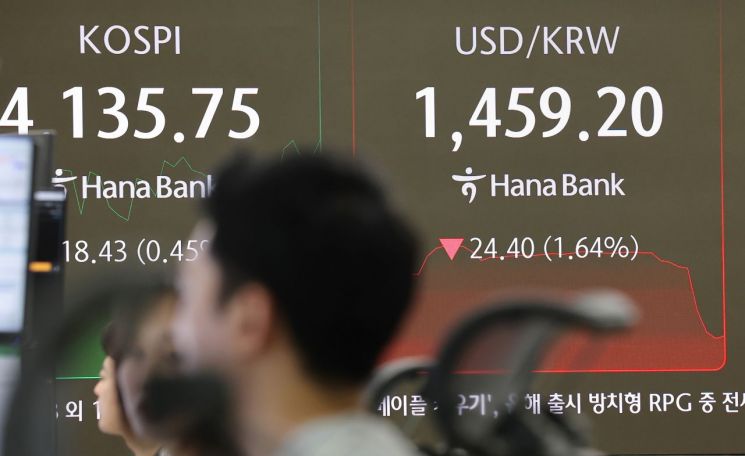 On the morning of the 24th, Christmas Eve, the won/dollar exchange rate is displayed on the status board in the dealing room at the Hana Bank headquarters in Jung-gu, Seoul. Photo by Yonhap News
Yoon Kyungsoo, Director General of the International Department at the Bank of Korea, and Kim Jaehwan, Director General of the International Finance Bureau at the Ministry of Economy and Finance, delivered a "foreign exchange authorities’ market-related message" immediately after the market opened, stating, "An excessive weakening of the won is not desirable." The authorities emphasized, "You will soon see that the series of meetings held over the past one to two weeks, and the announcements of measures by each ministry and agency, were part of efforts to demonstrate the government’s strong resolve and comprehensive policy implementation capabilities."
Following the verbal intervention, the exchange rate temporarily dropped by nearly 20 won and has since been fluctuating in the upper 1,460-won range.
The government and the Bank of Korea have recently announced a series of measures, including rational adjustments to the non-deliverable forward position system, easing the burden of foreign currency liquidity stress tests, expanding permission for foreign currency loans for residents for purposes other than won use, and seeking a new framework related to the National Pension Service.
The government and the Bank of Korea have decided to temporarily exempt financial institutions from foreign exchange soundness charges from January to June next year and to pay interest on excess reserve requirements for foreign currency deposits during the same period. Some in the market expect that the National Pension Service will engage in large-scale dollar selling through hedging in order to manage the year-end closing exchange rate.
© The Asia Business Daily(www.asiae.co.kr). All rights reserved.

















