Emphasizes Achievements of Tariff and Tax Cut Policies on Social Media
Directly Criticizes Fed's Monetary Policy
"Says Rates Should Be Lowered When Market Is Strong"... Sets Clear Criteria for Fed Chair Nominee
President Donald Trump of the United States credited the U.S. economy's third-quarter growth rate, which exceeded 4% this year, to his tariff policies and government performance. He also expressed his intention to nominate someone who shares his economic philosophy as the next Chair of the Federal Reserve (Fed).
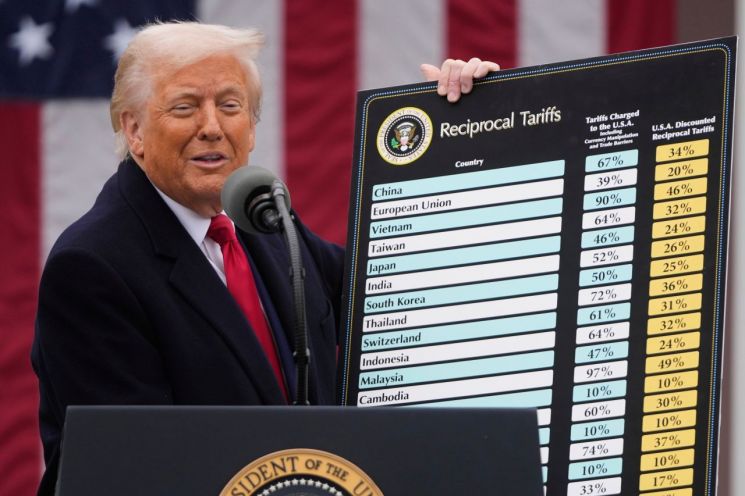
On the 23rd (local time), President Trump stated on his social networking service (SNS) platform, Truth Social, that the third-quarter gross domestic product (GDP) growth rate announced that day "reached 4.3%, far surpassing the expected 3.2%." He attributed this result to his policies.
According to the Bureau of Economic Analysis (BEA) under the U.S. Department of Commerce, the advance estimate for real GDP in the third quarter grew at an annualized rate of 4.3% compared to the previous quarter. This figure represents a significant improvement over the second quarter's growth rate of 3.8%.
President Trump asserted, "Consumer spending is strong, imports and the trade deficit have decreased, and net exports have increased significantly." He added, "There is no inflation, and thanks to my tax bill-often referred to as one big, beautiful bill-and tariff policies, investment is at record levels."
He also criticized many economic experts for underestimating the growth rate, pointing out that 60 out of 61 Bloomberg economists were wrong. He continued, "Trump and a few other geniuses predicted it accurately," describing the current economic performance as "The Trump Economic Golden Age."
Regarding financial markets, President Trump strongly criticized the Fed's monetary policy. He said, "These days, even when good economic indicators are released, the market does not rise. Instead, it falls due to concerns about potential interest rate hikes to curb 'potential' inflation." He argued, "This is because the mindset of Wall Street leaders is completely different from the past." He emphasized that it is not a strong market that causes inflation, but rather "foolishness" is the root of the problem.
Recently, on Wall Street, when economic indicators are strong, there is a tendency for stock prices to fall due to expectations that the Fed will raise interest rates to prevent economic overheating or inflationary pressures. Conversely, when economic indicators are weak, stock prices tend to rise in anticipation that the Fed will lower interest rates to stimulate the economy. President Trump's remarks can be interpreted as criticism of this market trend, where good news leads to declines and bad news leads to gains.
Furthermore, President Trump made it clear that his criterion for appointing the next Fed Chair is a willingness to lower interest rates. He stated, "I want the new Fed Chair to lower interest rates when the market is doing well. I want a market that rises on good news and falls on bad news. That is proper, and that's how it used to be."
Regarding inflation, he said, "It will resolve itself, and if not, we can always raise rates at the appropriate time." He continued, "If we let so-called eggheads who pretend to be smart do everything they can to destroy the upward curve, the country will never be economically great. Anyone who disagrees with me will never become Fed Chair."
Meanwhile, Kevin Hassett, Chairman of the White House National Economic Council (NEC) and a candidate for the next Fed Chair, criticized the Fed for not promptly lowering the benchmark interest rate despite the U.S. economy's faster-than-expected growth in the third quarter. In an interview with CNBC, Hassett pointed out, "The United States is far behind other central banks around the world in terms of rate cuts." He argued that the spread of artificial intelligence (AI) is boosting growth rates while putting downward pressure on inflation. He also explained that about 1.5 percentage points of the third-quarter growth rate stemmed from a reduction in the trade deficit due to tariff policies.
Hassett is considered a leading candidate for the next Fed Chair, along with former Fed Governor Kevin Warsh and current Fed Governor Christopher Waller. However, there are concerns that the independence of monetary policy could be compromised due to Hassett's close relationship with President Trump. President Trump previously stated on the 18th that he was interviewing three to four candidates for the next Fed Chair and would make a final decision within the next few weeks.
© The Asia Business Daily(www.asiae.co.kr). All rights reserved.
![Clutching a Stolen Dior Bag, Saying "I Hate Being Poor but Real"... The Grotesque Con of a "Human Knockoff" [Slate]](https://cwcontent.asiae.co.kr/asiaresize/183/2026021902243444107_1771435474.jpg)
















