Health Insurance Committee Analyzes Medical Costs to Strengthen Compensation for Critical, Emergency, and Basic Services
Reducing Overcompensated Tests and Redirecting Resources to Undercompensated Essential Care
"Korean-Style Primary Care Physician" Model to Launch Next Year... Integrated Health Management for Citizens Aged 50 and Older
The government is restructuring the imbalanced medical fee system to focus on essential healthcare services. Compensation for so-called "profitable" areas such as laboratory and imaging tests will be reduced, and the resources saved will be redirected to essential and basic medical services, including surgeries, procedures, and consultations. The scope of health insurance coverage for the high-cost immuno-oncology drug "Keytruda Injection" has also been significantly expanded.
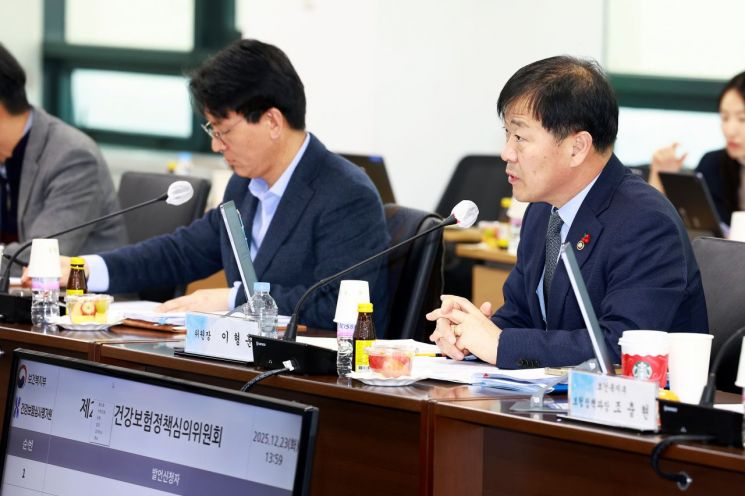 On the 23rd, Lee Hyun, Second Vice Minister of Health and Welfare and Chairperson, is speaking at the 24th Health Insurance Policy Deliberation Committee meeting for 2025. Ministry of Health and Welfare
On the 23rd, the Ministry of Health and Welfare held the 24th Health Insurance Policy Deliberation Committee meeting to discuss these measures.
Based on the analysis of medical costs for the 2023 fiscal year, the government will implement a system to regularly adjust the "relative value scores," which are the basic scores for calculating health insurance fees, starting next year. Previously, revisions to the relative value scores were made every five to seven years, which led to delays in reflecting changes in medical technology and persistent distortions and imbalances in fee structures across different fields.
According to the results calculated by the Medical Cost Analysis Committee, at tertiary general hospitals, laboratory tests (192%) and imaging diagnostics (169%) generate significantly higher profits compared to their costs, whereas basic medical services (63%) and physical therapy (33%) fall far short of covering their costs.
Accordingly, the government will review approximately 6,000 out of a total of about 9,800 medical fees, adjusting overcompensated fees in testing areas. The resources secured through this adjustment will be allocated to strengthen compensation for essential medical services such as critical and emergency surgeries, pediatrics, and childbirth, as well as to improve undercompensated basic services like consultations and hospitalizations.
The previously opaque consignment and subcontracting market for laboratory tests will also be reformed. The existing "consignment test management fee" (10%) will be abolished and replaced with new fees that reflect the roles of each consignment and subcontracting institution. In particular, to prevent the widespread practice of discounting test fees in the field, the government will improve the billing and payment methods, mandate the reporting of patient safety incidents, and establish regulations to limit re-subcontracting, all aimed at enhancing test quality.
Approximately 240 billion won in resources from the abolished management fee will be used to increase fees in undercompensated areas such as consultations. In addition, quality management measures, such as improving certification standards for subcontracting institutions and mandating incident reporting for patient safety, will be implemented in parallel. This reform of the consignment and subcontracting compensation system will be pursued through a revision of the notification in the first half of next year, and will be implemented in line with the timing of the regular adjustment of relative value scores.
For tertiary general hospitals and comprehensive secondary general hospitals, following the lifting of the emergency care system in October, the additional fees for emergency room specialist consultations have been converted to standard fees, and the corresponding fees and statutory copayments will be applied. For emergency and critical surgery fees, tertiary emergency centers, specialized emergency centers, and regional trauma centers where the fees have been converted to standard fees will maintain a 150% additional fee and apply statutory copayments. Regional emergency medical centers and regional emergency medical institutions will also apply a 150% additional fee and statutory copayments to the relevant fees.
Significant Reduction in Patient Burden for Keytruda Injection and Dupixent Injection
At the committee meeting, an agenda item to expand health insurance coverage for "Keytruda Injection" (ingredient: pembrolizumab) and "Dupixent Injection" (ingredient: dupilumab) was also approved.
Previously, Keytruda Injection was covered only for four types of cancer, including non-small cell lung cancer. Starting January 1 next year, coverage will be expanded to nine types of cancer (17 treatment regimens), including head and neck cancer and gastric cancer. As a result, the annual per-patient medication cost will be drastically reduced from about 73.02 million won to 3.65 million won (for monotherapy, with a 5% copayment). The atopic dermatitis treatment "Dupixent Injection" will also have its coverage expanded to include severe type 2 inflammatory asthma, reducing the annual patient burden from about 15.88 million won to approximately 4.76 million won.
Additionally, the government will, through a drug reimbursement adequacy reevaluation in 2025, maintain coverage for four ingredients-olopatadine hydrochloride, Clematis mandshurica-Trichosanthes kirilowii-Prunella vulgaris, bepotastine, and L-aspartate-L-ornithine injection (0.5g/mL)-for which clinical usefulness has been confirmed, while the remaining drugs will be reconsidered at a later date.
Meanwhile, in preparation for a super-aged society, the government will also launch a "community-based primary care innovation pilot project" centered on local clinics. Starting in July 2026, this project will target citizens aged 50 and older. When a patient registers with a specific clinic, a "primary care team" consisting of doctors, nurses, and nutritionists will provide integrated services ranging from prevention and disease management to home visits. The core of this model is to move away from the traditional "fee-for-service" system, which pays for each visit, and instead introduce an "integrated fee" system that rewards continuous patient management outcomes.
A Ministry of Health and Welfare official stated, "Given demographic and disease structure changes such as rapid aging and the increase in chronic diseases, it is crucial to establish a sustainable health management system centered on community-based primary care teams," adding, "We will build a primary care system in which patients and medical institutions can trust and participate."
© The Asia Business Daily(www.asiae.co.kr). All rights reserved.
![Clutching a Stolen Dior Bag, Saying "I Hate Being Poor but Real"... The Grotesque Con of a "Human Knockoff" [Slate]](https://cwcontent.asiae.co.kr/asiaresize/183/2026021902243444107_1771435474.jpg)











