The mechanism behind the formation of deuterium has been identified. Deuterium, which has a very weak binding energy, has long defied clear explanation regarding its creation and persistence in ultra-high temperature and high-energy collision environments. However, a recent international research team has provided definitive evidence that deuterium is not formed directly after collisions. Instead, by precisely analyzing the correlation between pions and deuterium, they demonstrated that deuterium is produced through 'pion-mediated nuclear fusion,' in which a pion absorbs excess energy following the decay of a resonance state and facilitates the binding of nucleons.
The National Research Foundation of Korea announced on the 23rd that the ALICE international research team, with Professor Minjung Kwon of Inha University serving as the Korean representative, has successfully elucidated the mechanism of deuterium formation through proton-proton collision experiments conducted at the Large Hadron Collider (LHC) of the European Organization for Nuclear Research (CERN).
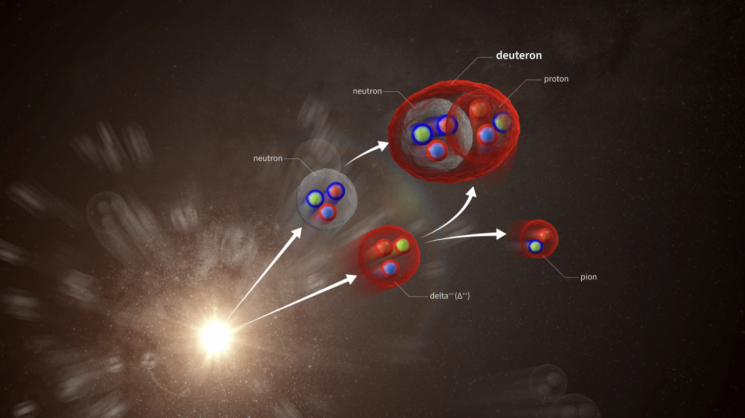 The process of deuterium formation after resonance particle decay. This illustration shows how deuterium is produced in high-energy proton collisions. Photo by Minjung Kwon, Inha University, CERN ALICE
ALICE is one of the international collaborative projects utilizing CERN’s LHC. The goal of ALICE’s experiments is to recreate and observe the 'primordial universe' as it existed one millionth of a second after the Big Bang, in order to clarify the creation and interaction of early cosmic matter and to understand the fundamental principles of strong interactions and cosmic evolution. The experiment involves more than 1,900 researchers from 170 institutions in 40 countries, including 52 researchers from eight institutions in Korea.
CERN is the world's largest nuclear particle accelerator, used to study the subatomic world by accelerating and colliding heavy ions such as lead or protons at near-light speeds. Deuterium is one of the isotopes of hydrogen and is classified as a heavier form of hydrogen atom.
Deuterium has a binding energy on the order of a few MeV (Mega-electron Volts, the energy gained or lost by an electron moving through a potential difference of 1 Volt), which is extremely weak. Nevertheless, an anomalously large amount of deuterium is observed to form in ultra-high temperature, high-energy particle collision environments where energies exceed several hundred MeV. The fact that such weakly bound nuclei are created under extreme conditions, when they should easily break apart, remains a major unresolved issue in nuclear physics.
The international research team precisely analyzed the movements of pion-deuterium pairs produced in proton-proton collision experiments at CERN’s LHC, tracking the process by which these particles are formed.

In particular, they focused on the fact that when protons and neutrons, generated from the decay of delta resonance particles (short-lived, excited state particles related to delta baryons observed in high-energy experiments), recombine, their traces are left in the data.
As a result, it was found that about 60% of the observed deuterium and anti-deuterium were formed after the decay of delta resonance particles, and when considering the contribution of all resonance particle decays, the proportion reached 90%. This clearly demonstrates that deuterium is not formed immediately during the collision process, but rather through the recombination of particles produced after the decay of resonance particles.
This research is significant in that it provides the first direct experimental evidence for how light nuclei are formed, thereby addressing a core challenge in high-energy nuclear physics.
Furthermore, it is expected to lay the groundwork for more accurately describing nuclear formation processes, thereby increasing the precision of astrophysical and cosmological models.
Professor Kwon stated, "This research focused on elucidating the mechanism of deuterium formation, but further studies will be needed for more complex nuclei such as tritium and helium. It is also necessary to systematically compare and verify the impact of resonance particle decay on nuclear formation in larger-scale collision environments."
This research was supported by the CERN collaboration project promoted by the Ministry of Science and ICT and the National Research Foundation of Korea. The results (paper) were recently featured in the international journal 'Nature.'
© The Asia Business Daily(www.asiae.co.kr). All rights reserved.


















