Prolonged Dispute Since Early This Year
Management Claims "We Proposed a 10% Increase"
Union Refutes "We Never Received Such a Proposal"
The dispute over ordinary wages between labor and management in Seoul's city bus sector regarding the collective wage agreement continues through the end of the year. The labor union plans to hold a general meeting on the 24th to discuss whether to proceed with a strike.
According to the Seoul City Bus Union on the 23rd, the union will hold a "Branch Chairpersons' General Meeting" at 10 a.m. on the 24th at the union hall in Yongsan-gu, Seoul, with representatives from 65 city bus branches in attendance. At this meeting, decisions are expected to be made regarding whether to strike and the possible date of implementation.
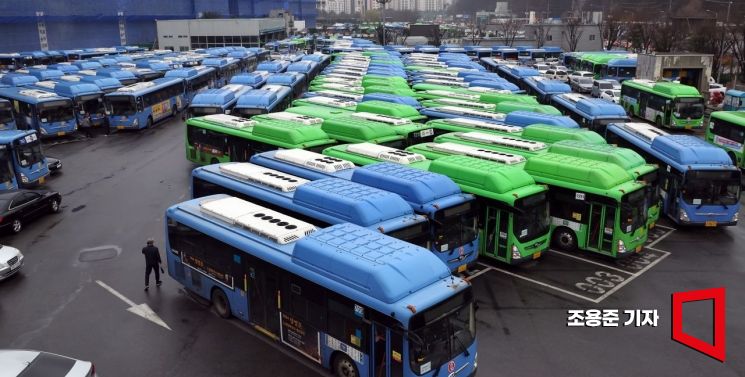
Previously, labor and management failed to reach an agreement on this year’s wage negotiations due to the ongoing conflict over ordinary wages. The management side, represented by the Seoul City Bus Transportation Business Association and the Seoul Metropolitan Government, maintains that the wage system must be restructured to include bonuses in the base salary, in light of a Supreme Court ruling in December last year that broadened the scope of ordinary wages and sharply increased labor costs.
On the other hand, the union argues that, according to the Supreme Court decision, bonuses should naturally be included in ordinary wages and paid as such. The union also points out that if bonuses are recognized as ordinary wages under the current system, overall pay would increase, but if the wage system is restructured, this increase would disappear. Therefore, the union views the management’s proposal as a "de facto wage cut."
In the appellate court ruling in October on a lawsuit filed by employees of Donga Transportation against the company, the court also recognized that bonuses should be included as ordinary wages. However, labor and management have still not reached an agreement on wage system restructuring or the rate of wage increase.
Since the ruling, several rounds of practical negotiations have taken place, but both sides remain at an impasse. The business association claims that during negotiations, it proposed a wage increase of around 10%, similar to other local governments such as Busan and Daegu. According to the Donga Transportation ruling, recognizing bonuses as ordinary wages would result in a wage increase of about 6-7%, so the association claims it offered a higher rate.
However, the union flatly refuted this in a statement, saying, "We have never received such a proposal, either at the Central Labor-Management Negotiation Committee or in working-level negotiations."
The union also emphasized, "We officially notified management in writing that discussions should take place between a wage freeze and our initial demand of 8.2%. Recently, we also discussed in practical negotiations the possibility of using a 3% increase, similar to the subway wage increase rate, as a basis for talks. Aside from these points, we have not made any separate wage increase demands."
Regarding the wage system restructuring, the union stated, "We are obligated to implement the current collective agreement in accordance with the Supreme Court en banc decision and the correction order from the Ministry of Employment and Labor. Just as employers must comply when the minimum wage is raised, the Seoul Metropolitan Government and management must also fulfill their obligations."
© The Asia Business Daily(www.asiae.co.kr). All rights reserved.

















