Targeting $21 Billion in K-Food Exports by 2030
Formation of K-Food Export Planning Group and One-Stop Export Support Hub
Song Miryung: "The Takeoff of K-Food Starts Now"
The government has decided to establish an "export support system" that mobilizes all available resources from relevant ministries in order to accelerate the growth of K-Food (agricultural, livestock, and fisheries products) exports. The plan is to create a sustainable foundation for K-Food growth by providing Korean cuisine education to overseas chefs, and to expand into promising markets such as the Middle East through halal food. Based on these efforts, the goal is to increase K-Food exports to 21 billion dollars by 2030.
On December 23, the Ministry of Agriculture, Food and Rural Affairs held the "K-Food Global Vision Declaration Ceremony" at the aT Center (Yangjae-dong, Seoul) and announced the "Global K-Food Export Expansion Strategy" containing these details.
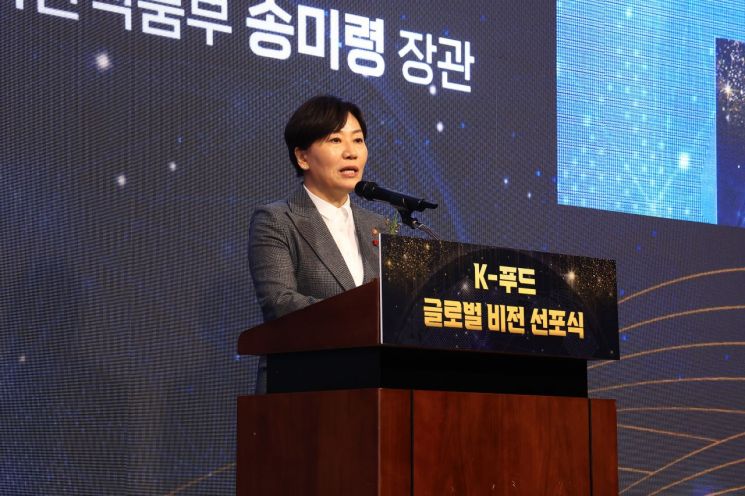 Song Miryung, Minister of Agriculture, Food and Rural Affairs, is announcing the "Global K-Food Export Expansion Strategy" at the "K-Food Global Vision Declaration Ceremony" held on the 23rd at the aT Center (Yangjae-dong, Seoul). Ministry of Agriculture, Food and Rural Affairs
As of the end of November this year, cumulative K-Food exports reached 12.34 billion dollars, setting a new all-time record. This year's target is 13.65 billion dollars, a 6.2% increase from the previous year. The government aims to expand K-Food exports to 21 billion dollars by 2030. To achieve this, exports must grow by 9% annually through 2030.
An official from the Ministry of Agriculture, Food and Rural Affairs stated, "This is an aggressive target, more than double the export growth of 3.6 billion dollars recorded over the past five years (2020-2025)," adding, "To achieve this, we will actively pursue five major strategies in collaboration with relevant ministries: discovering and nurturing attractive products, resolving export challenges through a one-stop system, integrating K-Initiatives, promoting digital and technological innovation, and expanding into promising markets such as the Middle East."
◆ Promoting Korean Cuisine to Encourage Continuous Overseas Consumption = First, the government plans to actively utilize private-sector Korean cuisine education and experience infrastructure by launching an open-lab style education program called "Sura School" next year, which will offer Korean cuisine curricula for foreigners to encourage sustained overseas consumption of K-Food. Korean cuisine courses will also be introduced and operated at overseas culinary schools such as the Culinary Institute of America (USA), Le Cordon Bleu (France), and ALMA (Italy).
Export strategy items will be selected and intensively supported for each region and market, taking into account overseas preferences, product competitiveness, and the potential for agricultural co-growth. In major export markets such as the United States, China, and Japan, the focus will be on barbecue sauces that pair well with meat dishes, traditional liquors, and fruit concentrates such as yuzu and omija. The government will also expand support for potential items based on local market trends. In the Middle East, which has recently emerged as a promising market, efforts will focus on nurturing halal Korean beef, fresh fruits such as grapes and strawberries, and other products that made their initial entry in October. For the European Union, high value-added health foods and heat-treated processed meat products will be selected as strategic items.
To secure a potential K-Food consumer base, the government will also support the development of K-Food aid products such as nutrition-fortified rice, ready-to-eat meals (such as porridge), infant formula, beverages, and energy bars, tailored to local conditions such as shortages of electricity and drinking water, by linking international cooperation projects (ODA) to corporate demand and Korean rice.
To ensure that private companies lead the overseas expansion of strategic items with government support, a public-private K-Food Export Planning Group will be formed to identify promising K-Food products and develop region-specific strategic programs. The planning group will appoint 35 private-sector members from the following fields: export companies (fresh foods, processed foods, food tech, agri-industry), culture, tourism, and content, overseas certifications such as halal, logistics and distribution, and customs and non-tariff barriers.
◆ Resolving Export Company Challenges through the 'One-Stop Export Support Hub' = The government will also focus on resolving challenges faced by export companies. To provide comprehensive support by sector, a K-Food One-Stop Export Support Hub will be established to serve as a unified consultation center for exporters, and hotlines will be set up between relevant ministries and agencies. In addition, the government will analyze and organize non-tariff barriers by region and type, and will actively address these challenges by leveraging diplomatic networks.
In particular, to flexibly respond to external uncertainties such as exchange rates, the government will double the agricultural export voucher support from 36 billion won this year to 72 billion won next year, and will expand export insurance support, including easing the self-payment ratio for exchange rate fluctuation insurance, as well as certification, consulting, and other K-Food export-specialized services.
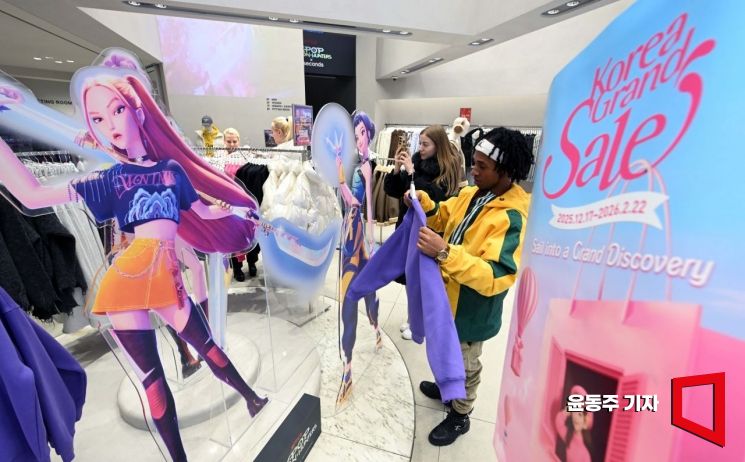 On the 17th, a foreign tourist is seen browsing K-Pop Demon Hunters collaboration products at the Eight Seconds store in Myeongdong, Seoul. 2025.12.17 Photo by Dongju Yoon
◆ Turning Tourists Visiting Korea into K-Food Consumers = The government will support inbound tourists becoming overseas K-Food consumers by integrating K-Initiatives such as K-tourism, content, culture, and consumer goods.
To this end, the government will enhance the K-Gastronomy Belt by combining local tourism resources and organizing experience events, aiming to expand inbound tourists into K-Food consumers. Starting with the Chicken Belt next year, the government plans to establish the second and third Korean cuisine belts, taking into account the demand from overseas tourists.
In addition, in collaboration with the Ministry of Culture, Sports and Tourism and others, the government will actively promote the production of entertainment programs and other content featuring K-Food, as well as marketing through global video streaming services (OTT). The government also plans to appoint Hallyu stars and influencers as K-Food ambassadors to further spread the positive image of K-Food.
◆ Expanding into Promising Markets such as 'Halal' Middle East = The government will diversify export markets to promising regions such as the Middle East and Africa, using the United Arab Emirates as a hub, and will also target special markets that require mandatory certifications such as halal, vegan, and kosher.
To expand into promising markets such as the Middle East, the "Halal Food Export Council" will be expanded and reorganized to include not only domestic certification bodies but also export companies, and a new "Overseas Export Support Center" will be established this month within the National Food Cluster (Iksan) to support entry into promising markets such as the Middle East. In addition, the Overseas Food Certification Support Center of the Korea Food Research Institute will further enhance ingredient analysis (such as alcohol) and technical support.
Minister of Agriculture, Food and Rural Affairs Song Miryung stated, "The real take-off of K-Food begins now. The government will do its utmost to ensure that the strategies announced jointly with relevant ministries are implemented in the field and provide strong support for our export companies," adding, "We will make every effort to ensure that these results lead to the realization of our global vision and the 2030 export target."
© The Asia Business Daily(www.asiae.co.kr). All rights reserved.


















