Delivered Year-End Message to Residents on the 23rd
Presented "100-Year Vision for Jeonnam" Including New Industry Development
Accelerating the Establishment of the Gwangju-Jeonnam Special Metropolitan Alliance
Reaffirmed Intention to Run for a Third Term as Governor Next Year
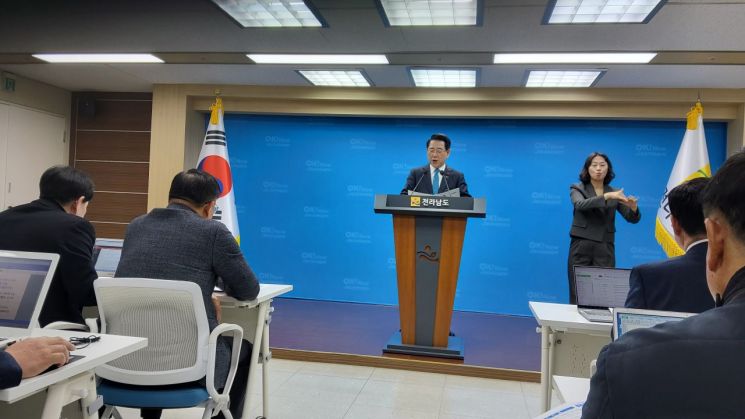 On the 23rd, Kim Youngrok, Governor of Jeollanam-do, held the 2025 year-end press conference at the provincial government briefing room, explaining this year's policy outcomes and next year's administrative direction. Photo by Shim Jinseok
Kim Youngrok, Governor of Jeollanam-do, made it clear that he will focus on revitalizing the economy next year, including realizing the vision of "Jeonnam as a Global Advanced Industry City."
At the 2025 year-end press conference held in the provincial government briefing room on the 23rd, Governor Kim summarized the achievements of the 7th and 8th popularly elected administrations, and announced the vision for Jeonnam's great revival centered on AI, energy, and science and technology, as well as next year's administrative direction.
Governor Kim stated, "Over the past seven years, Jeonnam has overcome the worst constitutional crisis of the illegal 12·3 emergency martial law and is now facing the greatest leap forward in its history. Now is the time to step forward as the center of the nation's strategic industries."
According to Jeollanam-do, the national budget, which stood at 6 trillion won in 2018, has expanded to 10 trillion won for the first time ever, and the provincial budget has also increased by 82% over seven years to reach 13.76 trillion won. During the same period, the province attracted investments totaling 55 trillion won and created about 50,000 jobs. The rankings for personal income and household income also rose to 9th and 8th nationwide, respectively.
In addition, longstanding regional issues have been addressed, such as the enactment of the Special Act on the Yeosun Incident, the inclusion of the spirit of the 5·18 Democratization Movement in the preamble to the Constitution as a national agenda, the promotion of state rivers, the abolition of entrance fees at Cheoneunsa Temple in Jirisan, the electrification of the Gyeongjeon Line, and the opening of the southern coastal railway (Mokpo-Boseong Line).
Governor Kim particularly assessed the integrated relocation of the Gwangju civilian and military airports and the establishment of the integrated national medical school as "the result of new cooperation and decisive action by the state."
In the area of public welfare, the province implemented seven rounds of livelihood stabilization measures totaling 456 billion won, and was the first in the nation to introduce population and youth policies such as basic income for newborns, youth culture and welfare cards, and the "10,000 won housing" program. Jeonnam also achieved the highest total fertility rate in the nation for two consecutive years.
Next year, building on these achievements, the plan is to actively foster future advanced industries such as energy and lead the development of blue ocean industries. A solid foundation has been laid to attract RE100 industrial complexes and advanced industries in connection with the distributed energy special zones designated throughout Jeonnam.
Governor Kim stated, "The core of Jeonnam's future strategy is energy and AI. Based on the nation's largest renewable energy potential of 444GW, the province plans to accelerate the creation of 30GW offshore wind power, expand distributed energy special zones, and establish RE100 industrial complexes. Large-scale offshore wind farms will be developed in Shinan, Jindo, Yeosu, and Goheung, and by clustering data centers, semiconductors, secondary batteries, and hydrogen industries, we will build an industrial ecosystem where power is produced and consumed locally."
He added, "Starting with the global AI data center to be established in Solaseado, Haenam, we will form an AI industry cluster, and through the artificial sun (nuclear fusion) research facility attracted to Naju, we will lead next-generation energy technology."
He also announced plans to foster industrial hubs such as the "Gwangyang Bay Area secondary battery cluster," the "Southwest Coast hydrogen industry belt," and the "Southern Region semiconductor innovation belt." In addition, he expressed his intention to strengthen global tourism competitiveness through projects such as the "Southern Coastwide Tourism Belt," "Dadohae Sunshine Way," the "K-Nobel Literature Center," and the "2026 Yeosu World Island Expo."
In particular, he unveiled a plan to launch the "Gwangju-Jeonnam Special Metropolitan Alliance," scheduled for the first half of next year, to initiate full-scale ultra-wide-area cooperation.
Governor Kim stated, "To lead the government's five-pole, three-special national balanced development strategy, we must draw a bigger picture for the future of Honam. The first step is the 'Gwangju-Jeonnam Special Metropolitan Alliance.' The metropolitan alliance, to be launched in the first half of next year, will break down the administrative boundaries of the past 40 years and serve as a stepping stone toward a unified Honam."
He continued, "We must clearly stipulate a decentralized state in the Constitution and move toward true national unity. Once a true framework for local autonomy with proper budgets and authority is established, we will immediately move toward administrative integration of Gwangju and Jeonnam."
He also mentioned his plans to run for a third term as governor next year.
Governor Kim stated, "There have been various opinions, but my intention to run for a third term as governor remains firm and clear. However, unlike other candidates, I have not yet decided on the schedule for announcing my candidacy or holding a publication event. There is still a lot of work to be done. Isn't it only right to do what needs to be done to prepare for the election?"
© The Asia Business Daily(www.asiae.co.kr). All rights reserved.
![Clutching a Stolen Dior Bag, Saying "I Hate Being Poor but Real"... The Grotesque Con of a "Human Knockoff" [Slate]](https://cwcontent.asiae.co.kr/asiaresize/183/2026021902243444107_1771435474.jpg)
















