UNIST and ADD Develop Model to Analyze Movement and Residual Characteristics of Liquid Chemical Weapons
Linked with 3D Computational Fluid Dynamics, Enables Local Concentration Prediction... Published in J. Hazard. Mater.
Urban areas are inherently disadvantageous environments for chemical weapons. The destructive power of chemical weapons is amplified through invisible pathways.
A simulation model capable of accurately analyzing the urban spread and residual risks of liquid chemical weapons has been developed.
Analysis using this model revealed that certain highly toxic chemical agents can remain hazardous even after initial dispersion. This is because secondary exposure occurs as droplets of the chemical agent that have settled on the ground evaporate over time.
On December 23, Professor Seongdeuk Choi's team from the Department of Urban and Environmental Engineering at UNIST announced that, in collaboration with a research team from the Agency for Defense Development, they have developed a predictive model called "DREAM-CWA" that analyzes the movement and residual characteristics of dispersed liquid chemical agents.

Unlike existing predictive models, DREAM-CWA realistically reflects the fact that chemical agents can remain on the ground in droplet form (as liquid particles). The model further improves simulation accuracy by categorizing the surfaces where droplets settle into soil, asphalt, and concrete, which are typical components of urban environments. This is important because the amount of toxic substances evaporating from the droplets into the atmosphere varies depending on the characteristics of each surface.
The research team used this model to simulate a scenario in which a persistent, highly toxic chemical agent-existing as a sticky liquid at room temperature-was dispersed.
The results showed that, 30 minutes after dispersion, evaporation of the agent from droplets on the ground increased the atmospheric concentration by 32 times, and the amount re-emitted into the air rose by 1.5 times compared to the initial level.
By inputting these DREAM-CWA results into a three-dimensional computational fluid dynamics (CFD) simulation, it is possible to predict the local concentration of toxic gases at a height of 2 meters above ground-close to human breathing height. DREAM-CWA calculates the "amount of toxic substances" released from liquid droplets on the ground, while the CFD model tracks "where the gas flows" as it is carried by complex wind patterns between buildings.
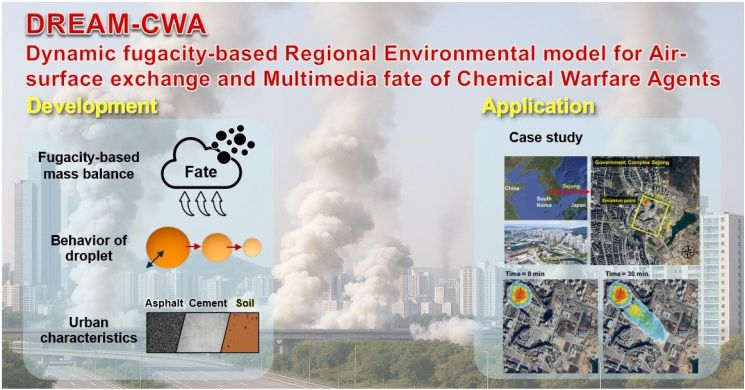
Professor Seongdeuk Choi explained, "This multimedia environmental model, which analyzes the process of chemical weapons passing through air, droplets, soil, asphalt, concrete, and urban streams after dispersion, is an unprecedented technology both domestically and internationally."
The Agency for Defense Development research team stated, "With the development of this model, we can further advance our previously developed NBC_RAMS system and precisely predict the diffusion pathways, human exposure levels, and residual times of various liquid chemical weapons under micrometeorological conditions. This will play a pivotal role in our military's chemical warfare and counter-terrorism operations."
This research was conducted as a commissioned project supported by the Agency for Defense Development's core technology program, "Analysis of Chemical Agent Contamination Characteristics for Establishing a Korean Operational Concept for CBRN Weapon Systems." Professor Kim Jaejin from the Department of Earth and Environmental System Sciences at Pukyong National University participated as a co-researcher, responsible for computational fluid dynamics modeling.
The research findings were published in the international journal "Journal of Hazardous Materials" on December 5.
© The Asia Business Daily(www.asiae.co.kr). All rights reserved.


















