66 Endocrinology Specialists Participate
Expanded into a Discussion-Based Academic Forum
Daewoong Pharmaceutical announced on the 23rd that initial treatment strategies and criteria for drug selection were discussed based on this year’s revised diabetes treatment guidelines at its academic program, the '4D Symposium,' where endocrinology medical professionals engage in discussion and debate.
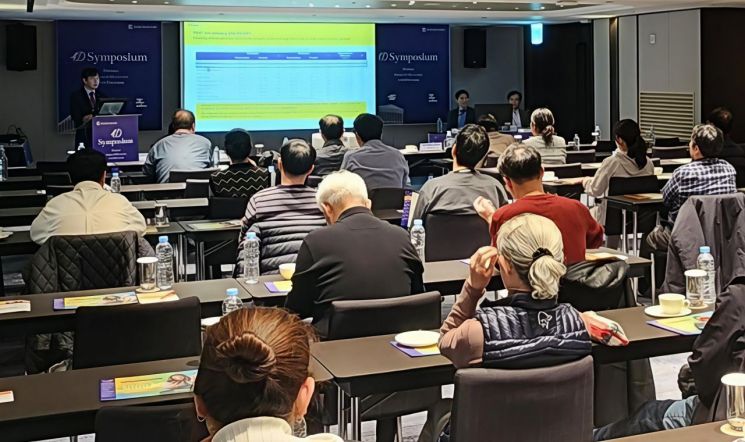 Medical professionals are discussing initial treatment strategies and criteria for drug selection based on the revised diabetes treatment guidelines this year at Daewoong Pharmaceutical's academic program, the '4D Symposium.' Daewoong Pharmaceutical
Now in its fifth year, the '4D Symposium' distinguishes itself from traditional lecture-based academic events by focusing on panel discussions and Q&A sessions. Professors from university hospitals and private practitioners participate together, sharing the latest evidence and real-world clinical experiences, and the program is designed to facilitate more practical discussions about common issues encountered in clinical practice.
This event was held from November 22 to 23, with 66 endocrinology specialists, including university hospital professors and private practitioners, in attendance.
During the program, medical professionals discussed how to apply this year’s revised diabetes treatment guidelines to actual prescriptions. The guidelines serve as a reference for clinicians when initiating treatment and selecting medications. In this revision, the emphasis was strengthened on setting treatment priorities by considering not only blood glucose levels but also the risk of major complications such as cardiovascular disease, heart failure, and kidney disease, as well as the patient’s overall condition. Accordingly, for high-risk patients, the discussion focused on prioritizing SGLT-2 inhibitors or GLP-1 receptor agonists, while for general patients, metformin remains an important option to be considered.
Jae Hyun Bae, a professor at Seoul National University College of Medicine, delivered the first lecture on day one and commented on the guideline revision, saying, "Metformin remains an important drug in diabetes treatment, but the new guidelines have shifted away from a glucose-centric approach. For high-risk groups, drugs such as SGLT-2 inhibitors, which can reduce the risk of cardiovascular disease, heart failure, and kidney disease, are now prioritized."
Jong Han Choi, a professor at Konkuk University College of Medicine, emphasized the importance of patient-centered care, stating, "Modern diabetes treatment is fundamentally structured to reflect patient characteristics such as comorbidities, body type, and lifestyle, moving away from the previous approach that focused solely on blood glucose levels."
On the second day, the latest blood glucose management strategies using continuous glucose monitoring (CGM) were introduced. Typically, average indicators such as glycated hemoglobin (A1c, HbA1c) are used to assess blood glucose status. However, relying solely on average values makes it difficult to fully understand the flow and patterns of blood glucose fluctuations throughout the day. Continuous glucose monitoring, which uses sensors to continuously track changes in blood glucose, was highlighted for its ability to more precisely identify glucose variability and the risk of hypoglycemia, and to support more effective management. In addition, there were projections that digital-based integrated management, such as linkage with automated insulin control systems, will be further developed in the future.
Sang Soo Kim, a professor at Pusan National University College of Medicine, said, "Glycated hemoglobin only shows average blood glucose and does not adequately reflect glucose variability or the risk of hypoglycemia. CGM allows for continuous monitoring of glucose trends, which can contribute to more comprehensive management."
Park Hyungchul, Head of ETC Marketing at Daewoong Pharmaceutical, stated, "The 4D Symposium is an academic discussion platform designed so that medical professionals can interpret and discuss key issues in the medical field, such as changes in clinical guidelines, together. We will continue to expand the sharing of the latest insights and provide ongoing academic support and information sharing, so that healthcare professionals can connect the evolving treatment environment to real-world clinical practice."
© The Asia Business Daily(www.asiae.co.kr). All rights reserved.