Selected as the Cover Article in International Journal CMES
Demonstrating the Competitiveness of Marine AI Research
The ocean thousands of meters below the surface is no longer an entirely unknown frontier.
The Korea Institute of Ocean Science and Technology (KIOST), led by President Lee Heeseung, has developed a technology for generating side-scan sonar (SSS) images used in seafloor geological analysis and underwater exploration, in collaboration with the National Pukyong University.
The results of this research were published in the November issue of the international journal "Computer Modeling in Engineering & Sciences (CMES)," which is recognized as a leading publication in the field of engineering and computational modeling.
Notably, the paper was selected as the cover article by the CMES editorial board, further underscoring the significance of the research due to its originality and academic advancement.
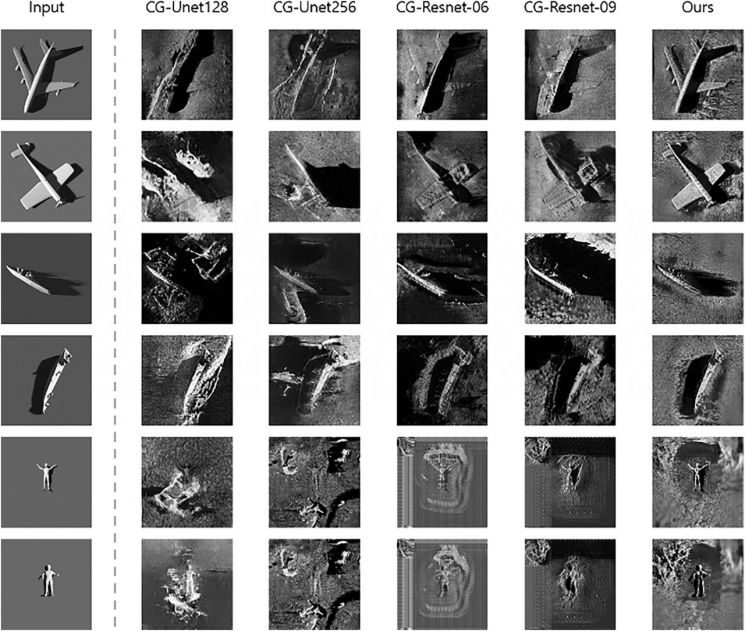
The research team led by Lee Seunghoon at the KIOST Division of Marine Power Enhancement and Defense Research, together with Professor Jang Wondu's team from the Department of Computer and Artificial Intelligence Engineering at National Pukyong University, developed a side-scan sonar image generation technology that combines 3D modeling and a physics-based shadow model based on the artificial intelligence (AI) image generation model 'CycleGAN.' This new technological foundation enables the creation of side-scan sonar images that closely resemble those obtained in real underwater exploration environments.
Side-scan sonar is equipment that transmits sound waves obliquely to the seafloor and receives the reflected signals to visualize the shapes of seafloor topography and objects. It is used in a wide range of fields, including seafloor geological analysis, structure exploration, and disaster response. However, obtaining large-scale real exploration data has been limited due to constraints such as weather and sea conditions, as well as high costs.
To address these challenges, the research team created 3D models of various artificial objects, such as shipwrecks and sunken aircraft, and applied diverse steering, rotation, and placement conditions to realistically reproduce reflection and shadow characteristics similar to those in actual environments.
In particular, by introducing a precise shadow model that reflects the distance, altitude, and acoustic scattering characteristics between the side-scan sonar and the target, the team was able to reproduce shadow areas at a level comparable to real exploration, whereas previous AI research handled these areas in a simplified manner.
By utilizing the developed model, the team converted virtually generated side-scan sonar images to closely match the texture, noise, and reflection patterns of real exploration footage, suggesting the possibility of securing large-scale, realistic training data even with reduced high-cost maritime exploration time.
This research is expected to serve as a technological turning point that can resolve the long-standing issue of data scarcity in the field of side-scan sonar image analysis.
Since it enables the efficient simulation of a variety of seafloor environments without lengthy field investigations, it is anticipated to become a core foundational technology supporting future AI research in marine science and technology. In addition, the research team plans to continue advancing the technology to more accurately reflect the complex characteristics of real marine environments.
Lee Heeseung, President of KIOST, stated, "The selection of this paper as a cover article is highly significant, as it demonstrates the international competitiveness of KIOST's research on the convergence of marine science and artificial intelligence. We will continue to actively support the establishment of reliable marine big data by consistently securing AI-based data that can accurately simulate the marine environment."
© The Asia Business Daily(www.asiae.co.kr). All rights reserved.

















