Human Washing Machine Priced at Approximately 600 Million Won
High Cost Fails to Deter Interest
Hotels and Salons in Japan Adopt Device as Customer Attraction
A review of Japan's "Future Human Washing Machine," which claims to cleanse not only the body but also the mind in just 15 minutes, has been released. On December 22, the Japanese weekly magazine Shukan Bunshun provided a detailed account of the "bathing experience" offered by the human washing machine launched last month by Japanese electronics company Science. The product features a streamlined design reminiscent of a spaceship cockpit. Some have also noted its resemblance to the "Medical Machine," a recovery device featured in the Japanese animation Dragon Ball.
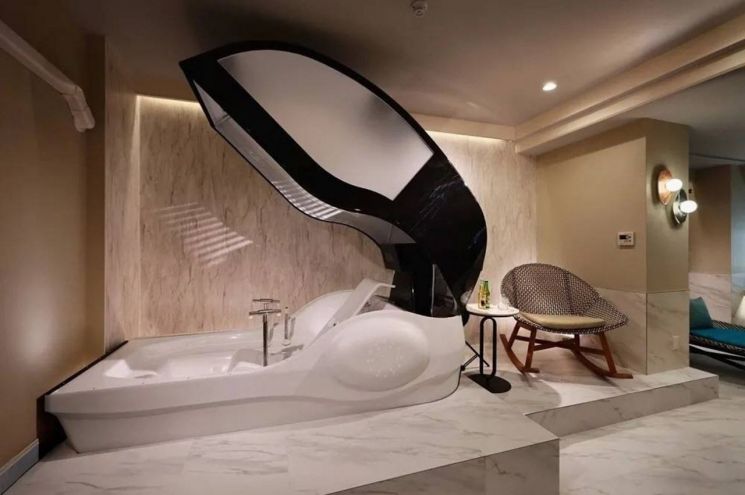 The "Future Human Washing Machine" installed at Dotonbori Crystal Hotel 3 located in Namba, Osaka, Japan. Photo by Namba Economic Newspaper
To use the product, users apply a special cleansing agent to their hair and then recline on the backrest. The screen displays the phrase "water filling," and warm water is sprayed from below the feet. In about ten seconds, 350 liters of water fills up to the chest, and the main cleansing process begins. During the cleaning phase, "microbubbles," which are fine air bubbles, are generated to remove impurities from the skin. The process works simply by sitting still and soaking in the water. Shukan Bunshun likened this to a "soaking wash."
Legacy of the 1970 Osaka Expo, Commercialized After Half a Century
The concept of the human washing machine is not new. The original idea was the "Ultrasonic Bath" unveiled at the 1970 Osaka World Expo, which also attracted significant attention at the time as a futuristic bathing device utilizing ultrasonic cleaning. In April, Science unveiled a prototype with dramatically improved performance at the Osaka-Kansai Expo, which received an explosive response and ultimately led to successful commercialization.
The core of this human washing machine lies in its artificial intelligence (AI)-based biometric data analysis. Sensors embedded in the backrest analyze the user’s electrocardiogram, stress index, and autonomic nervous system status in real time, automatically providing videos and music that help stabilize the mind and body. Additionally, the streams of water sprayed onto the neck, face, and head are adjusted in intensity by AI based on the user’s physical data to minimize discomfort. After the approximately 15-minute shower process is complete, the system drains the water and uses powerful air jets to dry the entire body, concluding the process. The reporter who experienced the machine described it as "a fully automated system that washes the entire body evenly in just 15 minutes," adding that it would be particularly useful for "those who are reluctant to bathe, the elderly, or people with limited mobility."
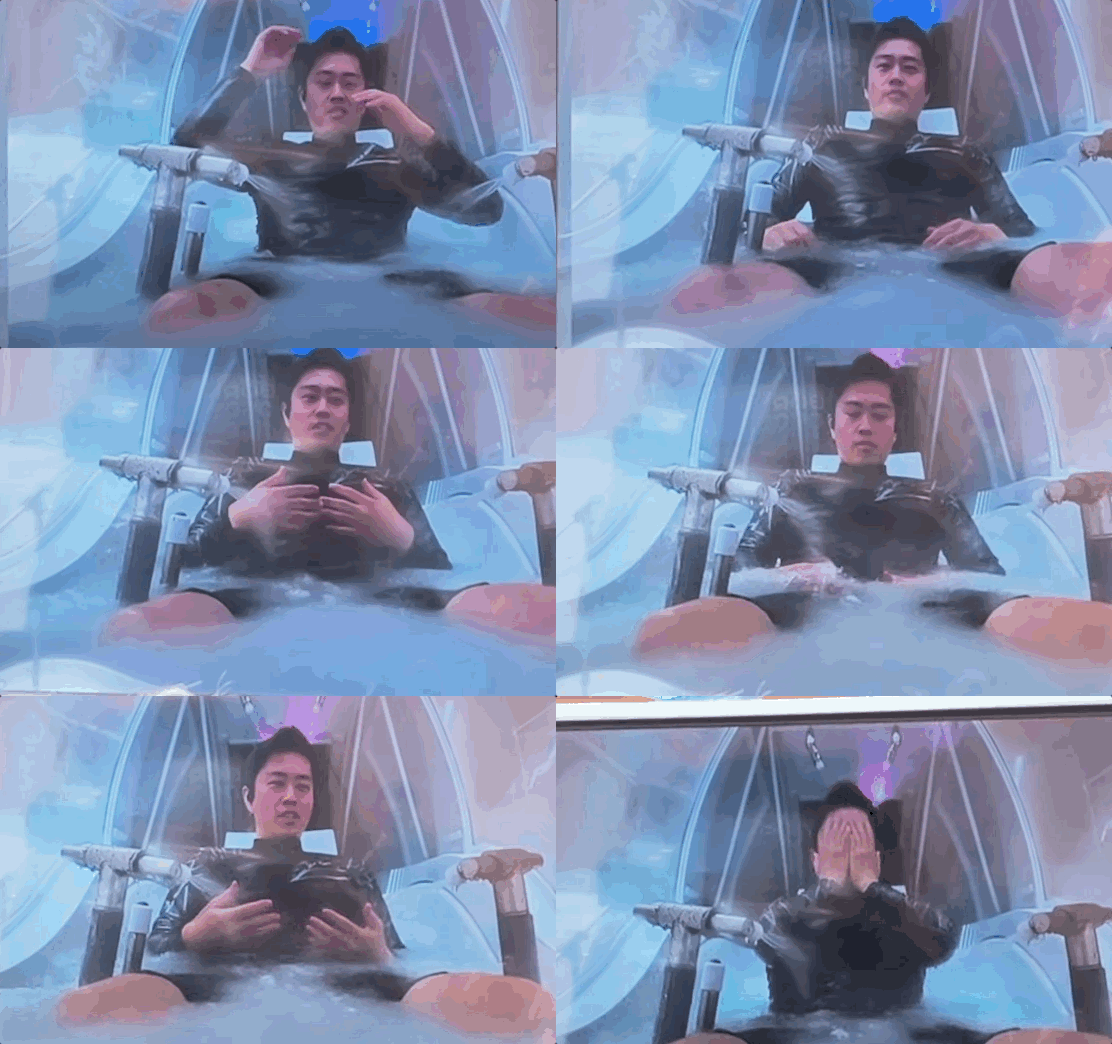 In March, Hirofumi Yoshimura, Governor of Osaka Prefecture, experienced a human washing machine at the "Osaka Expo Preview Exhibition." Photo by Kyodo News
The price of the human washing machine is approximately 6 million yen (about 564 million won). It is made to order, and production takes about three months. As a result, there have been numerous inquiries from hotels with bathing facilities interested in using it as a "guest attraction." Despite the high price, establishments such as the Crystal Hotel in Osaka's Dotonbori and luxury salons in Tokyo's Ikebukuro have decided to introduce the machine. In fact, after installing the "Future Human Washing Machine" in the spa area of the Dotonbori Crystal Hotel in Osaka's Namba district, the service is now being offered. Usage is available for groups of two or more, with a maximum reservation capacity of four people at a time. The fee is 18,000 yen (about 170,000 won) for a 90-minute session.
According to the company, as of last month, there have been about eight orders within Japan, and inquiries from both individuals and corporations overseas have also been received. Masaki Hirae, Executive Director of Science, stated, "Our sales target is around 50 units," adding, "We want to see how society accepts the technology we've developed before considering the next step." As the trends of an aging population, an increase in single-person households, and the expansion of the wellness industry continue, attention is focused on whether the human washing machine can establish itself as a new lifestyle appliance.
© The Asia Business Daily(www.asiae.co.kr). All rights reserved.
![Clutching a Stolen Dior Bag, Saying "I Hate Being Poor but Real"... The Grotesque Con of a "Human Knockoff" [Slate]](https://cwcontent.asiae.co.kr/asiaresize/183/2026021902243444107_1771435474.jpg)

















