Interview with Yoonseok Lee, Head of Water Care Advanced Research Team
Insights Drawn from Customer Usage Data Analysis
Winter Launch with Increased Ice-Making and Storage Capacity
LG Electronics is once again aiming for differentiation by launching its new ice water purifier in the winter this year. The decision to release the product in winter, rather than the usual summer launch, comes from the idea that customers should be able to use ice water purifiers year-round. For so-called “heavy users” who use ice throughout the year, the company has also increased both the ice-making capacity and ice storage volume.
According to LG Electronics on December 23, the company launched its new “PuriCare Objet Collection Ice Water Purifier” (PuriCare Ice Water Purifier) the previous day. This new model comes about a year after the company introduced its first ice water purifier with a freezing storage function last year.
Yoonseok Lee, Head of the Water Care Advanced Research Team at LG Electronics, who led the development of the new product, met with The Asia Business Daily in Jung-gu, Seoul. Lee explained, “After analyzing customer usage data, we found that people use a significant amount of ice even in winter,” and added, “We realized that the ice water purifier could become a product for all seasons.”
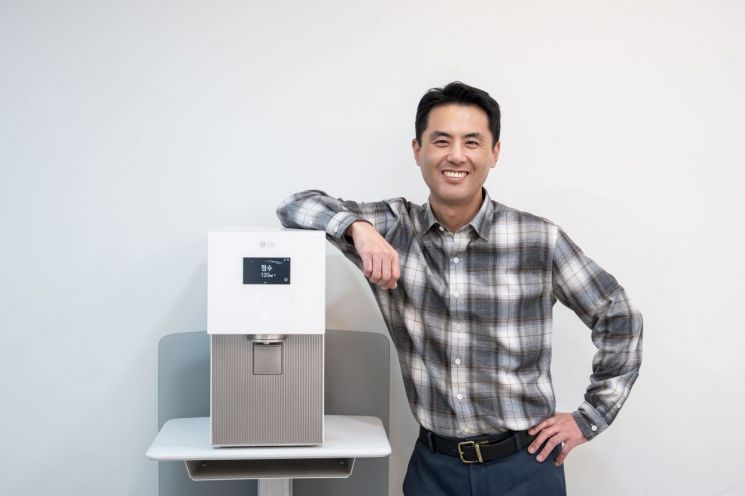 Yoon Seok Lee, Head of the Water Care Advanced Research Team at LG Electronics, is being interviewed by The Asia Business Daily in Jung-gu, Seoul. LG Electronics.
LG Electronics analyzed data from about 53,000 units registered on the LG ThinQ app as of October. The results showed that the top 1% of ice users consumed an average of 570g of ice per month even from December to February. These heavy users consumed over 800g of ice per month during the summer, indicating that the seasonal difference was not as significant as expected.
Furthermore, the maximum daily ice-making capacity has been doubled from 1.9kg (172 pieces) to 3.8kg (345 pieces). The ice storage capacity has also been expanded from 550g (about 50 pieces) to 1kg (about 91 pieces). Lee explained that, despite the increased internal capacity, the overall size and volume of the product remained unchanged from the previous model.
LG Electronics identified that ice has become an essential item for consumers. The popular phrase “Eoljuka” (a Korean term meaning ‘Iced drinks even if I freeze to death’) reflects how people have grown accustomed to cold beverages with ice. Lee commented, “As generations change, ice has come to be regarded almost as a food item,” and added, “Younger generations have incorporated ice into their daily lives.”
The previous model differentiated itself from competitors by offering a function to store ice in a frozen state. Ice water purifiers have been available in Korea since the early 2000s, with brands like Chungho Nice, Coway, and Cuckoo launching models with ice water purifier functions. Although LG Electronics entered the market later, it was the first in Korea to implement a frozen ice storage method, using proprietary technology to store ice at subzero temperatures. However, after the product launch, some customers raised concerns about insufficient ice production and lukewarm cold water temperatures. In response, the company began reviewing its technology at the end of last year.
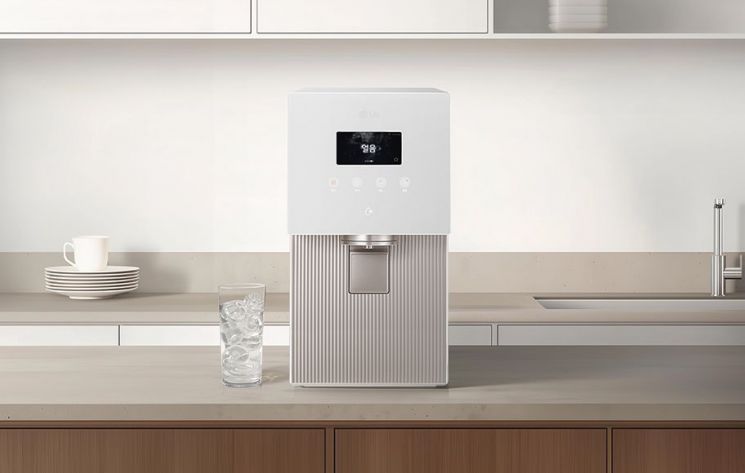
The PuriCare Ice Water Purifier’s freezing storage function also greatly enhances hygiene management. Although ice is classified as edible under the Food Sanitation Act, it is often less strictly managed than other foods, leaving a hygiene blind spot. Lee explained, “If the ice storage temperature is not below zero, repeatedly storing water at above-zero temperatures and then freezing it can cause hygiene issues. Our product stores ice at minus 7 degrees Celsius, making it much safer.” In addition, the PuriCare Ice Water Purifier automatically sterilizes and cleans its internal stainless steel water pipes once a week, and users can also select a sterilization button for the water outlet themselves.
He cited the development of the ice freezing storage technology as the most challenging aspect of the process. Lee said, “The need for both running water and ice to coexist presented conflicting requirements, and resolving this was the hardest part.” He added, “After over a year of development, we were able to achieve the right temperature and conditions so that water would not overflow even while storing ice in a frozen state.”
He concluded, “Although LG Electronics is a latecomer in the water purifier business, we are aiming for the top position,” and added, “We are also gradually expanding into overseas markets such as India and Southeast Asia.”
© The Asia Business Daily(www.asiae.co.kr). All rights reserved.