Detailed Coordination with the Fair Trade Commission on Scope of Consultations
Likely to Follow Franchise Business Act Model
"Maintaining Boundaries That Do Not Infringe on Managerial Decisions" Considered Most Probable
At a recent work report by the Ministry of SMEs and Startups, President Lee Jaemyung publicly pressed for the introduction of a consultation request right for small and medium-sized enterprise (SME) cooperatives, accelerating related legislative activities. While relevant authorities have reached a consensus on the intent and necessity of the bill, disputes are expected over the scope and content of the consultations, as there is a need to avoid conflicts with collusive acts under the Fair Trade Act.
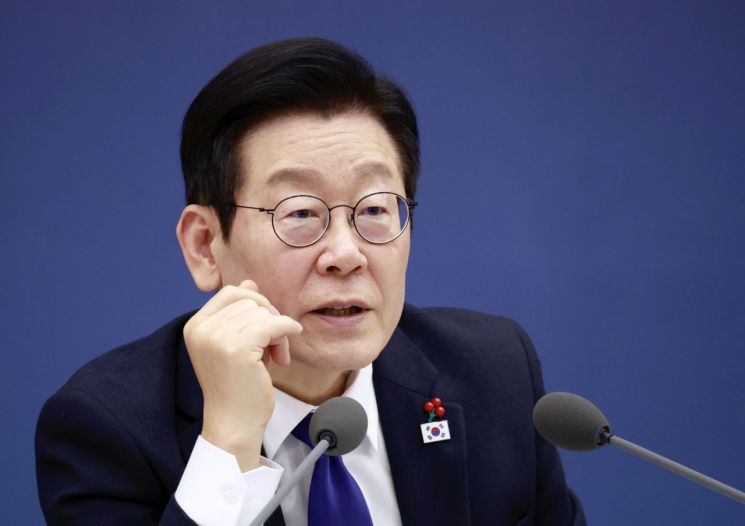 President Lee Jae-myung is speaking at the work report held at the Government Sejong Convention Center on the 17th. Photo by Yonhap News Agency
According to the government and the National Assembly on December 23, the Ministry of SMEs and Startups and the Fair Trade Commission are in the final stages of discussions regarding the amendment to the SME Cooperatives Act, which was sponsored by Assemblyman Kim Won of the Democratic Party of Korea in February this year. Since the consultation request right for SME cooperatives is included in the Lee Jaemyung administration’s national agenda, and President Lee recently instructed the ministry to prepare related response measures during the work report, both agencies appear to be expediting the process with the goal of passing the bill as soon as possible.
However, there are reported differences of opinion regarding the scope and content of the consultation request right. The amendment proposes a new clause stating, “The provisions of Article 40(1) and Article 51(1)1 of the Fair Trade Act shall not apply to consultations requested by cooperatives,” essentially excluding such consultations from being considered collusive acts as defined by the Fair Trade Act.
The Fair Trade Act prohibits collusive acts that unfairly restrict competition, but it also stipulates that “acts expressly deemed legitimate by other laws shall not be punished as collusion.” The intention is to recognize the consultation request right of SME cooperatives as legitimate collective action, while also defining the specific scope of consultations to the minimum necessary to avoid disrupting market order.
An official from the Ministry of SMEs and Startups stated, “Although the purpose of the bill is to create exceptions to collusive acts as specified by the Fair Trade Act, the fundamental principle is to establish a minimum standard so as not to disrupt market order through unfair competition restrictions,” adding, “We are continuing discussions with the Fair Trade Commission regarding the extent to which the consultation request right for cooperatives should be recognized.”

It is highly likely that the specific details will be designed similarly to the recently passed amendment to the Franchise Business Act. The amendment to the Franchise Business Act stipulates that franchisee organizations may negotiate with headquarters over matters such as changes to franchise agreements and transaction terms, but draws clear boundaries by prohibiting acts such as “demanding transaction terms that go against the unity or essential matters of the business” and “unjust interference in the management of the headquarters.”
For SME cooperatives, it is also being strongly considered that the scope of consultations will be limited to matters that do not involve demanding specific prices or price increases, or unjust interference in management decisions or business operations, such as changing suppliers.
Lee Jinwook, an attorney at Palma Law Office, who primarily handles unfair trade cases in the franchise sector, said, “It is possible to clearly specify transaction terms, such as price determination structures rather than specific prices or rates of increase, as the subject of consultation, or to narrow the scope to issues likely to be judged as unfair practices by large companies, such as unilateral price cuts,” adding, “It is also worth noting that SMEs not included in cooperatives may be excluded from having a voice.”
Hwang Taehee, a professor at Sungshin Women’s University School of Law, emphasized, “If SME cooperatives are granted the right to request consultations on all matters related to SMEs, there is a significant risk of severely infringing on corporate autonomy,” and added, “The key is to set the scope restrictively so as not to undermine the spirit of the Fair Trade Act.”
© The Asia Business Daily(www.asiae.co.kr). All rights reserved.
![Clutching a Stolen Dior Bag, Saying "I Hate Being Poor but Real"... The Grotesque Con of a "Human Knockoff" [Slate]](https://cwcontent.asiae.co.kr/asiaresize/183/2026021902243444107_1771435474.jpg)

















